
Table of contents
Open Table of contents
The Mountain’s Significance
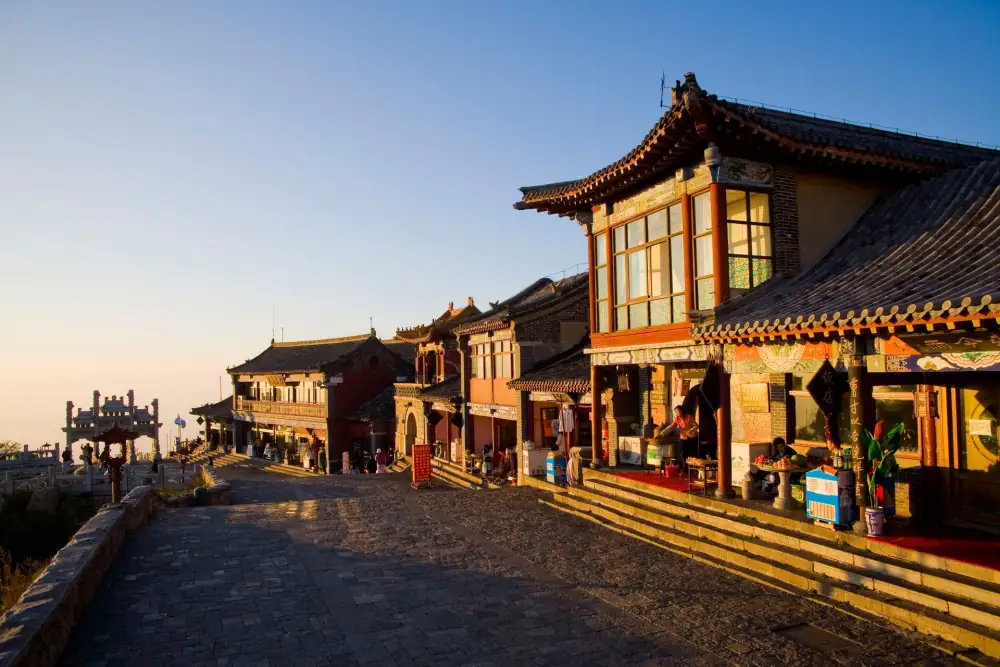
Mount Tai was the focus of imperial religious activity for reasons rooted in cosmology: it was the easternmost of the Five Sacred Mountains (五岳, Wǔ Yuè) and east was the direction of sunrise, of spring, of life beginning. To perform the feng shan ceremony here was to align the Emperor’s rule with cosmic order.
More than 72 emperors made the ritual pilgrimage to Mount Tai. The mountain is covered in inscriptions — carved into rocks by emperors, calligraphers, and ordinary pilgrims over millennia. The best-known is the “Diamond Sutra Cliff” (金刚经摩崖石刻), a 7th century complete Buddhist sutra carved on a massive cliff face. Over 22,000 inscriptions have been documented on the mountain.
UNESCO listed Mount Tai as a World Heritage Site in 1987, one of the first Chinese sites to receive the designation.
The Climbing Routes
The Central Route (中线) — The Main Pilgrimage Path
This is the classic route — and the most historically significant, as this is the path emperors took. The route begins at the Dai Temple (岱庙) at the foot of the mountain in Tai’an City, ascends through Tianmen Mountain Gate (天门), past Midway Gate to Heaven (中天门), and continues up thousands of stone steps to the South Heaven Gate (南天门) near the summit.
Key stats:
- Total steps: Over 7,000
- Altitude gain: From 150m (Tai’an City) to 1,545m (summit) — approximately 1,400m gain
- Distance: About 8km one way
- Time: 3.5–5 hours ascending (most people), 2.5–3.5 hours descending
- Difficulty: Strenuous due to sheer number of steps, but no technical climbing required
Gate tickets: ¥115 adult entrance to the scenic area (includes access to both routes and cable car zones).
Partial Route from Midway Gate (中天门)
If you drive or take a shuttle bus from Tai’an to Midway Gate (middle of the mountain), you cut off the lower section and start with about 4km/3,500 steps to the summit.
Bus from Tai’an to Midway Gate: ¥30 each way; runs from early morning
This partial route is the most popular for the sunrise hike — many people drive up in the evening, start from Midway Gate around midnight, and arrive at the summit around 3–4am for a pre-dawn wait.
The Back Mountain Route (后坡, Tianzhufeng Area)
A quieter, steeper, and less commercially developed alternative route ascending from the rear of the mountain. Much less crowded than the central route. Not suitable for darkness/sunrise hiking as signage is poor.
Cable Car
Two cable car options avoid most of the stairs:
- Midway Gate → Cloud Step Bridge (桃花峪索道): Runs from Midway Gate to the upper section. ¥100 up, ¥100 down.
- Cable car from the back route area: Serves the back approach.
Using the cable car up and hiking down (or vice versa) is a reasonable combination for less active travelers. Note: The cable car does not go all the way to the summit — there are still 800+ steps from the cable car terminus to the top.
The Sunrise Hike: How to Do It
This is the quintessential Mount Tai experience. Here’s the practical protocol:
Timing
The sunrise time varies by season:
- Spring/Autumn: 5:30–6:30am
- Summer: 5:00–5:30am
- Winter: 6:30–7:30am
Plan to be at the summit 45 minutes before sunrise. With the ascent taking 4–5 hours from Tai’an or 2.5–3.5 hours from Midway Gate (night hiking is slower), work backwards:
From Midway Gate for a 5:30am sunrise: Leave Midway Gate by 1:30–2:00am From Tai’an base for a 5:30am sunrise: Leave by 11pm–midnight
What to Bring
- Headlamp/torch: Essential. Bring spare batteries.
- Warm layers: The summit temperature can be 10°C lower than the base, and wind at the top can make it feel much colder. Even in August, a fleece is recommended. In spring/autumn, a down jacket is needed.
- Water: 2+ liters. Water is sold at stops along the route but at tourist prices (¥5–10/bottle).
- Snacks: The climb is calorie-intensive.
- Rain layer: Weather on the summit can change rapidly.
Summit Accommodation
Staying at the summit (the only way to be at the top for both sunset AND sunrise without doing two consecutive nighttime climbs) requires booking accommodation:
- Shenqi Hotel (神憩宾馆): The main accommodation at the summit area. Double rooms from ¥350–600/night (significantly more than valley options). The rooms are basic but functional. Book well in advance for weekends and national holidays.
- Basic guesthouses (客栈) near South Heaven Gate: Dormitory beds from ¥100–150/person in season.
The Summit Experience
The summit plateau (玉皇顶, Jade Emperor Peak at 1,545m) has several temple buildings including the Jade Emperor Temple (玉皇庙), where a stone tablet marks the highest point. On clear mornings, the plains of Shandong stretch in every direction below, and occasionally you can see the Yellow Sea in the distance (on exceptionally clear autumn days).
The morning light at sunrise on the summit is extraordinary — particularly in autumn when mist fills the valleys below and only the mountain tops are visible. This “sea of clouds” effect with golden sunlight hitting temple rooftops is the image that has drawn Chinese pilgrims here for millennia.
Historical and Cultural Sites
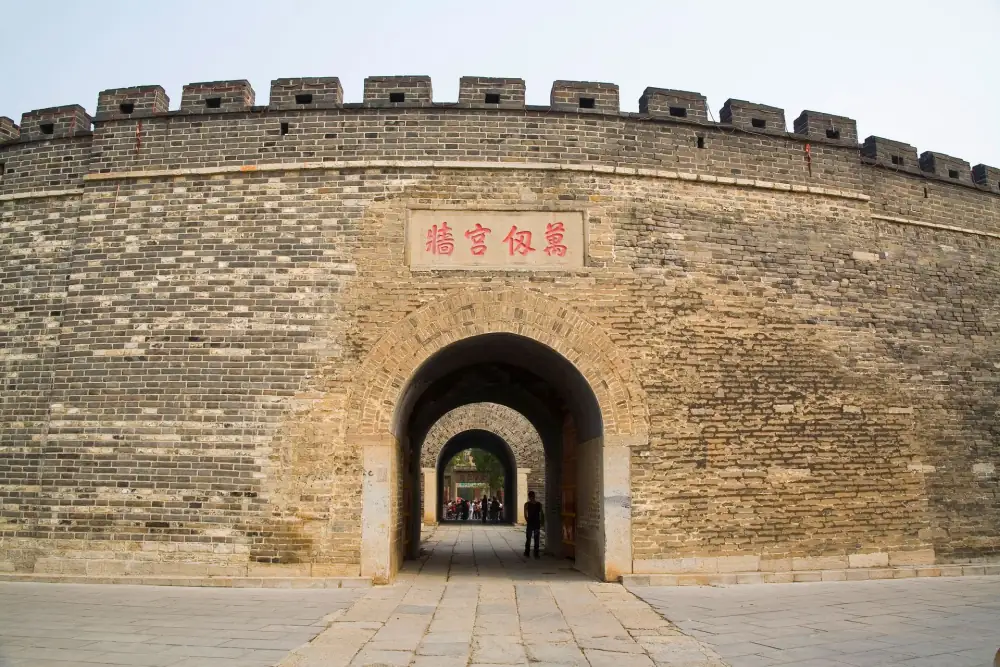
Dai Temple (岱庙)
The imperial temple complex at the base of the mountain, built and rebuilt over 2,000 years. The main hall (Tiankuang Hall, 天贶殿) is one of the three great palace halls of ancient China alongside the Forbidden City and Confucius Temple in Qufu. Dimensions nearly match the Forbidden City’s Hall of Supreme Harmony. Entry: ¥30.
The Yansou Cypress in the temple courtyard is over 2,000 years old. Several Han Dynasty stone tablets are preserved here.
Hongmen Palace (红门宫)
The first major temple on the climbing route, dedicated to the Goddess of the Azure Cloud (碧霞元君) who is the patron deity of Mount Tai. Pilgrims burn incense and leave offerings here at the start of the climb.
Stone Inscriptions Everywhere
One of the most distinctive features of Mount Tai is the density of inscriptions. Almost every large flat rock surface has been carved — imperial edicts, poetry, Buddhist texts, personal vows. The most significant cluster is the Jingshi Valley (经石峪) off the main route, where the Diamond Sutra inscription covers a 66-square-meter rock face in 6th century calligraphy.
Getting to Tai’an
By train:
- From Beijing South: 1.5 hours by high-speed train, ¥130–200. Very frequent service.
- From Shanghai Hongqiao: About 2 hours, ¥180–250.
- From Jinan (Shandong capital): 30 minutes, ¥30–50.
- From Qufu (Confucius Temple): 20 minutes, ¥25–35.
By bus: From most Shandong cities. Bus from Jinan: 1.5 hours, ¥40.
Combination: Mount Tai + Qufu (Confucius hometown, 75km away) + Shandong coast makes an excellent 4–5 day Shandong itinerary.
Where to Stay in Tai’an
Before the climb:
- The best base is in Tai’an City, within walking distance of the Dai Temple and mountain entrance
- Budget: Numerous guesthouses near the mountain entrance, from ¥80–150/night
- Mid-range: Tai’an International Hotel (泰安国际酒店) and similar, from ¥200–350/night
At the summit: As noted above, book in advance. The experience of staying at the summit is unique even if the comfort level isn’t.
Practical Tips
Tickets: Book online through the Mount Tai Scenic Area official WeChat mini-program or Ctrip. During holidays, online booking is mandatory.
Crowds: National Day week (Oct 1–7) and Spring Festival are absolute maximum. For the sunrise hike specifically, the first Saturday of Golden Week can have 30,000+ people on the mountain. Mid-week visits are dramatically better.
Physical preparation: The 7,000-step hike is genuinely demanding. If you’re not a regular hiker, build some walking stamina in the weeks before. Your knees will thank you on the descent.
Porter service: Older Chinese pilgrims sometimes hire porters (挑夫) to carry their bags up. This is a traditional service that still operates. Cost: ¥2–3/kg.
Weather: Check the summit forecast, not Tai’an city forecast. The mountain creates its own weather.
Mount Tai is one of those places that transcends tourism. Walking the same stone steps that emperors, philosophers, pilgrims, and billions of ordinary Chinese people have walked over thousands of years gives the experience a weight and continuity that’s impossible to manufacture. The physical effort is real; the reward — that moment when the sun clears the horizon and light floods the summit — is genuinely beyond description.