
Water is the reason people come to Libo. It arrives as a sheet of green-blue in the pools below Wolong, as a staircase of white noise in a gorge you walk beside for well over an hour, and as a shallow river running over bare limestone with trees growing out of it. Around all that sits cone karst — thousands of forested humps packed shoulder to shoulder, in one of the wettest corners of the country’s limestone belt.
Table of contents
Open Table of contents
What Libo actually is
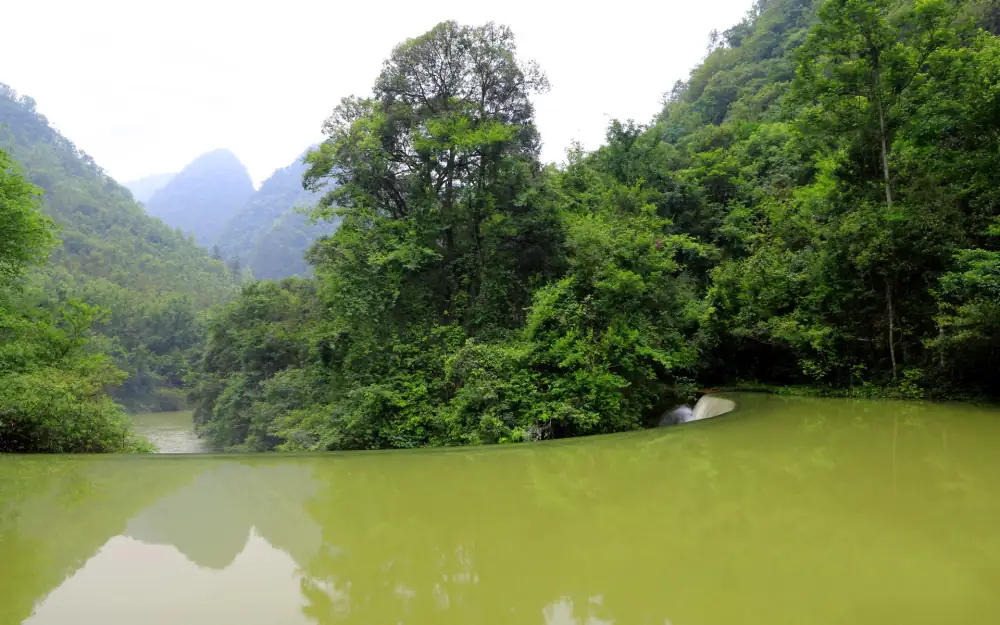
Libo (荔波) sits in the south of Guizhou province, pressed against the Guangxi border, and its landscape is the product of very old limestone plus a great deal of rain. Cone karst dominates: sharp forested peaks in dense clusters, drained by rivers that vanish into caves and reappear a valley later. Because the rock is soluble, the water carries dissolved calcium, and where it spills over ledges it lays down travertine. Hence pools that look tinted rather than merely clear.
Three areas do the work. Small Seven Arches (小七孔, Xiaoqikong) is the headline: a long, narrow gorge on the Xiangshui river holding a chain of cascades, a wadeable water forest, a mirror-flat travertine pool and a string of linked karst lakes. Large Seven Arches (大七孔, Daqikong) lies downstream and trades quantity of waterfalls for scale of rock — a gloomy walled gorge and a natural limestone arch over the river. Behind both spreads the Maolan (茂兰) karst forest reserve, subtropical primary forest growing directly on stone, with Buyi (布依) and Yao (瑶) villages, old arched bridges and farmland folded between the peaks.
The whole south Guizhou karst is recognised internationally for its natural value, and deservedly: this is not a single set-piece view but an intact wet-karst system, forest and river and rock still working on each other. You feel it most in Maolan, where nobody has built a platform to tell you where to look. The name itself comes from a seven-arched stone bridge over the Xiangshui river, built in the Qing dynasty as part of the trade road into northern Guangxi. It still stands, small and moss-furred, where the gorge walk begins.
Walking Small Seven Arches
The gorge is long and linear, with a road running its length and shuttle buses making the connections. Nobody walks it end to end; the skill is choosing which sections to walk and which to ride. Shuttles run continuously through the day in season, so being selective carries no penalty.
Which gate, and why it matters
There are two entrances, and your direction changes the day completely.
East gate, near the bronze-drum bridge, puts you at the bottom of the gorge. You start at the old seven-arched bridge, then climb very gradually beside the Sixty-Eight Cascades (六十八级瀑布) — a mile or so of river dropping over ledge after ledge, the path threaded along the bank at water level. Walking upstream, every cascade arrives face-on and gets larger. Laya Waterfall (拉雅瀑布) throws spray across the path above the bridge. You finish at the calm water: Wolong Pool (卧龙潭), then the Wild Duck Pond (鸳鸯湖) lakes. The gradient is gentle enough that most people never notice they have been climbing.
West gate reverses this. You begin at the lakes and the blue pool, then walk down through the cascades, meeting each from behind. The descent is easier on the legs and the west gate is quieter, but the day peaks in its first hour.
| East gate first | West gate first | |
|---|---|---|
| Gradient | Gentle, sustained rise | Downhill |
| Cascades | Head-on, building | From above, diminishing |
| Best light | Cascades in morning | Pools in morning |
| Crowds | Heavier | Usually thinner |
Our preference is east to west for a first visit, and west to east if you have tired knees or a late start. Either way, the earliest entry of the day is by a wide margin the quietest — arriving at opening rather than mid-morning is the difference between hearing the river and hearing coach parties.
The four things worth your time
- The Sixty-Eight Cascades. Not one waterfall but a dense sequence over a short stretch of riverbed, each step different in shape and sound. Where the water is low, side paths drop to the rock. The best walking in Libo.
- Water Forest (水上森林). A few hundred metres of shallow river over scoured limestone with mature trees rooted into the bed — no silt, no gravel, boulders rubbed smooth. In low water you pick along stepping stones; when the river is up, the proper way to do it is in sandals, in the water, which is the most fun anyone has in this park. It is also where people fall over.
- Wolong Pool. A weir holds the water into a flat sheet that shifts from pale to deep blue with light and season, drowned logs at angles beneath the surface. Overcast days beat bright ones.
- Wild Duck Pond. Two large lakes and several small ones linked into a water maze, fringed with limestone teeth and closed over by trees. Rowing boats can be hired, and unlike most park boating this one earns the time.
Allow the best part of a day inside the gorge if you want to walk rather than shuffle between shuttle stops. Food near the main stops is functional rather than good.
Large Seven Arches and the river
Large Seven Arches is a shorter, sterner outing — half a day is ample, and its own larger stone bridge gives it its name. From the entrance you follow a gorge named for its atmosphere: still water over tumbled rock, cliffs closing overhead, three dark cave mouths high in the wall. The walls throw sound back in a way that makes people lower their voices.
The gorge delivers you to the natural bridge, a karst arch carved through a limestone ridge, high and thick enough that trees grow on top of it. Standing underneath and looking up along the curve is the point of the visit: the stalactites all lean the same way, like a class following one instruction. Below, the river drops into a short waterfall. Boats operate inside, but the walk is better — skip it. Walkways deeper into the forest beyond the arch were damaged by past floods and closed, so treat the arch as the end.
Upstream of Libo town, the Zhangjiang (樟江) river narrows into the Shuichun gorge, where rubber rafts run shallow rapids between limestone walls. It is a wet, cheerful ride rather than serious whitewater — good with older children, and a sensible way to fill a hot afternoon once you have walked both gorges.
Maolan and the villages
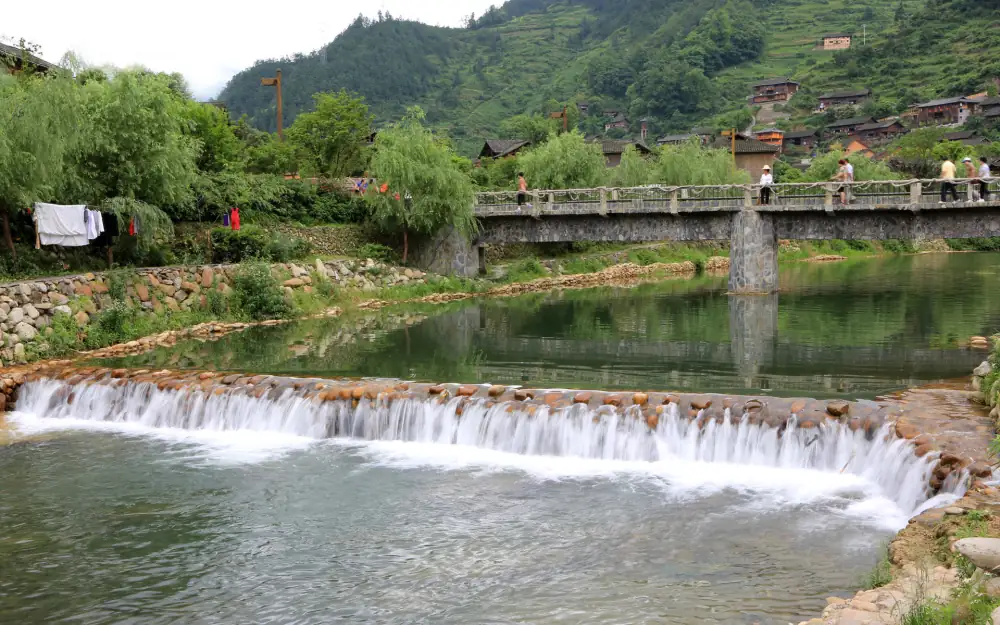
Maolan is the part most visitors miss, and the part we would defend hardest. Roads thread between peaks past rice terraces, maize and rape fields, and the forest grows out of rock in ways worth stopping for: roots splitting boulders, trunks swallowing stone, whole hillsides standing on limestone with no soil in sight. Water threads through it — the reserve’s largest waterfall drops in tiers down a green cliff, a boxwood ravine floods to treetop height in the wet season, and a spring-fed pool stays cold and glass-clear year round.
Yaogu (尧古) is the easiest village to visit: Buyi timber houses, ageing spinning and distilling gear still in use, and a papermaking workshop turning mountain bamboo into sheets by hand. Nearby, Shuiyao (水尧) is Shui country, and the Yao settlements in the hills keep distinct dress and rituals. Libo is overwhelmingly minority in population — Buyi, Shui, Yao and Miao are the four main groups — and the village texture justifies a third day. If craft and ritual interest you, the culture and nature tags here set context.
A driver hired for the day is close to essential here; public transport into the reserve is thin. Fill the tank first.
Getting there and getting around
Libo used to be genuinely awkward to reach, which is part of why it stayed quiet. That has changed.
- By air. A small airport sits close to Libo town, with a thin schedule of flights from Guiyang (贵阳), Chongqing and a few other cities. Routes come and go seasonally, but when one fits it removes half a day of ground travel.
- By rail. High-speed lines cross southern Guizhou to the north, so the usual pattern is a fast train to a railhead such as Duyun (都匀) or Dushan (独山), then a connecting coach or taxi.
- By coach. Long-distance buses reach Libo town through the day from Guiyang and from towns along the Guangxi border. Departures thin out in the afternoon, so travel in the morning.
- By road from Guangxi. Arriving from Guilin or Hechi by car is straightforward, which makes Libo a hinge between a Guangxi trip and a Guizhou one.
Locally, taxis and minibuses shuttle between town and the two park gates, and inside Small Seven Arches the park’s own buses do the linking. Roads are steep, wet and prone to landslip after heavy rain, so build slack into a tight plan.
Seasons and water volume
- Spring. Rape flowers across the Maolan farmland, plum blossom in the wild groves, moderate water, comfortable walking temperatures.
- Summer. Maximum water. The cascades roar, spray cools the paths, and the Water Forest becomes a wade rather than a hop. The trade-off is turbidity — heavy rain clouds the pools and dulls their colour — plus humidity, crowds and peak room demand.
- Autumn. The sweet spot for colour. Flow drops, sediment settles, and Wolong Pool and the lakes deepen to blue-green.
- Winter. No hard frost at this latitude, water low and very clear, paths almost empty, wild plum blossom in the Maolan groves. Some cascades thin to trickles.
Where to base yourself
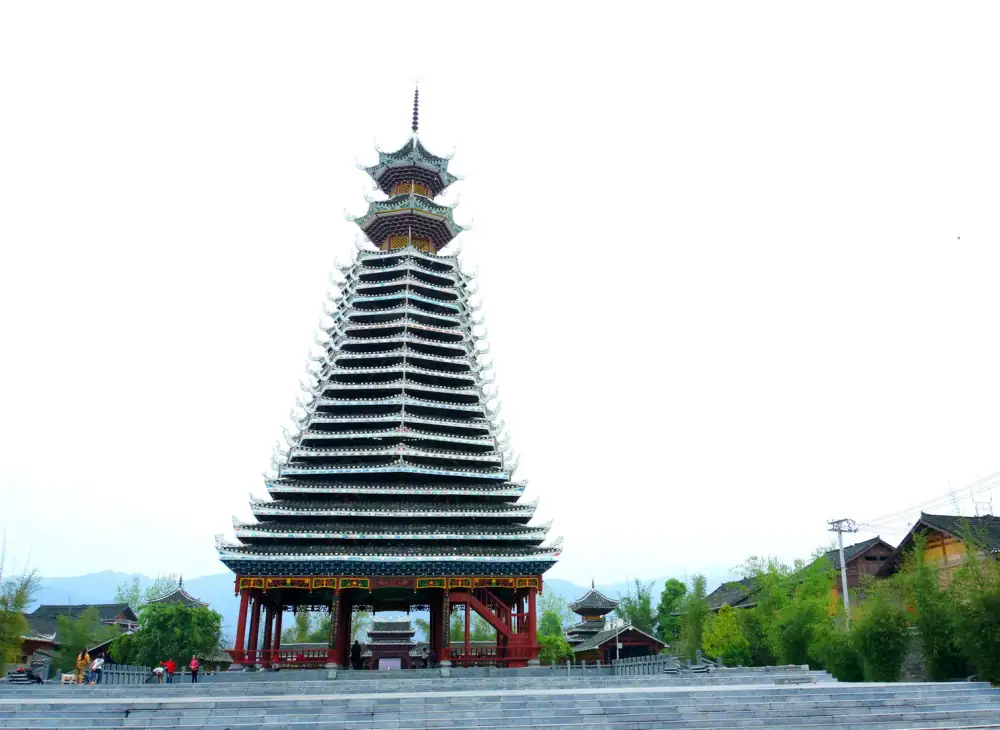
Libo town is the practical choice: the widest range of rooms, the night food street, the coach station and easy taxis, twenty-odd minutes from the park gates.
Staying immediately outside the east or west gate means small family-run guesthouses — simple, friendly, unbeatable if you intend to be at the gate at opening. Deep inside Maolan, farmstay rooms in stilted timber houses are the only option and are basic in the ways you would expect; the compensation is forest outside the door and better home cooking than any hotel restaurant. Book ahead in summer.
What to eat
Guizhou food is sour and fragrant-hot rather than numbing, and Libo has its own repertoire. Grilled Zhangjiang river fish is the local signature — charred, heavily spiced, finished with toasted soybeans that distinguish it from the Chongqing version. Smaller river fish come deep-fried whole from street stalls.
Beyond that: siwawa, thin rice pancakes rolled around shredded vegetables and doused in sour-chilli liquor; the notorious chou suan, a pungent fermented sour dish that smells alarming and eats brilliantly; pickled sour meat, crisp-skinned and sharp; water fern shoots, tender the whole length rather than just the tip; Shui-style carp stuffed with chives and steamed until the bones go soft; and iced bayberry juice in hot weather. Green plum wine from Maolan’s wild groves is the souvenir worth carrying. More on regional cooking under food.
Practical advice
Footwear. This is the thing people get wrong. Limestone under running water is slick, and travertine is slicker. Bring grippy walking shoes for the gorge paths, plus sandals or old trainers you are happy to soak for the Water Forest. Flip-flops are a bad idea on wet rock.
Rain gear. It rains here, often and hard. A light waterproof jacket beats an umbrella on narrow wet paths where you need both hands. Cascade spray will reach you even on a dry day, so bag anything electronic.
What to skip. The boat inside Large Seven Arches; the evening staged song-and-dance spectacular, unless that is your thing; the roadside lavender field near the west gate, which photographs better than it visits; and the revolutionary-history memorials in Maolan, meaningful locally but thin for foreign visitors. If time is short, cut Large Seven Arches first.
Crowds and timing. Go early, always. Summer weekends and national holidays fill the gorge until the boardwalk moves at a shuffle. If your dates are fixed to a holiday, walk the first hour after opening and take the middle of the day off.
Photography. The water reflects hard, and a polarising filter is the difference between white glare and visible blue depth. Overcast light suits the pools.
Water and shade. Trailside supplies thin out once you are walking, and humidity does more damage than temperature. Carry water. For more on structuring a Guizhou trip, see itinerary.