
Somewhere past Karamay the road runs dead straight for so long that the wind turbines on the horizon seem to stand still. Then the Altai foothills rise, the gravel gives way to birch, and within a day you are standing above a lake the colour of a bruised sapphire with snow peaks stacked behind it. Northern Xinjiang is the part of China that feels closest to Central Asia and furthest from anywhere, and the drive is the trip.
Table of contents
Open Table of contents
What northern Xinjiang is, and why the loop rewards the effort
Xinjiang splits neatly in two along the Tianshan range. South of the mountains lies desert, oasis towns and Uyghur market culture. North of them — Beijiang, the northern half — is mountain, forest, lake and grassland, closer in feel to Kazakhstan or southern Siberia than to anything in eastern China. Larch and Siberian spruce climb the slopes of the Altai. Kazakh herders move their flocks up and down the valleys with the seasons. Tuvan villages of squared timber sit in clearings where breakfast smoke hangs in the cold air until mid-morning.
The appeal is not one headline sight. It is the accumulation: a turquoise alpine lake, a river valley of white birch, a grassland so wide that yurts read as scattered grains of rice, a beach of banded red and ochre rock above a river flowing north to the Arctic. Add a food culture built on lamb, wheat and dairy. For anyone drawn to nature over monuments, this is arguably the most rewarding long trip in the country.
The distance reality
Get this straight before you plan anything else. Xinjiang is enormous, and the loop stitches together corners of it that sit hundreds of kilometres apart. Urumqi to Burqin, the gateway town for Kanas, is a full day behind the wheel with only fuel and lunch stops. Kanas across to Sayram Lake is another long day, sometimes broken with a night in an industrial town that exists in your itinerary purely as a bed. Days beginning at seven and ending after dark are normal, and two or three of your days will be almost entirely transit. Any itinerary promising Kanas, the Ili valley and Turpan in a week is selling you a coach seat, not a holiday. Build in slack: weather closes passes and roadworks appear without warning.
Choosing your route
There are really two sensible shapes for this trip.
The full loop, twelve to fourteen days
North from Urumqi (乌鲁木齐) to Burqin (布尔津), up into the Kanas (喀纳斯) scenic area and Hemu (禾木), back down and west across the Junggar basin to Sayram Lake (赛里木湖), down through the Guozigou valley into Yining (伊宁) and the Ili grasslands, east along the Tianshan to Nalati (那拉提) and Bayanbulak (巴音布鲁克), then back to Urumqi. It works because it never doubles back on itself. You get the Altai and the Tianshan, forest and grassland, Tuvan and Kazakh villages.
The northern half only, seven to eight days
Urumqi, Burqin, Kanas, Hemu, Baihaba, and home — with an internal flight on one leg to buy back a driving day. This is the right choice for the autumn colour window, when the north is at its best and the grasslands have already gone brown, and the better call with children or anyone who wilts on long drives.
| Full loop | Northern half | |
|---|---|---|
| Days needed | 12-14 | 7-8 |
| Long transit days | 3-4 | 1-2 |
| Best season | June to early October | late September to mid-October |
| Landscape range | Altai forest, high lake, grassland, gorge | Altai forest, lake, taiga village |
The stops, one by one
Urumqi
Your arrival and departure point, and a city more interesting than its reputation. The regional museum earns a couple of hours for its desert-preserved mummies, some thousands of years old, whose faces and woven clothing survive in unsettling detail. Otherwise spend an evening in the bazaar quarter among dried fruit stalls, hat sellers and carpet shops, and eat well. One day at the start, half a day at the end.
Burqin and Wucaitan
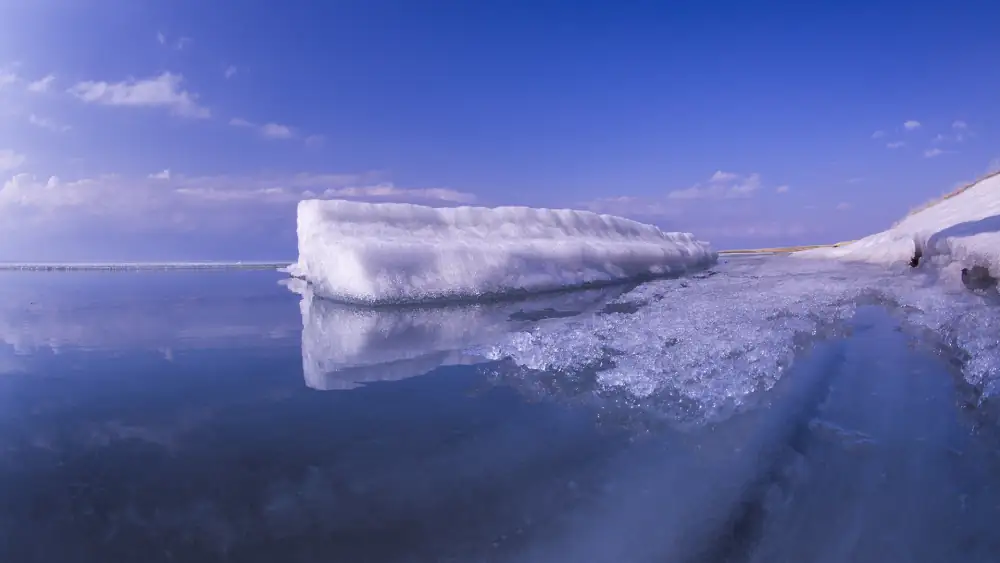
Burqin sits on the Irtysh, the one river in China that drains north towards the Arctic Ocean, and it is the natural overnight before the mountains. Just outside town, Wucaitan (五彩滩) — the colourful beach — is a low ridge of eroded rock striped in rust, cream and ochre on one bank, with green riverside woodland facing it across the water. Come at sunset, when the light does most of the work. Burqin’s night market is the other reason to stop: grilled river fish, cold malt drink poured foaming into plastic cups, skewers turning over charcoal.
Kanas
Kanas means beautiful mysterious lake in Mongolian, and the name earns itself. A long finger of water lies in a forested trough below the Altai watershed, shifting through the day from milky jade to deep blue as the light and the glacial silt change. A shuttle runs up the valley from the entrance, stopping at a sequence of river bends — each with its own legend, each photographed from a wooden platform. Sleeping Dragon Bay, Moon Bay, Fairy Bay. A short climb to the pavilion above the lake gives you the whole valley in one frame, and the walk up beats the queue for the shuttle that also goes there. Give Kanas a full day minimum, two if you want to walk. The lake has a resident monster story that herders have told for generations and nobody has ever settled.
Hemu
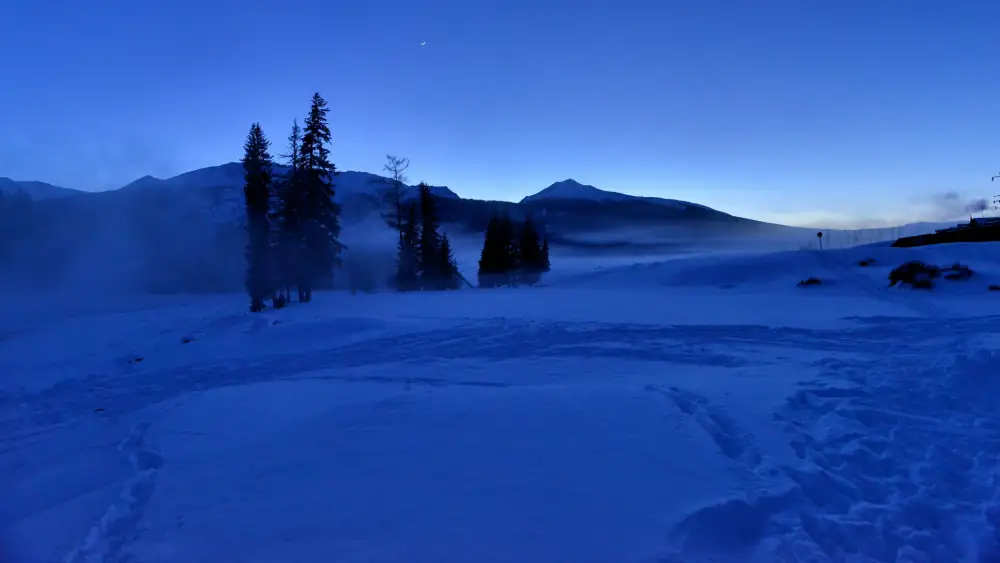
If one place justifies the whole journey, it is Hemu. A Tuvan village of timber cabins in a bend of the Hemu river, backed by birch woods and grazing horses, with the peaks of the border country beyond. Early morning is the event: mist pools in the valley, woodsmoke rises straight up, and the light hits the gold birch on the far slope while the village is still in shadow. Walk up to the ridge viewpoint for it — a steady twenty to thirty minutes on a stepped path, worth the cold start.
Stay a night. Hemu as a day trip is a bus ride to a viewpoint; Hemu overnight is horses being led past your window at dawn.
Baihaba
The other Tuvan village, smaller and quieter, right up against the Kazakhstan frontier. Baihaba needs a border-area permit arranged locally, which your driver or guesthouse will organise, and that small barrier keeps the crowds thinner.
Sayram Lake
Long, oval and set high on a plateau ringed by snow, Sayram is the most straightforwardly beautiful water on the loop and asks nothing of you but time to drive part of its shore. Alpine flowers cover the slopes in early summer. The road down through the Guozigou gorge — long viaducts curling between forested walls — is one of the best stretches of driving in China.
Yining and the Ili valley
Ili is the green, well-watered heart of Xinjiang: three sides mountain, one side open to the west, so rain and snow arrive where the rest of the region gets none. In June and July the lavender fields near Yining turn purple in blocks. Yining itself has a walkable old quarter, blue-painted courtyard doorways, and the best eating on the western half of the trip. Sunset at the Ili river bridge is a local ritual.
Nalati and Bayanbulak
Nalati is high summer pasture — river channels braided across a flat valley floor, forest on the shoulders, snow peaks to the south, felt tents pitched wherever the grazing is good. Ride a horse if you can; the scale only registers once you are out in it. Further east and higher, Bayanbulak is wetland rather than pasture: the Kaidu river loops back on itself in extravagant meanders, best seen from the platform at sunset, and swans breed here in summer.
Tianchi and Turpan
Tianchi (天池), the alpine lake below Bogda peak, makes an easy day out of Urumqi if you have a spare one — pretty, popular, heavily developed. Turpan (吐鲁番) is a different proposition: a searing desert basin below sea level, grape trellises, ruined Silk Road cities and ancient irrigation tunnels. It belongs with the Silk Road south rather than this loop, and adding it in high summer swaps mountain air for furnace heat.
Getting there and getting around
Fly into Urumqi. It is the regional hub with connections from every major Chinese city, and where any sensible loop starts and ends. Internal flights link Urumqi with the Kanas area and with Yining, and using one to skip a transit day transforms a tight itinerary — schedules are seasonal and thin, so treat them as a planning tool rather than a certainty.
On the ground, hiring a car with a driver is the standard way to do this. A driver who works the region knows which mountain roads are open, where to stop for lunch that is not terrible, and how the checkpoint routine works. Self-drive is legal and increasingly common if you hold a licence valid in China, and the highways are good — but mountain sections vary, fuel stops thin out, and rental logistics across such distances take planning. Long-distance buses connect the main towns and suit the frugal and patient, though they take days from you and cut you off from everything between the towns, which is half the point. For pacing across other Chinese regions, our itinerary collection is a useful comparison.
The seasons
Autumn, late September to mid-October
The prize. Birch and larch turn gold and copper around Kanas and Hemu, the air is glass-clear, and the morning light is extraordinary. The window is short — two to three weeks, shifting yearly with the first frosts — and everyone who cares about photography knows it. Book far ahead, and bring proper cold-weather layers: mornings in the Kanas valley are close to freezing even under blue sky.
Summer, June to August
Wildflowers on the grasslands, lavender in Ili, swans at Bayanbulak, and long days that let you drive further. Peak domestic holiday season, so popular viewpoints get busy and village beds tighten in August. Warm to hot on the plains, cool in the mountains.
Winter and shoulder
Deep winter shuts several high roads and effectively closes the northern scenic areas, though snow-village tourism at Hemu has grown. May and early June are quiet, green and unpredictable, with snow still on the passes. Late October empties out fast as the colour drops.
Where to stay
- Urumqi and Yining — proper city hotels, and the place to enjoy a real shower and a lift.
- Burqin — small hotels and family guesthouses, some run by families of Russian descent, comfortable and unpretentious.
- Hemu and Baihaba — timber guesthouses in the villages themselves. Simple rooms, basic bathrooms, thick quilts, hosts who cook. This is where you want to be, not in the resort hotels near the scenic-area gate.
- Inside the Kanas area — limited beds in high demand, and the reason autumn bookings need making early.
- Grasslands — yurt stays at Nalati and around Sayram are widely offered. A felt tent, a stove, communal facilities, an early night. Charming for one night, wearing for three.
The food
Northern Xinjiang eats extremely well. Lamb runs through everything: skewered over charcoal and dusted with cumin and chilli, baked in pastry as samsa, or simply boiled and served in great pieces to be eaten with your hands. Hand-pulled noodles arrive either tossed with a stir-fried topping of tomato, pepper and mutton, or diced small into a fried noodle dish. Naan comes out of clay ovens all day, plain and blistered or stuffed with meat.
Then the dairy, where the region diverges most from the rest of China: milk tea drunk salty and hot at all hours, sour dried curd, thick yoghurt eaten with sugar. Ili has its own specialities — horse sausage and smoked horsemeat particularly. Pilaf, cooked with carrot and lamb fat, appears everywhere, and in late summer the melons and grapes are unreasonably good. Our wider food writing covers the regional picture in more depth.
Honest practical advice
What to skip
Not everything on the standard circuit earns its slot. Turpan is a wonderful place and the wrong place for this trip unless you have spare days. Tianchi is easy to leave out if your loop already includes Sayram and Kanas. The overnight industrial towns on the western transfer are beds, not destinations. Short on time, drop Baihaba rather than shortening Hemu.
Cold, sun and thin air
Nothing here is high enough to cause serious altitude problems, but the grassland and lake sections sit high enough that nights are cold year-round and exertion feels harder than expected. The sun is fierce at that elevation and latitude — sunburn is the most common first-timer’s complaint. Hat, sunglasses, high-factor cream, and layers you can strip through a twenty-degree daily swing.
Fatigue is the real hazard
Long transfer days accumulate. Drink more water than you think you need, break drives with actual walks rather than photo stops, and resist adding one more place. Two nights somewhere good beats one night each in two places you barely see. If you want walking rather than driving, the birch valleys between Kanas and Hemu offer some of the best hiking in the region.
Booking and paperwork
In the autumn peak, guesthouses in Hemu and inside the Kanas area are booked out months ahead, and so are the good drivers. Sort those two things first and build around them. Carry your passport on your person rather than in your luggage — checkpoints along the highways and at scenic-area entrances involve routine identity checks, and border-zone areas such as Baihaba need a permit arranged locally. It is straightforward administration, faster if your documents are to hand, and your driver will steer you through it.
Come with the right expectations and northern Xinjiang delivers something rare: a landscape at a scale that resets your sense of the country, reached by roads that are part of the pleasure rather than the price.