
A monk in maroon leans into the wooden handle of a prayer wheel and the whole row turns with a dry rattle. He is halfway round a circuit that is more than three kilometres long, walled entirely in wheels, and there are perhaps a hundred people on it in the grey light before sunrise — pilgrims who arrived overnight from the grassland, old women in sheepskin, one child running ahead. Behind them, Labrang’s gilded roofs are beginning to catch.
Table of contents
Open Table of contents
Where Gannan is and why it matters
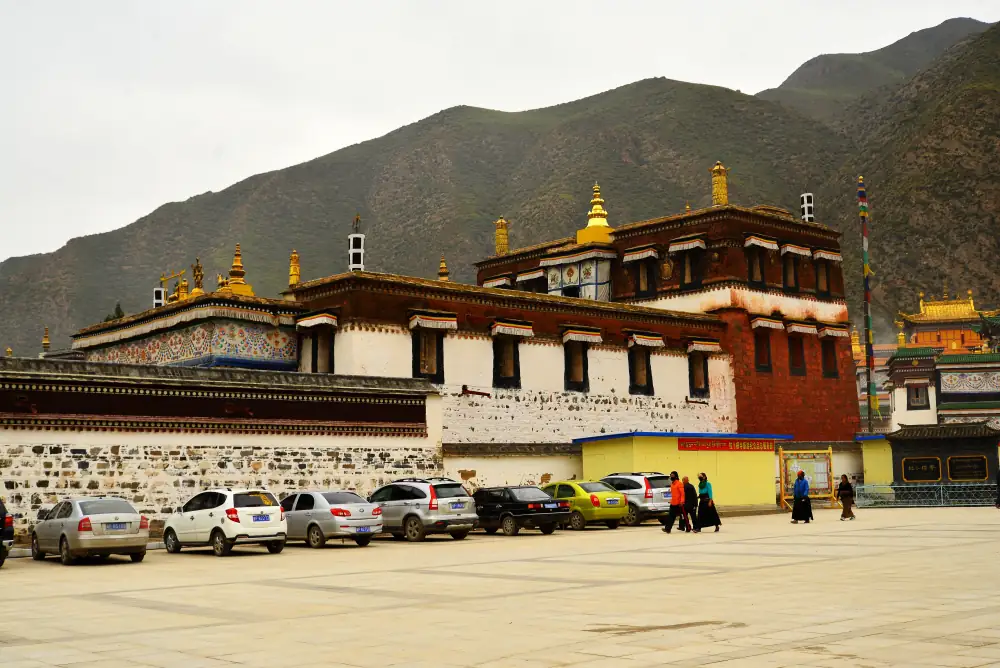
Gannan (甘南) is a Tibetan autonomous prefecture in southern Gansu, wedged against the borders of Qinghai and Sichuan, on high open country cradled by the long northern loop of the Yellow River. Culturally it is Amdo — one of the three great Tibetan regions — and it has one of the most important Gelugpa monasteries in the world at its centre.
What makes it valuable for travellers is what it lacks. There are no permits, no closed periods, no escorted-tour requirement, and, crucially, very little of the polished commercial treatment that has settled over Lijiang or the Tibetan quarter of larger cities. Xiahe is essentially one long street. Langmusi is a village with a river through it. The monasteries are working institutions with thousands of resident monks and no interest in performing for anyone. If you want to see Tibetan religious life functioning at scale rather than curated, this is the most accessible place in China to do it.
The trade-off is roads. The prefecture has no railway, distances between towns are real, and the weather changes its mind hourly.
Xiahe and Labrang Monastery
The monastery
Labrang (拉卜楞寺) is one of the six great monasteries of the Gelugpa school and second only to the Potala in scale. It holds six colleges — logic, tantra, medicine, astrology and more — dozens of Buddha halls, the residences of the incarnate lineages, and rows upon rows of monks’ quarters spreading up the slope. It is not walled off from the town. Much of it has no boundary at all: lanes run between the halls, monks’ courtyard gates open onto them, and you are walking through a place where people live. Tread quietly.
Give it a full half-day, and more if you can. The essentials:
- The kora. The outer circuit, its wall made entirely of prayer wheels — thousands of them. Walk it clockwise, at dawn or at dusk, and let the pilgrims set the pace. This is the single best hour in Gannan.
- The debating courtyards. Monks conduct doctrinal question-and-answer in open gardens and squares, with the clapping and stamping that goes with it. Sessions happen at set times; ask at your guesthouse, because staff at the better places know the schedule.
- The butter sculpture hall and museum. Genuinely remarkable — elaborate coloured butter reliefs, remade seasonally — and photography is permitted here, which it is not in the main assembly hall.
- Gongtang Pagoda and the hill across the river. Both give the overview of the whole complex. The hill is a short steep climb and the better of the two at sunset.
Interiors require a certain patience: dim, smoky with butter lamps, crowded, and you will not understand everything you see. That is fine. Sit down somewhere near the back and watch instead.
Around Xiahe
Sangke grassland (桑科草原) is the classic pasture excursion — a wide flat plain, yak herds, horse riding, yurt camps, bonfire evenings at the more commercialised end. It is pleasant, and honestly it is not essential if your trip continues into Sichuan or Qinghai, where the grasslands are larger and emptier. Ganjia grassland to the north is rougher and less visited.
Bajiao City (八角城), the octagonal town north of Xiahe, is more interesting than it sounds: an eight-cornered rammed-earth walled settlement, still inhabited, still farmed, sitting on a corridor that Tibetan, Tuyuhun and Western Xia powers all fought over. A couple of hours round trip if you have a vehicle.
Xiahe town itself is a single main street with guesthouses, noodle shops, a Tibetan medicine hospital where you can consult a doctor, and thangka studios where painters take students in season. It is not attractive. It is very easy to spend three days in.
The road south and Langmusi
The drive from Xiahe towards Langmusi crosses the Luqu grassland and takes most of a day if you stop properly. Two stops matter.
Milarepa Palace (米拉日巴佛阁) in Hezuo, the prefectural seat, is a multi-storey Buddha tower — creaking wooden stairs, near-darkness, murals and statues stacked floor upon floor. Most itineraries fold it into the return leg rather than the outbound one.
Gahai Lake (尕海) is the prefecture’s largest freshwater lake and a major plateau wetland, sitting in open pasture with the water usually mirror-flat. Late spring and early summer bring migratory swans and geese, and the birding is the best in the region. Worth the detour regardless of season.
Langmusi
Langmusi (郎木寺) is a small village split down the middle by the White Dragon River. The north bank is Gansu, the south bank is Sichuan, and you cross the provincial boundary several times a day without noticing. Red rock cliffs stand behind the village, mist sits in the valley at dawn, and the sound of the place in the early morning is chanting, dogs, and cooking fires being lit.
There are two monasteries, one on each side:
- Kirti (格尔底寺), on the Sichuan bank, the largest Gelug house in this part of Aba. The uppermost hall holds the preserved body of a former incarnation; access is limited and traditionally you go in at dawn with the circumambulating pilgrims. Masked vajra dances are sometimes performed on the ground in front.
- Sertri (赛赤寺), on the Gansu bank, smaller and quieter, with the red cliffs rising directly behind it.
A few hundred metres beyond Sertri lies one of Amdo’s largest sky burial grounds, centuries old, marked by prayer flags with vultures circling above the ridge. It is reachable on foot in about forty minutes uphill. Be extremely clear about the etiquette: do not approach a burial in progress, do not photograph, do not linger. If that feels uncomfortable to you, do not go. Nobody is owed the sight of it.
A mosque stands near Kirti, and Tibetan and Hui communities have lived side by side here for generations — the minaret and the monastery roofs in the same frame is the most honest image of what this region actually is. Beyond the village, Namo Gorge (纳摩大峡谷) and the caves above it make a good half-day walk, and horse trips into the hills are booked informally in the village.
Seasons and festivals
The plateau climate here is cold, damp and remarkably even across the year — summers are cool rather than hot, and the annual temperature swing is smaller than you would expect.
High summer is the scenery season and the peak season together. The grassland is green, wildflowers are out, days are long and warm, and beds in Xiahe and Langmusi need booking ahead.
Autumn turns the pasture gold and thins the crowds. Nights get sharp.
Winter is the religious season, not the scenic one. In the first lunar month Labrang holds the Monlam great prayer assembly over roughly a fortnight: livestock blessed and released, masked cham dances, a butter-sculpture and butter-lamp exhibition ringing the great hall, a Maitreya procession, and — the centrepiece — an enormous embroidered thangka unrolled down a hillside terrace while monks chant. It is one of the great religious spectacles in China and it is extremely cold. Some guesthouses close, and heating is not a given in those that stay open.
Other assemblies fall through the year: a treasure procession in the second lunar month, a Kalachakra gathering in the third, a fasting day in the fourth, a large summer session built around debating and a Milarepa morality play, an autumn masked rite, and a butter-lamp festival marking Tsongkhapa’s death. Around Xiahe, the Xianglang picnic season in the sixth and seventh lunar months sends whole families onto the hills to camp and cook for days, on no fixed schedule.
Whenever you come: weather flips constantly, so carry both a shell and a fleece, and expect cold mornings and hard wind on any ridge.
Getting in and getting around
Lanzhou is the default gateway — a full air and rail hub, with the airport well out of the city, and coaches to Xiahe running daily. Going via Linxia is the alternative, with frequent short connections onward. Xining works for anyone approaching from Qinghai, and Chengdu for anyone threading up through Sichuan, though that is a long haul.
There is no railway into Gannan. Road is the only way, and the way you travel it defines the trip:
- Chartered vehicle, by the day or by distance, arranged in Lanzhou or on arrival. This is the recommended option, because buses will not stop at the lake, the walled town or any grassland viewpoint, and those are half the reason to come. Negotiate.
- Public buses connect the towns adequately but sparsely, and departure times shift. Confirm the day before rather than trusting a timetable.
- Self-driving is not advised without genuine mountain-road experience. The surfaces around Xiahe and Ganjia are rough, a high-clearance vehicle is worth having, and yaks and sheep hold the right of way absolutely.
Where to stay
Xiahe has guesthouses at every grade along the main street between the monastery and the bus station. The characterful options cluster near the river: an old Tibetan-style inn whose roof terrace looks straight onto the kora path, a heated hostel on the south bank next door to a thangka painter’s studio, a courtyard place that film crews use as a base, and one comparatively smart Tibetan-style hotel on the square with circle dancing in the evenings. Ask specifically about heating if you are travelling outside summer — it is not universal.
Langmusi is village lodging: small, plain, quiet, with no resort scene at all and a genuine advantage in being able to step outside at five in the morning into mist and chanting. Book ahead in July and August.
Eating
Two traditions overlap here, Tibetan and Hui Muslim, and both are worth eating through. Notes on regional food elsewhere on the site cover the wider Gansu picture.
- Tsampa (糌粑) — roasted barley flour worked with butter tea into a dough by hand. The staple, and an acquired skill.
- Butter tea (酥油茶) and yak yoghurt — the yoghurt is thick, sour and superb with a spoon of sugar.
- Tibetan steamed buns (藏包) and yak meat in every form, plus juema-root rice.
- Lanzhou hand-pulled beef noodles — clear broth, white radish, chilli oil, coriander. The famous shops sell out by mid-morning, so this is a breakfast, not a lunch.
- Hand-grabbed mutton (手抓羊肉) — boiled on the bone, served with nothing but a dish of salt. The regional showpiece.
- Paozhang noodles (炮仗面) and yellow-braised mutton in the Hui restaurants, which are alcohol-free.
A six-day loop
Day one. Arrive Lanzhou. An afternoon along the Yellow River waterfront — the waterwheel park, the Mother River sculpture, White Pagoda Hill — and the provincial museum if time allows. Noodles at the night market.
Day two. Road to Xiahe. Half a day at Labrang, ideally with the kora at dusk. Sangke grassland in the late afternoon if you want it.
Day three. Labrang again at dawn for the morning chanting and the pilgrims, then Bajiao City, then the road south — Hezuo passed through, Gahai Lake shortly before dark. Sleep in Langmusi.
Day four. Pre-dawn on the Langmusi hillside. Kirti on the Sichuan side in the morning, Sertri and the red cliffs in the afternoon, the ridge above the village at sunset.
Day five. Namo Gorge, the mosque, or a horse trip. A slow day, and the one most people wish they had built in.
Day six. Choose an exit. North through Hezuo and Tongren — the thangka-painting heartland of Rebgong, worth an overnight of its own — and on to Xining, with Kumbum Monastery and Qinghai Lake beyond. Or back to Lanzhou. Or south into Sichuan via Zoige and the Yellow River’s nine-bend viewpoint towards Chengdu, which opens onto our southwest-china coverage.
Practical advice, honestly
Altitude. Symptoms above roughly three thousand metres are usually mild and pass within a day or two: headache, poor sleep, breathlessness on stairs. Arrive rested, skip alcohol for the first day, drink more water than you want, and do not run or jump about at high viewpoints. Do not travel up with a chest infection. Reaching for bottled oxygen at the first twinge tends to prolong rather than shorten the adjustment.
Sun. Plateau ultraviolet is brutal. High-factor sunscreen, sunglasses, a hat with a brim, and lip balm are not optional, and this matters as much on a cold overcast day as a bright one.
Etiquette. Clockwise on any kora, always. No photography of monks chanting in the main hall and never a flash. Ask before pointing a camera at anyone. Nothing at all at the sky burial ground. Ask permission before entering a relic hall.
What to skip. The grasslands if Sichuan or Qinghai is on your route. The theme-park end of the horse-riding camps. Any offer of tickets from someone who materialises beside your car on the road.
What not to skip. The dawn kora at Labrang, the butter sculptures, and the first hour of daylight in Langmusi. Everything else in Gannan is negotiable. Those three are the trip. For related plateau travel, see our tibet archive.