
Cloud pours through the granite spires of Sanqingshan (三清山) like water finding a drain, and then, for a minute or two, it clears and you see the whole absurd geometry of the place: fins, needles and toppling columns, pines gripping bare rock at impossible angles, and a plank walkway pinned to a vertical wall a very long way above the forest floor. This is a mountain the Taoists claimed early and never really let go of. It is also, for a walker, one of the most satisfying days in eastern China — engineered enough to be safe, wild enough to feel earned.
Table of contents
Open Table of contents
What Sanqingshan is, and why it earns the detour
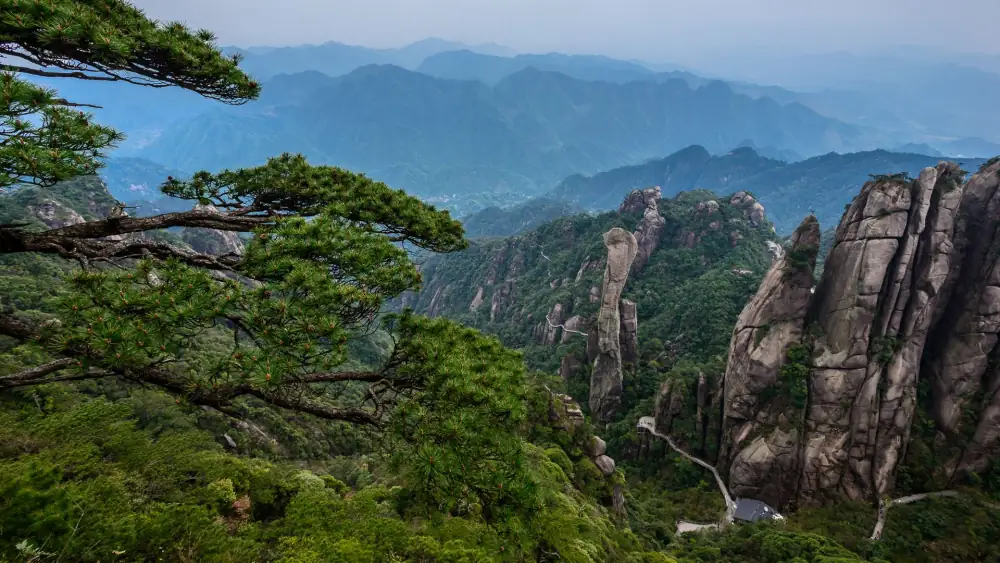
Sanqingshan rises in the north-east of Jiangxi, on the boundary between Yushan (玉山) and Dexing (德兴) counties, close enough to the Zhejiang border that many visitors arrive from the coast rather than from Nanchang. Its three highest summits — Yujing (玉京), Yuxu (玉虚) and Yuhua (玉华) — were read by early Taoists as the three pure ones of their pantheon seated on the crest, and the mountain took its name from them. Ge Hong (葛洪), the alchemist and physician, is credited as the first to build a hermitage and a furnace here in the fourth century; the well he is said to have dug still holds water. Sixteen centuries of that continuity are why the place feels less like a scenic reserve and more like a shrine with a very good view.
Geologically it is one enormous body of granite, worked by rain, frost and gravity into the densest cluster of rock spires in the region. Comparisons to Huangshan are unavoidable and not unfair — same rock, same pines, same theatrical mists — but Sanqingshan is smaller, quieter and far more vertical in the way it presents itself. Where Huangshan gives you broad summit plateaus, this gives you a ridge circuit and a gallery of freestanding pillars you walk around rather than over. Two of them carry the mountain’s reputation: a slender column read locally as a python heaving itself out of the hillside, and a facing pinnacle whose profile resolves, from exactly one bend in the path, into a woman with hair falling past her shoulders.
Add several thousand plant species, a genuinely rich forest and a Taoist complex built entirely of dry-laid granite, and you have a mountain that rewards attention as much as fitness. Anyone drawn to China’s mountain landscapes should have it on the list.
The circuits, and how they fit together
Sanqingshan is organised as a loop at around the 1,600-metre contour, with two cable cars feeding into it from opposite sides. Understand that loop and the mountain becomes simple.
Nanqingyuan (南清园)
This is the rock garden and the reason most people come. A closed circuit of stairs threads between the python column, the goddess pinnacle, a cluster of peaks read as three dragons breaking from the sea, and a hooded summit that looks uncannily like a robed alchemist holding out a gourd. Everything is close, everything is steep, and the sequence of reveals is beautifully judged — you round a corner and the valley drops away beneath a spire you stood on top of ten minutes earlier.
Walk it clockwise if you can. The gradient works with you that way, and you finish descending rather than grinding upwards on tired legs. Give it two to three hours and resist the urge to rush the first half; the best of it is not at the end. Below Nanqingyuan a narrow cleft called Yixiantian (一线天) lets a single strip of sky in over a long stone staircase, and above it Yutai (玉台) is the ridge’s most accessible viewpoint.
The West Coast walkway (西海岸)
Wide, level and utterly exposed, the western walkway is the mountain’s signature engineering: a plank-and-steel gallery bolted to a cliff face for well over a kilometre, cliff and old-growth forest on one shoulder, a gorge and a horizon of blue ridges on the other. Because it barely climbs, it is the easiest serious walking here, and it is where cloud seas actually behave — vapour rides up the western flank in the afternoon and spills over the railing at your elbow.
Save it for late in the day. Light rakes along the cliff from the west, the crowds have thinned, and if the sky is doing anything interesting you will be in the best seat for it. Allow around three hours there and back.
The Sunshine Coast walkway (阳光海岸)
The eastern counterpart, and the newer of the two galleries. It is gentler, shadier and better for morning, with a suspension bridge over a ravine and a glass-floored platform for those who want their vertigo undiluted. Because it faces east, it is a credible sunrise alternative if you cannot face a pre-dawn summit push.
Sanqinggong (三清宫) and Yujing Peak (玉京峰)
Sanqinggong sits on the northern side and is the cultural heart of the mountain: a Ming-era hall cut and fitted entirely from local granite — beams, screens, pools and door frames included — oriented in deliberate contradiction of convention. Around it lie old altars, stele, spring-fed wells and, out on a cliff edge, a small six-storey stone pagoda that has stood through a millennium of weather. Walking here is easy and the crowds thin: an hour of quiet Taoist culture after a morning of stairs.
Yujing Peak is the high point and the hardest work on the mountain. Two lines lead up — a steep, sparse, thoroughly wild ravine route from the Nanqingyuan side, and a longer but kinder approach from behind the temple. From the top you look down on the entire massif, which is precisely why people set an alarm for it.
Wanshouyuan (万寿园)
South of the ridge and by far the most relaxed section, themed on longevity and studded with rock shapes given auspicious names — an old priest bowing to the moon, a beast with its head thrown back mid-roar. Some staircases want a hand on the rail, but an hour covers it at a stroll. If your day is tight, this is the section to trade away.
Getting there and moving around
No airport or railway station sits at the foot of the mountain, so every itinerary involves one transfer — which sounds worse than it is.
- By train. High-speed services along the Shanghai–Kunming corridor stop at Yushan and Shangrao (上饶). Both towns have frequent onward road transport, and the ride takes roughly an hour on a good ring road.
- By air. Nearby regional airports include Quzhou in Zhejiang and Nanchang, Jingdezhen and Huangshan further out. Quzhou is closest by road, but for most travellers the train is faster door to door.
- By car. Expressways drop you onto the ring road from the Shanghai–Kunming motorway if you come from the coast, and from the Wuyuan side if you arrive via Huangshan or Jingdezhen.
- From Wuyuan (婺源). Regular buses cross between the two and stop at the eastern service area. Pairing Sanqingshan’s granite with Wuyuan’s whitewashed Huizhou villages makes an excellent five-day loop through east China.
Two cable cars — eastern, at the Jinsha (金沙) service area, and southern, at Waishuangxi (外双溪) — climb to the ridge in about ten minutes each and are functionally interchangeable. Which you choose matters mainly for where you sleep and which end of the loop you start from. The eastern base sits closest to Nanqingyuan; the southern delivers you nearer Wanshouyuan.
Walking up instead of riding takes several hours of stone steps enclosed by forest. Almost nobody should do it: the views only begin at the top, and you will arrive with nothing left in your legs for the part of the mountain you came for.
Once on the ridge, everything is on foot — no vehicles, no shortcuts, no shuttle. Carry what you need, and note that the first cable cars run early and the last ones stop well before dark. The walkways are no place to be caught out by dusk.
The four seasons
Spring is the mountain’s showpiece. From roughly April into June, rhododendrons flower in bands along the ridges, densest in the valley below the goddess peak, on the slopes towards Yujing, and — most memorably — clinging to the cliffs beside the western walkway, so that you look down into flowers rather than up at them. Spring is also the wettest stretch of the year: expect days when the whole mountain sits inside a cloud, mud on the approach roads, and damp bedding if you sleep high. Take waterproofs seriously and treat every stone step as slippery until proven otherwise.
Summer is cool and green at altitude, a genuine escape from the heat of the Yangtze cities, but it brings thunderstorms and the heaviest crowds. Be off the exposed walkways when the sky darkens.
Autumn is the connoisseur’s season. Air dries out, visibility lengthens, sunrises become dependable rather than hopeful, and late light turns the granite the colour of weak tea. If you can choose freely, choose October or early November — and book early, because everyone else has worked this out too.
Winter empties the mountain and transforms it. Frost welds itself to the pines, ice sheathes the railings, and rime turns the spires into something closer to porcelain than rock. Superb photography, demanding walking; sections can close after a freeze, and the shorter cable car window compresses your day. Come with proper boots or don’t come in January.
Where to stay
Two strategies, and the choice decides whether you see a sunrise.
| On the ridge | In the valley | |
|---|---|---|
| Access to sunrise viewpoints | Walkable before dawn | Not realistic |
| Number of options | A handful of guesthouses and lodges | Many, across all standards |
| Comfort | Simple; heating, hot water and signal can be patchy | Reliable, more variety |
| Booking pressure | High — reserve well ahead | Light outside holidays |
Ridge accommodation clusters near the temple and the pine woods behind it, and around the southern gate. Rooms are functional rather than plush, supplies come up by porter, and mist can leave everything faintly damp — but you can be at a viewpoint in the dark with a flask, which is the entire point. Reserve as far ahead as you can for spring weekends and holidays.
Valley bases at the eastern and southern service areas, and in Yushan town, offer more choice and easier logistics, and suit anyone treating the mountain as a single strong day. Shangrao works too if you want a proper town in the evening, at the cost of an earlier alarm.
What to eat
Mountain food in this corner of Jiangxi is unfussy and generous with chilli and smoke. Look for cured pork stir-fried with dried bamboo shoots, freshwater fish braised with ginger and rice wine, wild greens and ferns from the slopes, and clay-pot stews built on preserved vegetables. Jiangxi seasons with a firmer hand than neighbouring Zhejiang, so ask for it milder if you need to.
Local specialities travel well as gifts: wild kudzu starch, whisked into a translucent gelatinous drink; a fragrant wild tea grown in the Huaiyu range, clean and faintly bitter; and small chestnuts shaped like a hen’s heart, sweet enough to eat raw and harvested around the first frosts. Valley restaurants are consistently more interesting than the ridge ones.
On the mountain itself, provisioning is thin. Rest points sell simple food and drink, but the range is narrow. Eat properly before you ride up, and carry more water than feels necessary.
Honest practical advice
- Pick a direction and commit. The classic single day runs up the eastern cable car, clockwise through Nanqingyuan, across to the eastern walkway, round to the western walkway, and back down the way you came. Five to six hours of walking, and it delivers the mountain’s best in one sweep.
- Two days beats one, decisively. Ridge night, dawn on Yujing or Yutai, then the eastern walkway at your leisure. The difference is not more sights but more weather.
- Weather is the whole game. Check the forecast the night before and be willing to reshuffle. Cloud seas need moisture and sun together; a flat grey day gives you neither.
- Layers, not bulk. Pre-dawn on the ridge is markedly colder than the afternoon, at any time of year. A windproof shell and one warm layer solve most of it.
- Grip matters more than gear. Proper soles on wet granite are worth more than anything else you carry. Bring a torch for a dawn start, and keep your hands free.
- Avoid national holiday weeks. Cable car queues in peak periods can consume the hours you needed for walking, and the stair sections become single file.
What you can skip
- Walking up from the valley. Ride the cable car and spend your legs on the ridge, where the scenery is.
- The far outlying sections, several undeveloped scenic areas well away from the central loop. They suit experienced hikers with time to spare.
- Wanshouyuan, if your day is compressed. Pleasant, gentle, and the least remarkable of the main sections.
- The first souvenir shop you see. Quality varies considerably between the service area stalls; look at a few and check packaging and provenance before committing.
- Chasing every named rock. Half the fun of the shapes is spotting them yourself, and hunting each one from a list turns a mountain into a checklist. Build your route around light and weather instead, and let the rest arrive on its own. For more on structuring multi-stop trips through the region, see our itinerary planning notes.