
Penglai: Where Myths and Sea Mist Meet the Shore
In ancient Chinese mythology, Penglai (蓬莱) was one of three islands floating in the Bohai Sea where immortals (xian) lived — a paradise of eternal life and divine plants, approached by the ships of emperors desperate for immortality. Qin Shi Huang sent 3,000 young men and women to sea under the direction of the alchemist Xu Fu to find Penglai’s elixir of life; none returned (legend places them in Japan). The Han Emperor Wu made multiple expeditions to the Shandong coast, searching the horizon.
Whether or not Xu Fu found Japan, the city that bears the mythological name is real: Penglai City on the northern tip of Shandong Peninsula has been an inhabited port for 2,000 years, and the sea mirage (蓬莱海市蜃楼) that appears above the Bohai Sea on warm spring mornings — a phenomenon caused by temperature inversions — remains the most reliable natural mirage in China.
The Mirage
The Penglai mirage occurs when warm air from the sea surface is trapped beneath cooler air above, causing light to refract and project images of distant objects (islands, ships, cities) above the horizon line. These floating images can last from a few minutes to several hours.
The best conditions: Warm days in late April to mid-May, when the sea surface temperature exceeds the air temperature by 3–5°C and winds are calm. The mirage typically appears in the morning.
The most famous mirage event recorded in modern times occurred in 2006, when thousands of witnesses saw a 4-hour display of detailed images including ancient city walls and trees floating above the sea. Videos of this event circulated widely in China, reviving public interest in the phenomenon.
No guarantee: The mirage is a natural phenomenon and cannot be scheduled. The Penglai Tourism Bureau sometimes posts alerts on WeChat when conditions look favourable.
Penglai Pavilion (蓬莱阁)
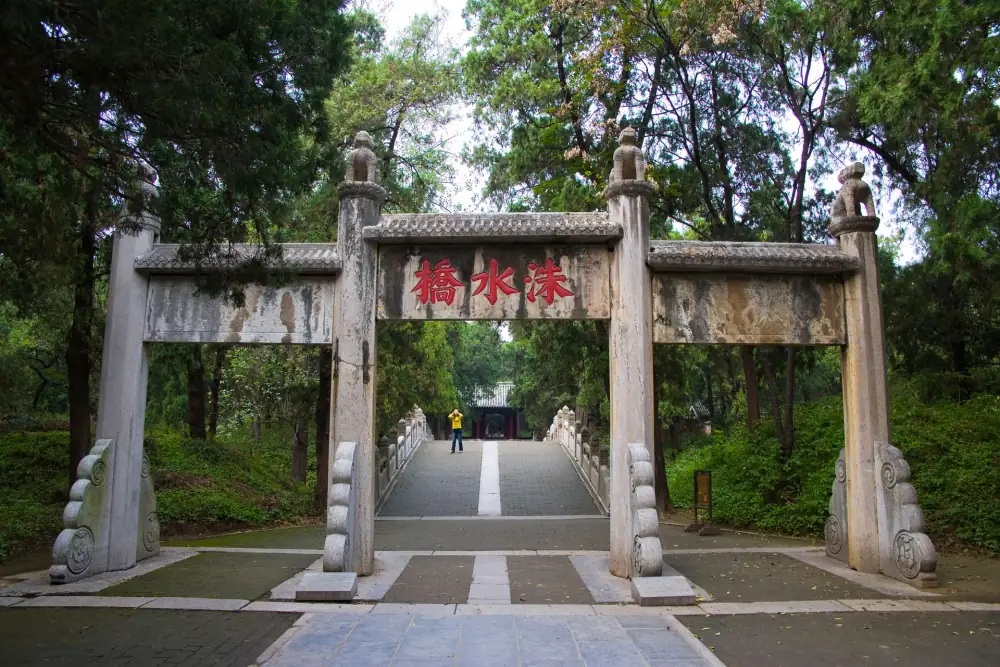
The most important historical structure in Penglai, the Penglai Pavilion complex sits on a cliff above the sea, commanding views north over the Bohai Sea and east toward the Bohai Strait. The main pavilion was first built in 1061 CE (Northern Song dynasty) and rebuilt/expanded through the Ming and Qing periods.
The complex includes:
- Main Pavilion (蓬莱阁): A two-storey wooden pavilion with views considered the finest in northeast China in the pre-railway era; the 8 Immortals are said to have crossed the sea from here on their wine gourds.
- Dragon King Temple (龙王宫): The primary prayer site for Bohai fishermen; model ships and votive offerings crowd the altar.
- Luzu Temple (吕祖殿): Dedicated to the immortal Lü Dongbin — one of the Eight Immortals and patron of barbers, literary scholars, and those seeking enlightenment through wine.
Admission: ¥130 (includes all pavilion buildings and coastal path).
Penglai Water City (蓬莱水城): A Ming Naval Fortress
Adjacent to Penglai Pavilion, the Penglai Water City is one of the best-preserved Ming-dynasty naval facilities in China — a fortified harbour designed to shelter warships and protect the coast from Japanese pirate raids (wokou) that plagued the northern coast in the 15th–16th centuries.
The harbour enclosure, still filled with water, is surrounded by walls of massive dressed stone. The Small Sea Gate (小海) — the entrance channel between the fortified harbour and the open Bohai Sea — still functions as a fishing harbour today.
The Water City is most interesting for what it reveals about Ming naval strategy: the ships stationed here were capable of crossing the Bohai to the Liaodong Peninsula, making Penglai a strategic point in the defence of the entire northern coast.
Admission: Included in Penglai Pavilion ticket.
Penglai Seafood
The Bohai Sea and the strait connecting it to the Yellow Sea produce exceptional seafood:
Scallops (扇贝): Penglai is one of China’s major scallop farming centres; the bay-raised scallops have a sweetness and size that make them exceptional when grilled with garlic butter or steamed with glass noodles.
Yellow Croaker (黄花鱼): The Bohai yellow croaker is considered the finest in China; braised or steamed with minimal seasoning.
Sea Urchin (海胆): Smaller than the Dalian variety but intensely flavoured; eaten raw.
Prawns (虾): The Bohai cold-water Fenneropenaeus chinensis has firmer, sweeter flesh than southern species.
The best seafood restaurants are concentrated in the old fishing harbour area (渔港) — away from the tourist streets near the pavilion. A meal of 4 dishes for two with local seafood typically costs ¥150–¥300.
Practical Information
Getting there: High-speed train from Jinan to Yantai (2.5 hours), then bus to Penglai (1 hour). Or direct buses from Qingdao (2.5 hours).
Best time: April–May for mirage season; October for clearest skies and autumn seafood peak. Summer (July–August) is hot and crowded; avoid.
Duration: A comfortable full day covers Penglai Pavilion, Water City, and a seafood lunch; overnight adds the possibility of dawn mirage-watching.
Penglai has been waiting for immortals for 2,000 years and learned in the process how to make the waiting pleasant — good seafood, a sea view, and the occasional morning when the horizon does something inexplicable.