
Meili Snow Mountain (梅里雪山) — known in Tibetan as Kawagebo (卡瓦格博) — is the holiest mountain in Tibetan Buddhism. It has never been climbed: a 17-member Chinese-Japanese expedition died on its slopes in 1991, and no subsequent summit attempts have been permitted out of respect for the mountain’s sacred status. The mountain’s inaccessibility to climbers paradoxically preserves its atmosphere.
At 6,740 metres, it’s the highest peak in Yunnan, visible from the hillside village of Feilaisi (飞来寺) across the Mekong River gorge.
Table of contents
Open Table of contents
The Sunrise at Feilaisi
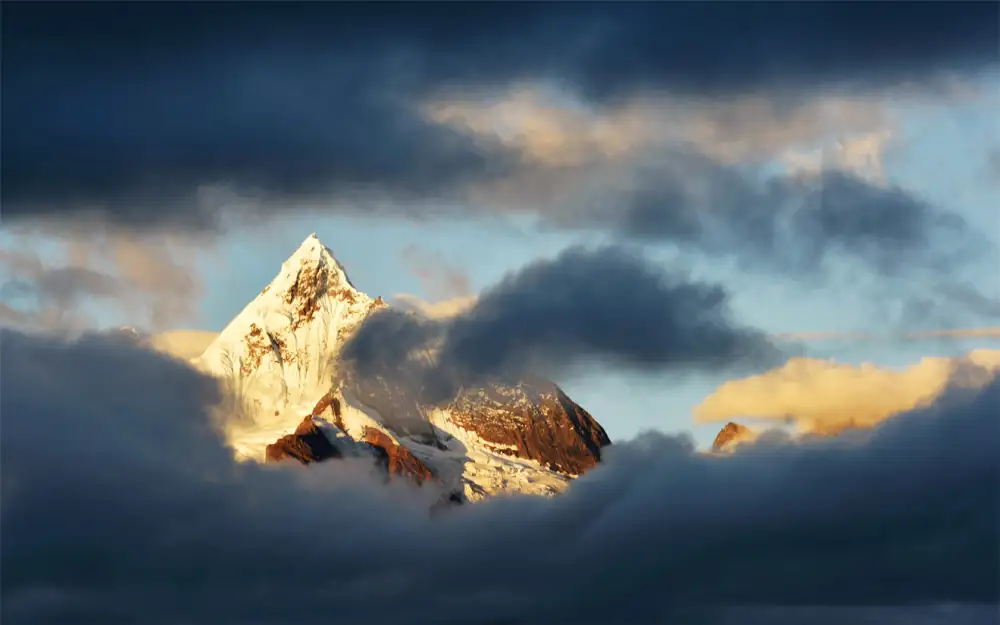
The reason people come to Deqin is a single image: the first sunlight of the day striking the thirteen snow peaks of the Meili range, while the valley below is still in shadow and cloud. The peaks glow orange-gold against a deep blue dawn sky for approximately 5–10 minutes before the full sun rises.
The viewing point: The rooftop terraces and hillside slopes facing east from the Feilaisi village. Most guesthouses and hotels have outdoor terraces designed for this view. Arrive at the viewpoint 30 minutes before sunrise; the exact time varies by season (4:30–6:30 AM).
The odds: Cloud cover obscures the peaks approximately 70% of mornings — allow 3+ nights at Feilaisi for a reasonable chance of seeing the sunrise. The best season is October–December and February–April.
When it happens: When the conditions align — clear sky, frozen mist in the valley creating a white carpet, the sunrise light arriving precisely — it is one of the most extraordinary natural light shows in China. Tibetan pilgrims who have traveled weeks on foot to see this moment cry; professional photographers book return trips.
Kawagebo Pilgrimage Kora
The circumambulation (kora) of Meili Snow Mountain is one of the three holiest koras in Tibetan Buddhism — the full circuit covering approximately 200 km through three countries (China, Myanmar, Tibet) at altitudes of 3,000–4,800 metres over 12–16 days.
The accessible section: The initial section of the kora, entering the valley from the Mingyong Glacier (明永冰川) side, is walkable in 2–3 days. The Mingyong Glacier itself descends to 2,700 metres — a rare low-altitude valley glacier, surrounded by azalea and rhododendron forest.
Pilgrims: During the Year of the Monkey (every 12 years in the Tibetan calendar, 2028 is the next), thousands of Tibetan pilgrims complete the full kora. Meeting pilgrims on the trail — who have traveled from across the Tibetan plateau to make this journey — is a powerful human encounter.
Deqin Town (德钦)
The administrative centre at 3,500 metres — a functional rather than beautiful town, used as a base. The Feilai Temple (飞来寺) and its courtyard below the guesthouses are the geographic heart of the viewing area.
Tibetan Buddhist culture: The area has been primarily Tibetan cultural territory for centuries. The monastery at Dongzhulin (东竹林寺) near Deqin is an active Gelug community with 100+ monks — the crimson-robed monks visible on the monastery road in morning light is a recurring image.
Practical Tips
Getting to Deqin:
- From Shangri-La (香格里拉): 4 hours by bus or car on the twisting mountain road
- Shangri-La Airport (DIG) is the nearest airport — flights from Kunming (1 hr), Chengdu (2 hrs)
The road: The 185 km between Shangri-La and Deqin is one of the most scenic drives in China — the Mekong Gorge, the dramatic switchbacks ascending from the Mekong valley floor, and the first views of the Meili peaks emerging ahead.
Accommodation at Feilaisi: Several guesthouses with terrace sunrise views. Book ahead (October–November and February–April peaks); simple but clean rooms, ¥150–300/night.
Last updated: May 2026