
Dongting Lake (洞庭湖) in northern Hunan Province is the second-largest freshwater lake in China and one of the country’s most culturally resonant landscapes. Every Chinese student reads the essay about Yueyang Tower (岳阳楼) overlooking the lake, and every Chinese person associates the words “Be the first to worry about the world’s sorrows, the last to enjoy its joys” (先天下之忧而忧,后天下之乐而乐) with this location. For foreign travelers, Dongting offers a combination of classical Chinese cultural heritage, extraordinary seasonal birdwatching and one of China’s most undervisited major lakes.
Yueyang Tower (岳阳楼)
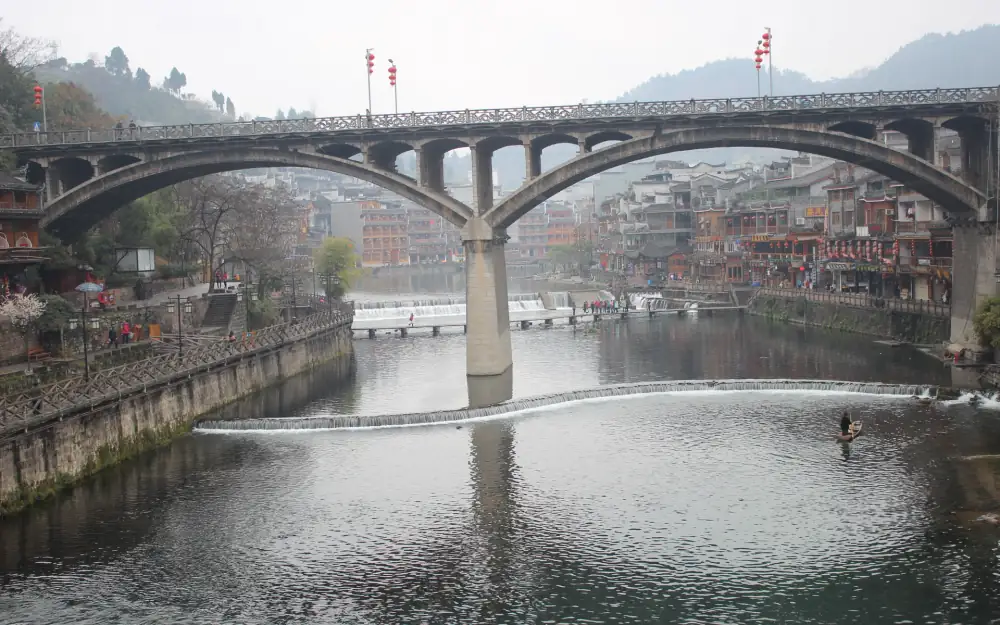
The tower that stands at the northwest corner of the lake today is the fifth major reconstruction (1984) on a site that has hosted a watchtower or pavilion since at least the 7th century AD. But the tower’s fame comes from a prose-poem written in 1046 by the Northern Song official and writer Fan Zhongyan (范仲淹) — “On Yueyang Tower” (岳阳楼记). This piece, memorized by every Chinese schoolchild, describes the view of the lake in different seasons and weathers and culminates in the famous statement about bearing public responsibility before personal pleasure.
The building itself: Three stories, traditional Tang-style roof construction with flying eaves, wooden columns and crossbeam frame. The interior contains inscribed plaques of the famous essay in various calligraphy styles. The entry pavilion has stone engravings of Fan Zhongyan’s text.
The view: Facing west over the lake, Yueyang Tower commands a panorama of open water — particularly dramatic in winter when the water level drops and the lake’s floodplain ecosystem is exposed, attracting migratory birds.
Entry: ¥75 (includes the tower and the waterfront park area)
Hours: 08:00–18:00 (summer); 08:00–17:30 (winter)
Junshan Island (君山岛)
A 0.96 km² island in Dongting Lake, accessible by ferry from Yueyang (30 minutes, ¥10 one way). The island is famous for:
Junshan Silver Needle Tea (君山银针): One of China’s Ten Famous Teas, produced exclusively on this island. The needle-shaped silver-green buds, when brewed in a clear glass, visually stand upright in the water before slowly lying down — a famous spectacle. The tea has been grown here since the Tang dynasty.
Mythological associations: The island is associated with the legend of E Huang and Nu Ying — the two consort wives of the mythological Emperor Shun — who wept at the island when learning of the emperor’s death. Their tears supposedly created the spotted markings on Hunanese mottled bamboo (湘妃竹).
Peach Garden (桃花园): Thousands of peach trees bloom in spring (late March to early April) creating one of Hunan’s most photographed spring scenes.
Entry to island: ¥75
Migratory Bird Season
Dongting Lake is one of the most important overwintering sites in East Asia for migratory waterbirds. The lake basin (which floods seasonally, creating shallow wetlands that attract birds) hosts in winter:
- Siberian Crane (critically endangered): Dongting is one of three remaining global wintering sites for this species
- White Crane (Whooper Swan, Tundra Swan)
- Lesser White-fronted Goose
- Bean Goose, Greater White-fronted Goose
- Eurasian Spoonbill
- Oriental Stork
Best time: November through February; December–January for peak populations.
Viewing locations: The East Dongting Lake Nature Reserve has viewing hides and observation platforms accessible from Yueyang. The reserve management office can provide current bird location information.
Dragon Boat Connection
Dongting Lake is the traditional location of the Dragon Boat Festival (端午节) origin story. The patriot poet Qu Yuan (屈原, 340–278 BC) drowned himself in the Miluo River (汨罗江), a tributary of Dongting, in protest of political corruption. Local fishermen raced in boats to his location to prevent fish from eating his body — the mythological origin of dragon boat racing. The Miluo area 40 km east of Yueyang hosts commemorative events during the festival each year.
Hunan Food at Dongting Lake
The lake provides the protein backbone for distinctive local cuisine:
Braised fish head with chili (剁椒鱼头): The classic Hunan dish. A large fish head (carp or silver carp from the lake) covered in chopped red chilies and steamed, then finished with hot oil. The combination of fatty fish, fierce chili and garlic is deeply satisfying.
Dongting crab (洞庭湖螃蟹): Seasonal (September–November); freshwater hairy crabs from the lake. Less celebrated than Shanghai’s Yangcheng Lake crabs but excellent and significantly cheaper.
Water lily cake (荷叶糕): Sweet pastry made with dried lotus leaf; a local festival food.
Smoked pork with leeks (腊肉炒韭苔): Hunan’s characteristic preserved pork in combination with spring vegetables.
Getting There
From Changsha: High-speed train Changsha North to Yueyang East (30 minutes, ¥45–70). Yueyang is a natural day trip from Changsha when combining with Zhangjiajie (see separate guide for that route).
From Wuhan: High-speed train Wuhan to Yueyang East (1 hour, ¥75–110).
Within Yueyang: Taxi or Didi from Yueyang East Station to Yueyang Tower (15 minutes, ¥20); to the ferry pier for Junshan Island (15 minutes, ¥20).
Dongting Lake rewards travelers who seek depth over sensation — the view from Yueyang Tower is more literary experience than scenic spectacle, and the lake’s extraordinary bird populations are a natural phenomenon of global significance hidden in plain sight in a part of China that Western tourists rarely visit.