
Wuyi Mountain: Where China’s Greatest Teas Grow
In a landscape of red sandstone peaks and clear rushing rivers, one of China’s most revered teas grows in conditions so particular that the same variety planted even 5 km away produces a distinctly inferior flavour. The Wuyi Mountains (武夷山) in northwest Fujian are not merely a scenic area — they are the birthplace and continuing home of Da Hong Pao (大红袍) and the broader family of Wuyi rock oolongs (武夷岩茶), and the landscape itself shaped the tea’s character.
The mountains are simultaneously a UNESCO World Heritage Site (inscribed 1999 for both natural and cultural values), a Taoist sacred site with a 2,000-year ritual history, and a recreational destination centred on a spectacular nine-bend river bamboo raft experience.
The Nine-Bend River (九曲溪)
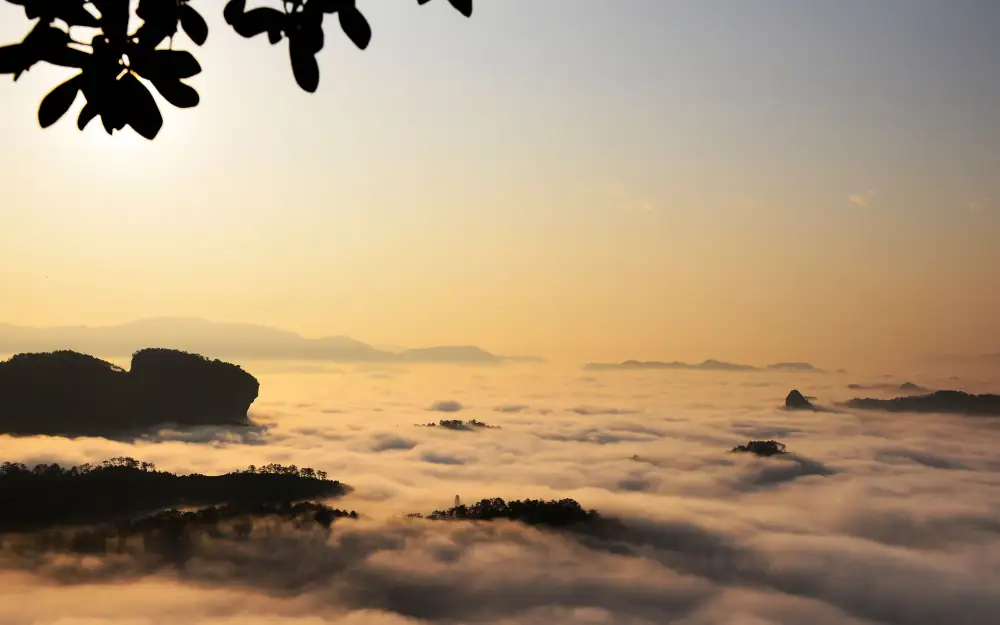
The defining visitor experience on Wuyi Mountain is the bamboo raft float down the Nine-Bend River — a 9.5 km journey through the gorge on a slim bamboo raft poled by two boatmen over 90 minutes.
The river takes its name from its nine distinct bends through the sandstone gorge. Each bend reveals a new arrangement of vertical red peaks, hanging temples, and Neolithic wooden coffins lodged in cliff-face crevices 100 metres above the water. The most famous section — Sky Raft Peak (天游峰) — flanks the river on both sides with cliffs rising 408 metres, creating a canyon of extraordinary drama.
Practical Details
- Duration: 90 minutes downstream.
- Cost: ¥180/person (included in comprehensive scenic area ticket; or ¥230 standalone).
- Booking: Advance booking online strongly recommended in peak season (April–October). Same-day tickets sometimes available from the scenic area operations centre.
- Boarding points: Several entry points exist; the standard tourist route begins at the Wuxia Scenic Area pier and ends at the One Line Sky (一线天) area.
- Best time: Morning trips have fewer crowds; the river is typically clearest after rain.
Wuyi Rock Oolong Tea
Why “Rock Tea”?
The term Yancha (岩茶) — rock tea — refers to teas grown in the rocky gaps and crevices of the Wuyi mountain range. The sandstone substrate, combined with morning mist, high altitude, and high rainfall, creates conditions that stress the tea plants in ways that concentrate aromatic compounds.
The most prized cultivation sites are “zhengyan” (正岩) — the inner core of the scenic area between the river and the highest peaks. Only approximately 6.78 km² of the total tea-growing area qualifies as zhengyan.
Da Hong Pao (大红袍): The Most Famous Tea in China
Legend attributes the origin of Da Hong Pao to a Ming dynasty scholar cured of illness by a tea brewed from a mountain monastery’s bushes, who rewarded them by draping his red robes (hong pao) over the plants.
The six original mother bushes still grow in a cliff crevice near Tianxin Rock Monastery (天心岩寺) — they are among the most photographed plants in China. Tea from these specific bushes last sold at auction for approximately ¥1.08 million per gram in 2002; the bushes have since been declared a national cultural heritage object and are no longer harvested.
Commercial Da Hong Pao is made from clonal cultivars propagated from the original plants and is widely available; quality ranges from ¥200/100g (acceptable) to ¥5,000+/100g (exceptional zhengyan material).
Other Wuyi Oolongs
| Tea Name | Flavour Character |
|---|---|
| Rou Gui (肉桂) | Cinnamon spice, warming; currently the most fashionable variety |
| Shui Xian (水仙) | Floral, softer; traditional style; excellent aged versions |
| Qi Dan (奇丹) | Rare; considered closest to the original Da Hong Pao character |
| Tie Luo Han (铁罗汉) | One of the “Four Famous Oolongs”; unusual mineral quality |
Tea Tasting and Buying
The scenic area and town of Wuyishan City have hundreds of tea shops. Most offer complimentary tasting sessions lasting 20–40 minutes where you can compare different grades and varieties. Be aware that the highest-pressure sales environments are often in the scenic area itself; better value and more relaxed tastings can be found in the streets of Wuyishan city (the administrative centre 3 km from the scenic area).
A budget approach: Buy from a shop affiliated with a specific farm/production cooperative, ask to taste before buying, and compare at least three shops before committing.
Key Sights Within the Scenic Area
Tianxin Rock Monastery (天心岩永乐禅寺)
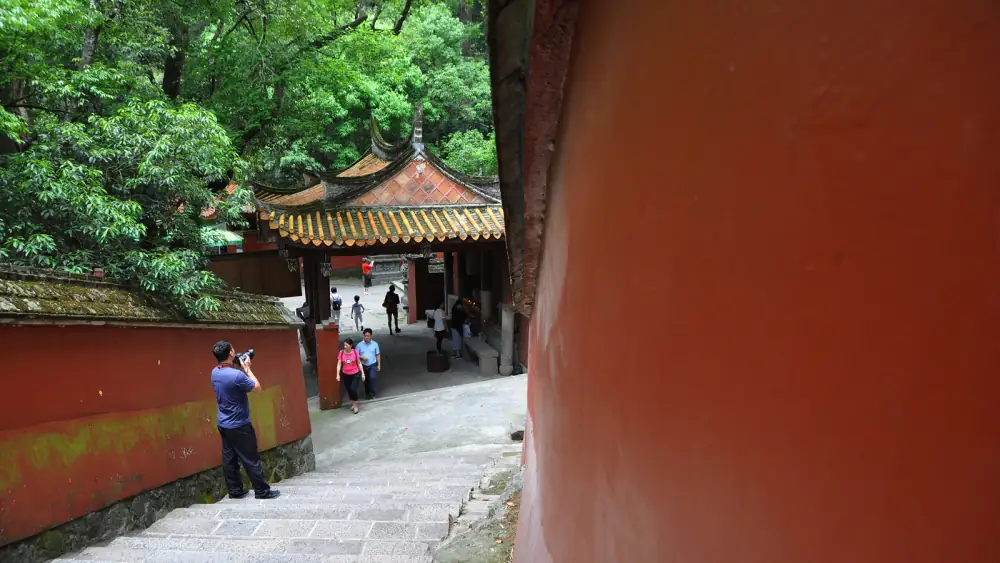
A Buddhist monastery operating at the foot of the cliffs near the original Da Hong Pao mother bushes. The monastery’s monks cultivate tea in the small plots adjacent to the walls — the tea is used in ceremony and occasionally sold to visitors. The architecture is modest but the setting — cliffs on three sides, ancient tea plants visible through the latticed gate — is memorable.
Sky Raft Peak (天游峰)
The highest accessible viewpoint in the main scenic area — 408 metres above the river — reached by approximately 800 stone steps. From the summit, the Nine-Bend River below is visible in five of its nine bends simultaneously; the green water against red sandstone is Wuyi’s signature image.
Allow: 90 minutes up; 60 minutes down. Difficulty: Moderate-strenuous; the steps are steep and can be slippery when wet.
One-Line Sky (一线天)
A narrow fissure in the rock through which the sky appears as a sliver of blue — roughly 200 metres long and in places only 50 cm wide. Walking through it requires turning sideways. A torch (flashlight) is recommended.
Water Curtain Cave (水帘洞)
A large natural overhang in the cliff face from which water drips in a curtain during the wet season. The sheltered space beneath has been used for Taoist practice for centuries; bronze incense burners and faded inscriptions cover the cave walls.
Combining the Scenic Area with City Activities
Wuyishan City (the modern administrative town) hosts:
- Wuyi Mountain Tea Research Institute: A serious museum on oolong cultivation and processing; free entry.
- Tea market streets: Wholesale and retail tea shopping in a relatively competitive market.
- Riverside restaurants: Specialising in local Minbei (northern Fujian) cuisine — thin rice noodles, bamboo shoots, river fish.
Practical Information
Getting There
By Train: Direct high-speed trains from Xiamen (2 hours), Fuzhou (2 hours), and Nanjing (4 hours). The station is Wuyishan North (武夷山北站) — 30 minutes by taxi from the scenic area.
By Air: Wuyishan Airport (WUS) has flights from Shanghai, Beijing, Guangzhou, and Xiamen.
Admission
The comprehensive Wuyi Mountain scenic area ticket (¥205 peak / ¥140 off-peak) includes the Nine-Bend River bamboo raft, all bus connections within the area, and entry to all major sights. Online advance purchase recommended.
Best Season
- Spring (March–May): Tea harvest season; Wuyi Rock Tea competitions in April; scenery lush.
- Autumn (October–November): Lower crowds; clear skies; river at comfortable water level.
- Avoid: National Day Golden Week (first week of October) and major tea festival dates when accommodation prices triple.
Wuyi Mountain teaches that the best teas grow in adversity — in the cracks of cliffs, in thin soil, under clouds that obscure the sun for most of the morning. The hardship that produces great tea is not so different from what produces anything worth tasting.