
Guangzhou has a reputation problem in the travel world: most articles about China skip straight from Beijing and Shanghai to the scenic landscapes further afield, barely pausing at this city of 15 million. That’s a serious mistake. Guangzhou is arguably the best city in China for eating — the birthplace and living heartland of Cantonese cuisine — and one of the most historically layered, with two millennia of maritime trade history compressed into a navigable old city.
Visitors who come find a city that combines tropical warmth (palm trees, year-round warmth), extraordinary food, a distinctive architectural heritage, and the relaxed energy of a city that has always been more focused on commerce than imperial ceremony.
Table of contents
Open Table of contents
Essential Information
| Detail | Info |
|---|---|
| Province | Guangdong |
| Airport | Guangzhou Baiyun International (CAN) — well-connected to all major Chinese cities and many international destinations |
| Getting there | High-speed rail from Beijing (8 hrs), Shanghai (4.5 hrs), Shenzhen (30 min), Hong Kong (50 min via Guangzhou South station) |
| Best season | October–April (mild and dry); May–September is humid and hot with frequent typhoon threats |
| Language | Cantonese is the local language; Mandarin widely understood; some English in tourist areas |
| Currency | RMB; Alipay and WeChat Pay universal |
The Food: Why Guangzhou Is Different
Cantonese cuisine is the most influential regional cooking in the world — it’s what “Chinese food” means to most people in North America, Europe, and Southeast Asia, because the waves of Cantonese emigration from the 19th century onward took their cooking with them.
But what most Westerners have eaten in Chinese restaurants abroad is a distant adaptation. Guangzhou is the original.
Dim Sum (早茶, Morning Tea)
The defining Guangzhou institution: yum cha (饮茶, drink tea) or zǎochá (早茶, morning tea). A multi-hour social meal of steamed and fried small dishes — har gau (shrimp dumplings), siu mai (pork dumplings), char siu bao (BBQ pork buns), cheung fun (rice noodle rolls), egg tarts, turnip cake, chicken feet, spare ribs — ordered in bamboo steamers from trolleys or tablets.
This is not a quick breakfast. Guangzhou families spend 2–3 hours at yum cha on a Sunday, ordering progressively through a progression of savoury and sweet dishes, drinking jasmine or pu-erh tea throughout.
Where to go:
- Guangzhou Restaurant (广州酒家): The oldest continuously operating restaurant in the city (since 1935). The flagship on Wenchang South Road is enormous — 3 floors, hundreds of tables — and the quality remains consistently excellent. Expect queues on weekend mornings. Go at 7:30 AM on a weekday to walk straight in.
- Tao Tao Ju (陶陶居): Founded 1880, recently renovated. The most beautiful interior of any Guangzhou dim sum house — ornate woodwork, painted lanterns, an atmosphere that feels genuinely historical. ¥80–120/person.
- Lian Xiang Lou (莲香楼): Famous for its lotus paste products and traditional dim sum. The Lychee Bay location is the best. Old-school service (trolley carts rather than tablets).
Cantonese Roast (烧味)
The other pillar of Guangzhou food culture: roasted meats hung in restaurant windows, served over white rice or noodles.
- Char siu (叉烧): BBQ pork, the classic. Look for the versions with a higher fat content — “honey-glazed fat char siu” (蜜汁肥叉) is richer and better than the lean version.
- Siu yuk (烧肉): Crispy-skin roast pork. The crackle should shatter; the fat below should be silky.
- Roast goose (烧鹅): Guangzhou’s signature roast — whole geese lacquered with malt syrup and roasted until the skin is dark, shatteringly crisp, and the meat deeply flavoured. The best version in the world is here; the best restaurant version in Guangzhou is often cited as Yuhua Roast Goose (御花苑烧鹅专家) in the Tianhe district.
Cantonese Congee (粥)
The most humble and perhaps most satisfying Guangzhou food: smooth rice porridge cooked to a silken consistency, topped with preserved egg and pork, fish, or sliced liver. The best versions are cooked for hours — the rice completely dissolved into the soup.
Artful Congee (生记粥品) near Shamian Island: Open 24 hours, serving primarily locals.
What to See
Shamian Island (沙面)
A small sandbank in the Pearl River that served as the foreign concession quarter during the 19th and early 20th centuries — the French and British each maintained separate administrative zones here.
Today Shamian is a pleasant tree-lined island with European colonial architecture (French baroque, British Georgian, early 20th-century commercial) on a very small scale — 900 metres long, 200 metres wide. The architecture is relatively well preserved, some buildings converted into boutique hotels and cafés.
What to do: Walk the main boulevard (Shamian Dajie) for the architecture, drink coffee in one of the colonial-house cafés, photograph the white and yellow facades in the evening light.
Getting there: Metro Line 1 to Huangsha Station, then 15-minute walk or short taxi. Or walk from the Qingping Traditional Medicine Market next door.
Old Town: Beijing Road & Nanjing Road Area
The commercial core of old Canton, with 2,000-year-old city walls buried underneath. Several significant historical sites:
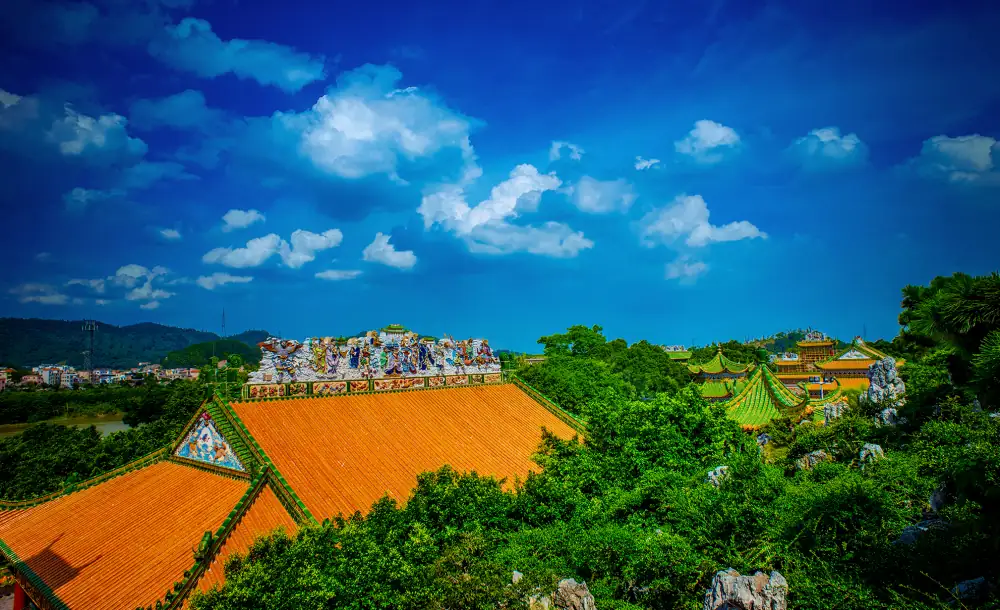
Chen Clan Ancestral Hall (陈家祠): Built 1888–1894 as a shared ancestral hall for the Chen clan from all 72 counties of Guangdong. One of the most extraordinary examples of Lingnan (South China) decorative architecture in existence: six horizontal and six vertical buildings connected by corridors, entirely covered in carved stone, wood, brick, and ceramic ridge decorations. The figurative ceramic sculptures on the roof ridges alone are extraordinary. Tickets ¥10. Metro Line 1 to Chenjiaci.
Guangxiao Temple (光孝寺): The oldest temple in Guangzhou — founded in the 4th century, though the current structures are from the Tang and Song dynasties. Less visited than it deserves. The sixth Zen patriarch Huineng received his initial religious instruction here.
Beijing Road Commercial Pedestrian Street: The 2,000-year-old commercial axis of the city, with a glass floor section revealing the layered city walls of successive dynasties from 2 to 5 metres below street level. The archaeology is visible from the glass viewing platforms embedded in the pavement.
Canton Tower (广州塔)
The 600-metre television tower visible from across the city — the world’s fourth-tallest tower when completed. The observation deck (¥150) offers the best aerial view of Guangzhou’s extraordinary urban spread. The bungee jump from the roof antenna ring is one of the world’s highest. Illuminated from sunset onward in programmed light displays.
Pearl River Cruise: The cruise from near Canton Tower westward past the old city at night is excellent — the combination of the historical waterfront, the modern towers, and the river reflections. Several operators; ¥50–80 for a 1-hour circuit.
Yuexiu Park (越秀公园)
The largest park in central Guangzhou — 860,000 square metres — containing the Museum of the Nanyue King (南越王博物馆), which houses the extraordinarily well-preserved 2,100-year-old tomb of Zhao Mo, second king of the Nanyue Kingdom. The burial goods — jade suits, bronze ritual vessels, the king’s royal seal — are among the finest Han Dynasty archaeological finds in China. Museum tickets ¥20. Metro Line 2 to Yuexiu Park.
Practical Tips
Cantonese vs Mandarin: Guangzhou speaks Cantonese (粤语) as its primary language. Mandarin is widely understood, but Cantonese is the language of street markets, dim sum restaurants, and older residents. Learning a few Cantonese phrases (唔該 m̀h’gōi = thank you/excuse me, 好食 hóu sihk = delicious) is appreciated.
Heat: May–September is hot and humid. Stay hydrated, carry an umbrella (afternoon thunderstorms are common), and plan outdoor activities for early morning.
Getting around: Guangzhou has an excellent metro system (13 lines). Taxi/DiDi very affordable. For the Pearl River waterfront, walking is possible along the riverside promenade.
Hong Kong connection: The 50-minute high-speed train connection to Hong Kong’s West Kowloon terminal means Guangzhou works extremely well as a combined trip. Many visitors do 2–3 days in each city.
If you come to Guangzhou and do nothing except eat extremely well for three days, that’s a successful trip. But the city has much more beneath the surface — the Chen Clan Hall alone is worth the detour from any other city in China.
Last updated: May 2026