
Table of contents
Open Table of contents
Day 1: Old Canton — Shamian Island, Liwan, and Xinhua Garden
Morning: Dim Sum at a Traditional Teahouse (7:00–9:30am)
Start with the ritual. Dim sum breakfast (叫早茶, “calling the morning tea”) in Guangzhou is genuinely different from dim sum anywhere else — the variety is larger, the quality is higher, and the social ritual is more embedded.
Best first-day choice: Taotao Ju (陶陶居, founded 1880) at 20 Dishifu Road, Liwan District. Queue or book in advance for weekends. Arrive at 7am — the restaurant opens then and fills within 30 minutes.
What to order: Har gow (虾饺, shrimp dumplings), siu mai (烧卖, pork and shrimp), cheung fun (肠粉, rice noodle rolls), turnip cake (萝卜糕), and most importantly — order a pot of tea immediately (选茶 is the first thing you do at a Cantonese dim sum restaurant).
Budget: ¥50–80 per person including tea. This is typical at traditional teahouses.
Late Morning: Shamian Island (10:00am–12:30pm)
Walk to Shamian Island (沙面岛) — a 5-minute metro ride or 15-minute walk from the Liwan dim sum area. Shamian was the foreign concession area from 1859, shared between French and British commercial interests. The island’s streets are lined with intact colonial architecture — solid stone buildings in French Second Empire style and British commercial Georgian, now housing boutique hotels, cafes, and government offices.
The tree-lined main avenue is one of the most pleasant walks in Guangzhou — broad shade trees, almost no traffic, and architecture that wouldn’t be out of place in Lyon or Edinburgh. Walk the full circuit (about 2km) slowly, look at architectural details, stop for coffee at one of the several cafe-bars that have colonized the old buildings.
Don’t miss: The Sacred Heart Cathedral (石室圣心大教堂) nearby — a late 19th century Gothic church entirely built from granite, designed by a French architect and largely intact. Free entry.
Lunch: Liwan District Street Food (12:30–2:00pm)
Return to the Liwan commercial streets for lunch. This area has some of Guangzhou’s best casual eating:
- Chenpi beef noodles (陈皮牛腩面): Braised beef with dried tangerine peel in noodle soup. ¥18–25.
- Fried rice with XO sauce: A Guangzhou specialty dish. ¥25–35.
- Preserved duck porridge: Cantonese congee (粥, zhōu) at a traditional shop. ¥15–20.
Afternoon: Xiguan Traditional Houses (2:30–5:30pm)
The Xiguan (西关) area of Liwan District has the best preserved examples of traditional Guangzhou domestic architecture — the “bamboo tube houses” (竹筒屋) of narrow-fronted, deep-plan shophouse design, and the “Western-Guangzhou” (西关大屋) merchant mansions with their distinctive black-brick construction and carved wooden interior screens.
The Yongqing Fang (永庆坊) district along Enning Road has been renovated into a walkable historic street with good food and craft shops integrated into the old buildings. Worth exploring for 1–2 hours.
Evening: Lychee Bay (荔湾湖) at Dusk
The lake at Lychee Bay in Liwan Park catches beautiful late-afternoon light. The traditional pavilions and the lychee trees that gave the bay its name create an image that feels genuinely old Guangzhou. Walk the lakeside path for an hour.
Dinner: Return to the Liwan commercial district for evening eating. Try a traditional Cantonese restaurant for roast meats — roast goose (烤鹅, ¥45–65/portion), BBQ pork (叉烧, ¥35–45/portion), and crispy pork belly (脆皮烧肉, ¥40–55/portion).
Day 2: Modern Guangzhou — Tianhe, Pearl River, and Canton Tower
Morning: Dim Sum at a Modern Teahouse (8:00–10:00am)
Contrast yesterday’s traditional experience with a more modern take. Many of Guangzhou’s newer teahouses in the Tianhe commercial district serve the same dim sum classics in sleeker settings.
Try: Lianxiang Lou (莲香楼) — a Guangzhou institution since 1889, also has modern branches. Order the same classics but try their specialty: the char siu bao (叉烧包) is considered one of the best in the city. ¥45–70/person.
Mid-Morning: Yuexiu Park and City Walls (10:30am–12:30pm)
Yuexiu Park (越秀公园) is Guangzhou’s central park and contains several important historical sites:
- Zhenhai Tower (镇海楼): The most iconic surviving Ming Dynasty structure in Guangzhou. A five-story tower overlooking the original city from a hill, now a municipal museum. Entry ¥10.
- City walls (古城墙): Sections of the original Ming city walls are preserved in the park.
- Statue of the Five Rams (五羊石像): The symbol of Guangzhou — five stone rams representing the mythological founding of the city. This is the most photographed monument in Guangzhou.
Lunch: Tianhe Food Scene (1:00–2:30pm)
The Tianhe CBD area has excellent lunch options. The area around Tianhe North Road (天河北路) and Zhujiang New Town (珠江新城) is the most international-feeling part of Guangzhou.
For a Cantonese splurge: The Tianhe branch of Da Dong (大东) or similar upscale Cantonese restaurants: ¥80–120/person.
For local lunch: Cantonese noodle shops in the side streets: ¥15–25.
Afternoon: Zhujiang New Town and Architecture Walk (3:00–5:30pm)
The Zhujiang New Town (珠江新城) district has some of China’s most ambitious recent architecture:
- Guangzhou Opera House (广州大剧院): Designed by Zaha Hadid, the double-pebble design is extraordinary. Tours available; performance tickets from ¥50.
- Guangdong Museum: The building itself, designed by Rocco Yim, resembles a Chinese lacquer box. Entry free; collection covers Guangdong history and culture.
- IFC towers: The twin towers of the Guangzhou International Finance Centre, the tallest buildings in the city.
Evening: Pearl River at Sunset and Canton Tower (6:00–10:00pm)
Walk to the Pearl River embankment as the sun sets. The northern bank promenade from the Convention Center toward Haixinsha Island gives views of the river and the city skyline.
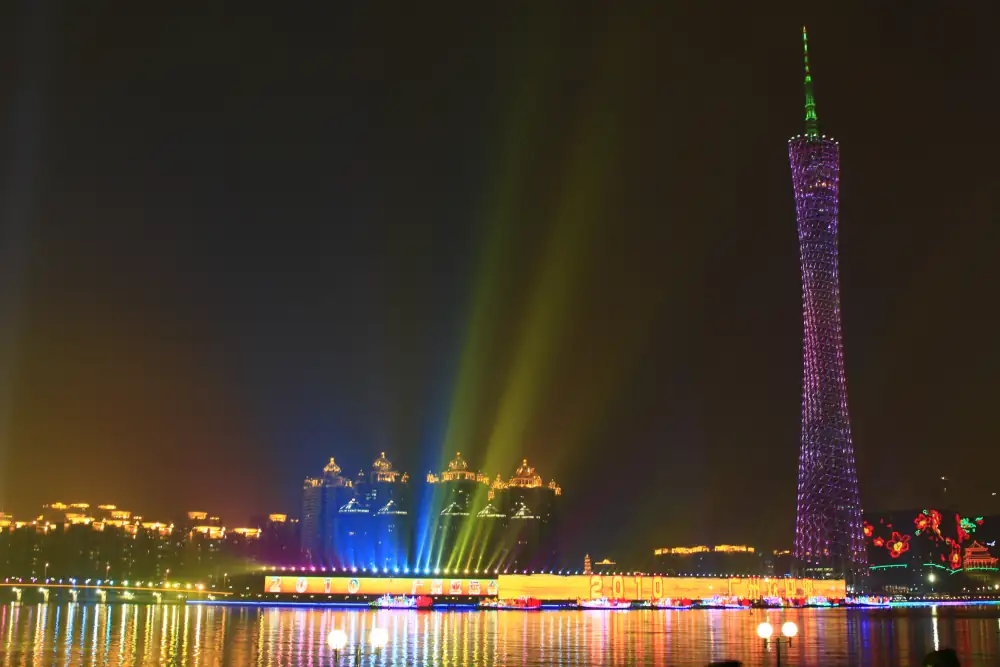
Canton Tower (广州塔, 600m): The distinctive twisted-waist tower at 600m is one of the tallest structures in China. The observation deck at 488m: ¥180. The revolving restaurant: reservation required. The outdoor sky viewing area: dramatic and vertiginous.
The view from the top at night, with the Pearl River curving away in both directions and the city lights extending to the horizon, is spectacular.
Dinner: The area around the Canton Tower has excellent evening food options — from the Haizhu District’s local Cantonese restaurants (¥40–80/person) to the upscale riverside restaurants.
Day 3: Cultural Depth — Chen Clan Ancestral Hall, Food Markets, and Temple Fair
Morning: Chen Clan Ancestral Hall (9:00–11:30am)
The Guangdong Folk Arts Museum housed in the Chen Clan Ancestral Hall (陈家祠, 1894) is one of the finest examples of late Qing decorative architecture in China. The six courtyards are surrounded by buildings whose every surface is covered in carved stone, carved wood, painted ceramic tiles, and iron casting. The visual density is extraordinary — no surface undecorated.
The craftsmanship represents the peak of Pearl River Delta artisanal tradition. Entry: ¥10. Allow 1.5 hours.
Near the Chen Clan Hall: The Zhongshan 8th Road area (中山八路) has traditional morning market activity and several good dim sum and noodle spots for a late breakfast or early lunch.
Late Morning: Haizhu Wetlands (11:30am–1:00pm)
The Haizhu National Wetland Park (海珠国家湿地公园) on an island in the Pearl River — an unexpected urban wilderness of ponds, reed beds, and fruit orchards in the middle of the city. Free entry. Walk or cycle the paths through 1,100 hectares of greenery. Best in the morning before heat builds.
Lunch: Wuyang Market Food (1:30–3:00pm)
The Wuyang Market (五羊市场) area in Tianhe has excellent local food stalls. Alternatively, the Liede Village (猎德村) area has traditional Cantonese village cooking — urban villages absorbed into the city but retaining traditional food culture.
Must try: Cantonese claypot rice (煲仔饭): rice and toppings cooked in individual clay pots with a slightly caramelized bottom crust. ¥25–40. Available from late afternoon.
Afternoon: Beijing Road Historic Area (3:30–6:00pm)
Beijing Road (北京路) pedestrian area sits on top of 2,000 years of Guangzhou commercial history. Excavations have exposed section of ancient road surfaces (Tang, Song, Ming, Qing strata), visible through glass panels in the modern pedestrian street — an extraordinary urban archaeology exhibit. Free to view.
The surrounding streets have colonial-era commercial buildings and some of the oldest shops in Guangzhou.
Evening: Farewell Dinner — Cantonese Seafood
End with Guangzhou’s best. Several excellent seafood restaurants in the Tianhe area and along the Pearl River serve the full range of Cantonese seafood cooking. The “pick your ingredients from tanks” model — pointing at live lobster, crab, fish, and abalone and then choosing the cooking method — is the quintessential Guangzhou experience.
Budget: ¥150–300/person for a good seafood dinner. Worth it.
Practical Information
Getting to Guangzhou:
- From Hong Kong: 50 minutes by high-speed train (Guangzhou South from West Kowloon, ¥235). Or 2 hours by regular bus.
- From Shenzhen: 15 minutes HSR or 1.5 hours bus
- From Shanghai: 8 hours by HSR or 3 hours by flight
- From Beijing: 8 hours by HSR
Getting around: Guangzhou’s metro system (11 lines) is excellent. Download the Guangzhou Metro app. Taxi: base fare ¥10.
Language: Cantonese (粤语) is the local language; Mandarin is universally understood. Some English in tourist areas and major hotels.
Best seasons: October–April, when temperatures are comfortable (15–25°C). May–September is hot and humid with monsoon rains.
Avoid: Chinese New Year week if you want restaurants to be open — most family-owned restaurants close for the holiday.
Guangzhou is a city you experience through your stomach. Three days of eating properly here — dim sum breakfasts, street noodles, roast meats, fresh seafood — will completely change your understanding of why Cantonese cuisine is considered one of the world’s great culinary traditions.