
The Bund: Reading Shanghai’s Architecture
The Bund (外滩, Wàitān) is one of the world’s great urban waterfronts — a 1.5-kilometer stretch of the Huangpu River lined with 52 historical buildings representing an extraordinary concentration of early 20th-century European architectural styles. The buildings were constructed between 1844 and 1939, during the period of Shanghai’s International Settlement when Western financial institutions and trading companies dominated the city’s economic life.
Today the buildings face the spectacular contrast of Pudong’s modern skyline across the river. The juxtaposition is intentional — it’s China’s architectural statement about its transformation from colonial economic subject to global financial power.
This guide focuses on reading the architecture, understanding the history, and experiencing the Bund as more than a photographic backdrop.
Understanding the Historical Context
The International Settlement was created by the Treaty of Nanking (1842) following the First Opium War. British, American, and French nationals were granted extraterritorial rights — living and operating under their own legal systems in designated zones of Shanghai. The financial institutions that moved to the Bund were operating in a jurisdiction that was legally equivalent to their home countries, which explains the confidence of the architectural ambitions.
The organizations that built these structures — HSBC, the Hong Kong and Shanghai Banking Corporation; Jardine Matheson; the Sassoon family; various insurance companies and trading firms — were some of the world’s most powerful financial entities in the early 20th century. They invested in architecture that communicated permanence, authority, and wealth.
Building-by-Building: Key Structures
No. 12: HSBC Building (汇丰银行大楼)
Built 1923, designed by the British firm Palmer & Turner. One of Shanghai’s most significant buildings architecturally and historically — when it was completed, it was reportedly “the finest building east of Suez” according to contemporary accounts.
The neoclassical exterior (Ionic columns, massive dome, two bronze lions at the entrance) communicates the banking confidence of the era. The interior features extraordinary mosaics in the central dome, depicting the eight major trading ports of the world at the time.
HSBC’s lions (nicknamed “Ching” and “Stephen”) were removed during World War II for melting down but saved at the last moment. They were returned to the building after Shanghai’s opening period and are now iconic Shanghai symbols.
Currently: Part of the Shanghai Pudong Development Bank.
No. 13: Customs House (海关大楼)
Built 1927. The clock tower (called “Big Ching” after London’s Big Ben) chimes every 15 minutes and has become one of Shanghai’s most recognizable sounds. The clock mechanism was installed by the British; it plays traditional Chinese music (东方红, “The East Is Red”) rather than Westminster Chimes, replacing the original chimes after 1949.
The building’s function has remained consistent for nearly 100 years — the Shanghai Customs House.
No. 20: Peace Hotel (和平饭店, formerly Sassoon House)
The most famous hotel on the Bund. Built 1929 by Victor Sassoon, one of Shanghai’s most influential property developers of Jewish-Iraqi origin. The distinctive green pyramid roof is the Bund’s most recognizable architectural detail.
The hotel’s jazz bar was the heart of Shanghai’s 1930s social scene. The Peace Hotel Jazz Band — all elderly musicians who began their careers before 1949 — continues to perform in the original bar space. Their set list includes Shanghai jazz standards from the 1930s and 40s. The performance begins at 8 PM; a minimum consumption applies.
Currently: Fairmont Peace Hotel. The lobby and bar spaces are accessible to non-guests; the architecture and the jazz band are both worth experiencing.
No. 1: Asia Building (亚洲楼, McBain Building)
Built 1913. One of the earliest remaining commercial buildings on the Bund, its Baroque decoration is characteristic of Edwardian commercial architecture.
No. 3: Shanghai Club (上海总会, now Three on the Bund)
Built 1910. The British men’s club had what was reportedly the longest bar in the world at the time of its construction. The building now houses a luxury retail and dining complex (Three on the Bund), with excellent restoration work. The lobby is accessible; entry to the restaurants and galleries is free.
No. 18: Former Chartered Bank Building (渣打银行大楼)
Built 1922. One of the more purely classical buildings on the Bund — Corinthian columns, classical cornices, the architectural grammar of serious financial authority. Now a luxury retail destination (Bund 18).
No. 23: Bank of China Building (中国银行大楼)
Built 1937. Unusually, this is the one building on the Bund that is explicitly Chinese-influenced — the architects incorporated traditional Chinese architectural elements (flying eaves, glazed tile roofing on the upper stories) into a largely Western commercial building. It was designed to represent Chinese national agency in an otherwise Western-dominated streetscape.
Currently: Bank of China branch.
Walking the Bund

The Promenade: The Bund’s riverfront promenade runs the full length of the historical buildings. It’s open 24 hours; the experience changes dramatically by time of day.
Dawn (5-7 AM): Elderly Shanghai residents practice tai chi and various exercise routines. The city begins waking. The light from the east (across the river) illuminates the building facades with a warm directness.
Daytime: Tourist crowds at their most intense. Good for close architectural inspection; not ideal for photography (flat midday light).
Golden hour (1 hour before sunset): The western-facing Pudong skyline is illuminated; the Bund buildings themselves are in shadow. Works well if you’re at the Pudong side looking back at the Bund.
Evening (7-10 PM): The Pudong skyline lights up; the Bund buildings are warmly lit. This is the “classic Bund shot” moment — the combination of illuminated historical Bund buildings and neon-lit Pudong skyline is what most Bund photographs try to capture.
The best photography angle: The elevated walkway behind the buildings (accessible from the Bund itself) provides a slightly elevated viewpoint. The platforms between buildings also provide good sight lines.
Beyond the Main Strip
Waitan 5 (外滩五号): The buildings continue south of the main tourist stretch, along Zhongshan East 2nd Road (中山东二路). These buildings are less famous but equally interesting architecturally; the commercial traffic is less, allowing closer inspection.
The Historic Chinese areas behind the Bund: Old Shanghai Street (老街) and the Yuyuan area immediately behind the Bund represent the Chinese city that predates the International Settlement. The contrast between the Western financial architecture of the Bund and the traditional Chinese architecture of Yu Garden (a few blocks away) captures the spatial division of colonial Shanghai.
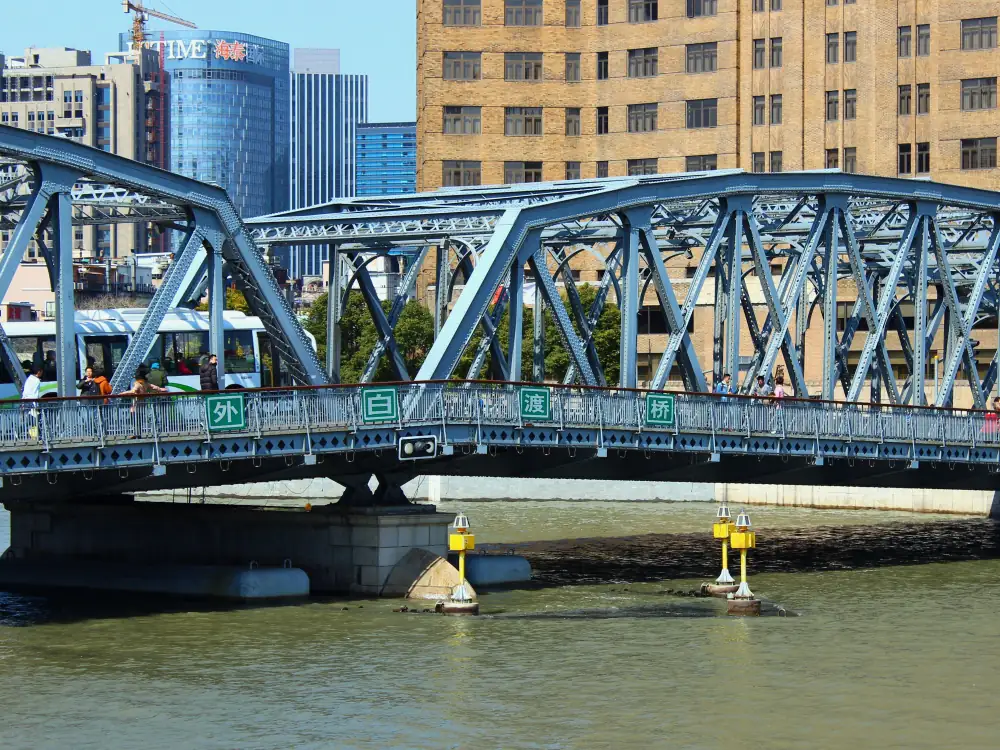
North Bund (北外滩): The area north of Suzhou Creek and the Waibaidu Bridge (外白渡桥 — Garden Bridge) was the American Settlement. Some historical buildings survive; the area is less visited and has a different atmosphere from the main Bund.
When to Visit
Best seasons: Autumn (September-November) and spring (March-May) provide the best combination of comfortable weather and good photography conditions.
Avoid: The period around Chinese New Year (January-February) when the promenade is exceptionally crowded; hot summer days when the outdoor promenade is uncomfortably hot.
Time of day recommendation: Visit in late afternoon, spending the golden hour on the promenade, then staying for the evening illumination. This covers both the architectural detail (afternoon) and the iconic nighttime view (evening).
Practical Information
Access: The Bund is free and open 24 hours. Metro Line 2 and 10, East Nanjing Road Station.
Across the river: The Pudong waterfront is accessible via pedestrian tunnel (free) under the river, or by the tourist ferry (¥2). The views from Pudong looking back at the Bund are excellent — particularly at night.
Guided architectural tours: Several operators offer detailed Bund architectural tours with historians who explain the building histories and Shanghai’s colonial period in depth. Worth considering for architecture enthusiasts.
The Bund is Shanghai’s most visited tourist area — and for good reason. But most visitors rush through it without engaging with what the buildings actually say about Shanghai’s history, China’s transformation, and the extraordinary compressed period of the International Settlement. Approach it slowly, with this architectural context, and the promenade becomes a reading of one of history’s most complex and consequential urban experiments.