
Shaolin Temple (少林寺, Shàolín Sì), founded in 495 AD at the foot of Mount Song (嵩山) in Henan Province, is the most famous Buddhist monastery in China and arguably the most globally recognized symbol of Chinese martial arts. The story of its founding — by the Indian monk Bodhidharma (达摩, Dámó) who meditated facing a wall for nine years and then developed exercises that became the foundation of Chan (Zen) Buddhism and martial arts — is legend rather than documented history. But the Shaolin martial arts tradition that grew from this foundation is entirely real, and the temple remains an active monastic and martial arts center.
The Temple Complex
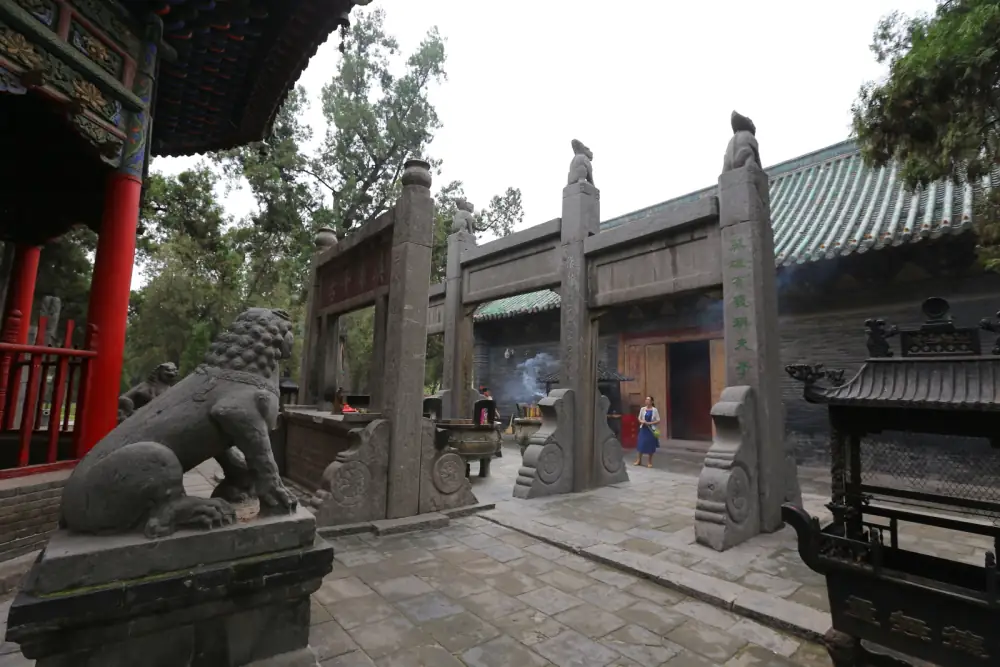
Shanmen (山门, Mountain Gate): The main entrance gate, built in 1735. The calligraphed plaque above reads “少林寺” in the calligraphy of Emperor Kangxi.
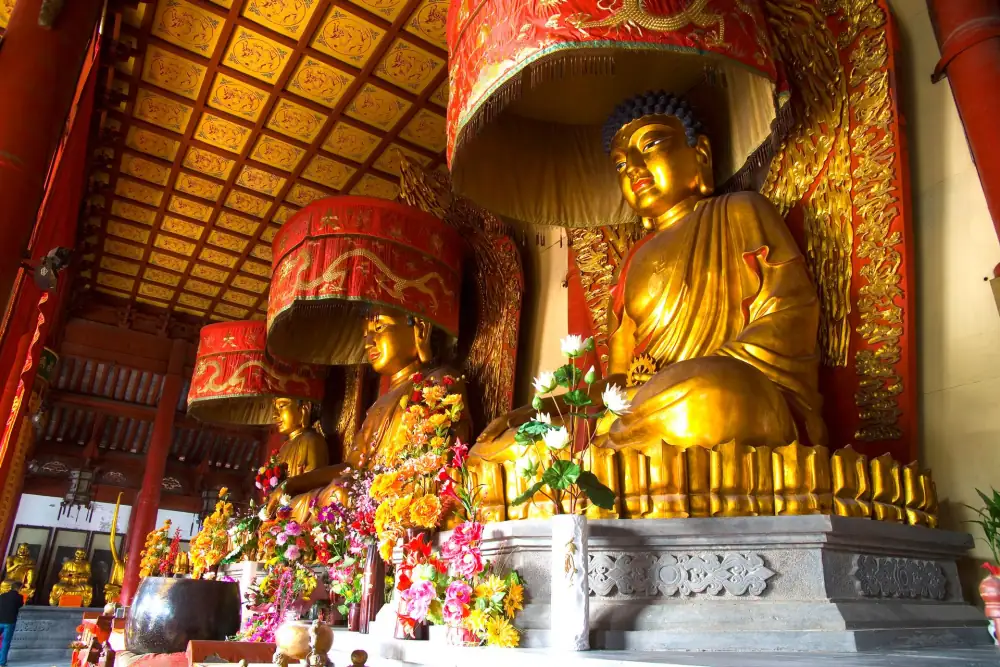
Tianwang Hall (天王殿): The first main hall, containing statues of the Four Heavenly Kings and a smiling Maitreya Buddha.
Main Buddha Hall (大雄宝殿): The central devotional hall. Note the hollows in the stone floor — worn down over centuries by monks practicing their martial arts stances in the same spots repeatedly. These floor depressions are one of the most evocative physical traces of the temple’s history.
Sutra Library (藏经阁): Where the Buddhist textual collection was held. The original library was burned in 1928 during a military attack; the current building is a reconstruction.
Stele Gallery: Hundreds of inscribed stone steles recording temple history, imperial donations and famous visitors. The variety of calligraphy styles on display is a scholarly treasure.
Thousand Buddha Hall (千佛殿): At the rear of the temple. The famous painted wall murals (partially surviving) show 500 Shaolin monks in various martial arts poses — a historical document as much as religious art. The floor here has even more pronounced hollows than the Main Hall.
The Pagoda Forest (塔林)
Just outside the main temple complex is the Pagoda Forest — a field of 248 stone stupas built between the 9th and 19th centuries. Each stupa marks the burial site of a past abbot or monk of great achievement. The size and ornamentation of each pagoda reflects the importance of the person it commemorates. It’s one of the largest pagoda forests in China and profoundly atmospheric — the sound of the wind through the pagodas, surrounded by mountains, with monks occasionally visible moving between buildings.
Kung Fu Performances
The temple runs public demonstrations of kung fu forms twice daily at a performance hall inside the complex. Performance times vary by season; check the current schedule posted at the ticket office.
The performances feature:
- Traditional Shaolin forms (套路, tàolù) — solo and group forms
- Breaking techniques — bricks, concrete slabs, iron spears bent against the practitioner’s throat
- Iron-body demonstrations
- Balance and acrobatics sequences
Quality varies by the group performing. The daily performances are done by trained monks and students; they are impressive without being theatrical in the tourist show sense.
Martial Arts Schools
Outside the temple, the valley is lined with dozens of martial arts schools that teach Shaolin kung fu to thousands of students, mostly Chinese children aged 6–18. This has created an unusual landscape — walking toward the temple, you pass school after school with students drilling forms in courtyards.
As a tourist: You can observe open practice sessions from the road. Most schools don’t offer drop-in classes for tourists.
Long-term training: A handful of schools offer foreigner-oriented training programs (1 week to 6 months). Research in advance if martial arts training is your primary reason for visiting. Conditions and quality vary enormously; reputable schools include Tagou Martial Arts School (塔沟武校) and Shaolin Tagou Wushu School.
Mount Song Hiking
Mount Song itself is one of the Five Sacred Mountains of Daoism (alongside Tai, Hua, Heng and Heng). The mountain rises to 1,512m and has good hiking paths.
Zhongyue Temple (中岳庙): A massive Daoist temple complex at the foot of the mountain, separate from the Buddhist Shaolin Temple. One of the largest Daoist temple complexes in China. Free entry to temple grounds.
Mount Song Cable Car: From Shaolin Temple area, a cable car rises toward the mountain summit area. Walk or take cable car depending on time and fitness.
Pagoda Forest + Hiking: Combine the Pagoda Forest walk with the adjacent mountain trail for a 3–4 hour half-day in the natural environment.
Sanhuang Stronghold (三皇寨): A scenic loop trail on the mountain’s ridge with hanging boardwalks along cliff faces and views of the surrounding mountains. This is the most spectacular hiking in the area; 3–4 hours for the full circuit.
Practical Information
Address: Dengfeng City, Zhengzhou, Henan Province (河南省郑州市登封市)
Opening hours: 08:00–18:00 (summer); 08:00–17:30 (winter)
Entry fee: ¥100 (covers temple, Pagoda Forest, martial arts performance hall); cable car extra
Getting there:
- From Zhengzhou: Regular bus from Zhengzhou Long-distance Bus Terminal to Dengfeng (1.5 hours, ¥35); then local bus or Didi to Shaolin Temple (15 minutes, ¥10–20)
- From Luoyang: Bus from Luoyang New Bus Station to Dengfeng (1.5 hours, ¥25); same connection from Dengfeng to temple
- Organized tours: Day tours from both Zhengzhou and Luoyang are common and efficient for single-day visitors
Time needed: Half day for the temple complex + pagoda forest. Full day if you add Mount Song hiking.
Crowds: Weekdays are much less crowded. Summer and Golden Week are very busy. Early morning (08:00–10:00) has the best atmosphere — monks doing morning practice, fewer tour groups.
The Shaolin Temple experience ranges from the genuinely moving (the hollows in the floor worn by centuries of practice; the pagoda forest at dusk; a silent dawn in the monastery) to the commercial and touristy (souvenir shops, costumed photo ops). The trick is to engage with the former and navigate past the latter — which is entirely possible with early arrival and patient exploration of the quieter corners.