
Fourteen kilometers east of central Luoyang stands the White Horse Temple (白马寺, Báimǎ Sì), traditionally recognized as the first official Buddhist temple established in China. The temple’s founding legend tells of Emperor Ming of Han (ruled 57–75 AD) who dreamed of a golden figure floating westward. His envoys traveled to Central Asia, encountered Buddhism, and returned to Luoyang in 68 AD with Buddhist scriptures loaded on the backs of two white horses — giving the temple its name. The Buddhism they brought would become the defining philosophical force of Chinese civilization.
Historical Significance
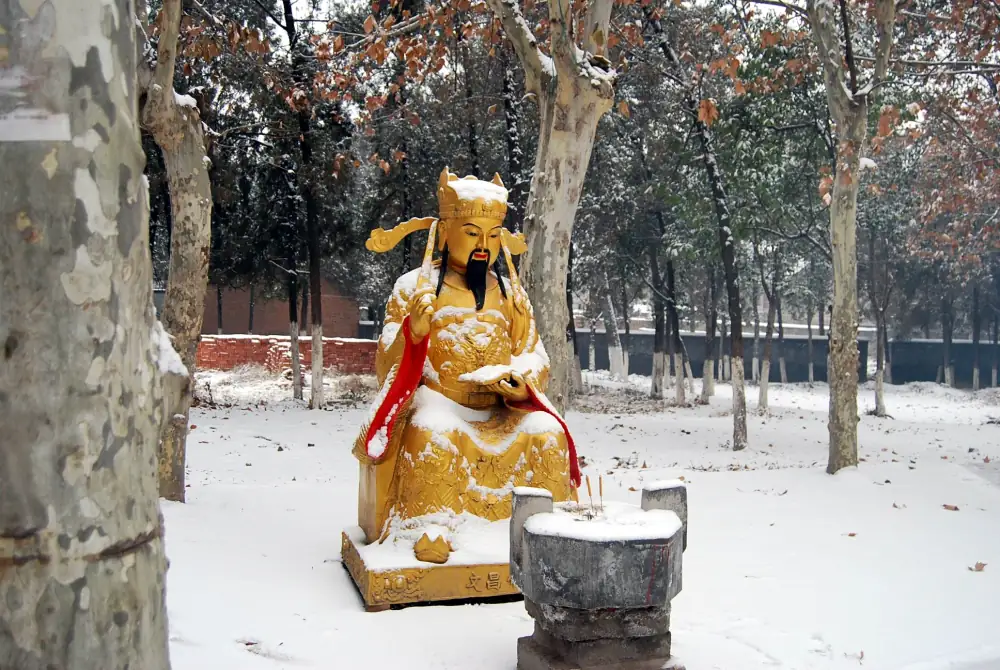
At the time of its founding, Luoyang was the capital of the Eastern Han Dynasty and one of the most powerful cities in the ancient world. The White Horse Temple was established as an imperial project, directly under the patronage of the Han court, and represented the formal reception of Indian Buddhism into Chinese culture.
Over the following centuries, the temple served as a translation center where Indian, Parthian, Sogdian and Central Asian monks worked alongside Chinese scholars to translate Sanskrit sutras into Chinese — a monumental intellectual project that required not just linguistic skill but the creation of entirely new vocabulary. The Chinese Buddhist canon of translated texts, much of which can be traced to work done at Baima Si and nearby centers, shaped the spiritual and literary heritage of China, Korea, Japan and Vietnam.
The current structures date primarily from the Ming and Qing dynasties, with some elements from earlier restorations. The temple covers approximately 40,000 square meters and is organized along a traditional central axis.
The Temple Compound
Shanmen Gate (山门): The entrance gate bears two stone horses — replicas of the originals that stood here for centuries. The horses symbolize the white horses that carried the first scriptures.
Tianwang Hall (天王殿): First main hall containing the Four Heavenly Kings and Maitreya (the “laughing Buddha”). Standard structure found in most Chinese Buddhist temples but particularly fine examples of Ming dynasty craftsmanship.
Main Hall (大雄宝殿): The principal hall containing statues of Shakyamuni Buddha flanked by Manjushri and Samantabhadra. The 18 luohan (arhats) statues here are considered among the finest surviving examples of Buddhist sculpture from the Yuan dynasty (13th–14th century) — brought from a Japanese collection.
Bi Gong (碧公塔): The tomb and tower of the two Indian monks who traveled to China with the first scriptures — Kashyapa Matanga and Dharmaraksha. A small stupa-like tower in the northwest corner of the complex. Entering requires removing shoes; monks perform daily chanting rituals here.
齐云塔 (Qiyun Pagoda): A 12-tiered brick pagoda behind the main compound, dating to the Jin Dynasty (12th century). One of the oldest intact wooden-format brick pagodas in Henan. Climb to the second level (accessible) for views of the surrounding farmland.
The International Temple Gardens
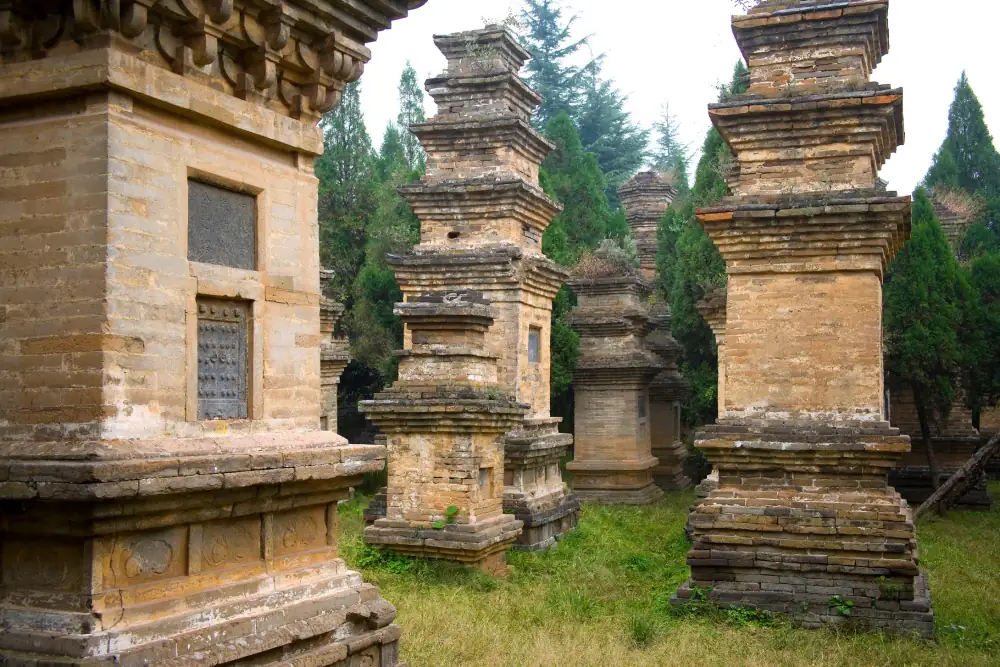
One of Baima Si’s most distinctive features is its collection of Buddhist temples built in the architectural styles of different Asian countries:
Indian Temple (印度风格佛殿): Built with Indian funding and expertise, with characteristic mandapa columns, curved roof forms and lotus symbolism. The Sakyamuni statue inside was donated from India.
Burmese Temple (缅甸风格佛殿): White stupa with Burmese tiered spire, characteristic of Theravada Buddhist architecture.
Thai Temple (泰国风格佛殿): Golden and red exterior with characteristic Thai decorative patterns; contains a Thai-donated Buddha.
These three “international” pavilions plus the traditional Chinese compound create an unusual world-religions campus that illustrates how Buddhism adapted across different cultures from its single source.
The Peony Connection
Luoyang is China’s “Peony Capital” (牡丹之都) — the city has cultivated tree peonies since the Tang Dynasty when they were the most prized flowers in China. White Horse Temple’s extensive garden grounds contain hundreds of peony plants. During the Luoyang Peony Festival (洛阳牡丹文化节), held annually in April (usually April 10–May 10), the grounds come alive with blooming flowers.
The combination of visiting the ancient temple during peony season — when the spring light is soft, the weather pleasant and the temple grounds carpeted in color — is one of the most special combinations in Henan tourism.
Visiting Longmen Grottoes the Same Day
Longmen Grottoes (龙门石窟), a UNESCO World Heritage Site with over 100,000 Buddhist carvings and 2,300 cave shrines, is 15 km south of central Luoyang. Most visitors combine a morning visit to the White Horse Temple with an afternoon at Longmen — both accessible from Luoyang’s city center, with ample time for both in a single day.
Logistically: Visit White Horse Temple first (morning, allow 2–3 hours), return to the city for lunch, then take a Didi to Longmen Grottoes for the afternoon (2–3 hours).
Practical Information
Address: Baima Si Village, Luolong District, Luoyang (洛阳市洛龙区白马寺镇白马寺)
Opening hours: 08:00–17:30 (summer); 08:00–17:00 (winter)
Entrance fee: ¥50 (temple compound), additional fee for international temple garden areas during peak season
Getting there:
- Bus 56 from Luoyang train station to White Horse Temple (40 minutes, ¥2)
- Didi from central Luoyang: 25 minutes, ¥30–45
From Beijing: High-speed train Beijing West–Luoyang Longmen: 2.5–3 hours, ¥200–300. Excellent day trip or weekend from Beijing.
From Xi’an: High-speed train Xi’an North–Luoyang Longmen: 1.5 hours, ¥90–160.
Dress code: Modest clothing is appropriate; shorts and sleeveless tops are technically allowed but feel incongruous in the active monastic environment.
Monks in residence: White Horse Temple is an active monastery; monks perform daily rituals. If chanting is occurring when you arrive, wait respectfully rather than walking through mid-ceremony.
Standing in the ancient courtyard of Baima Si, surrounded by architecture that has been modified, destroyed, rebuilt and re-modified across 2,000 years, you’re standing at the point where one of the world’s great intellectual traditions entered Chinese civilization and changed it permanently. That’s a rare quality — even among China’s extraordinary historical sites.