
Nanjing Fuzi Temple & Qinhuai River: A Complete Guide
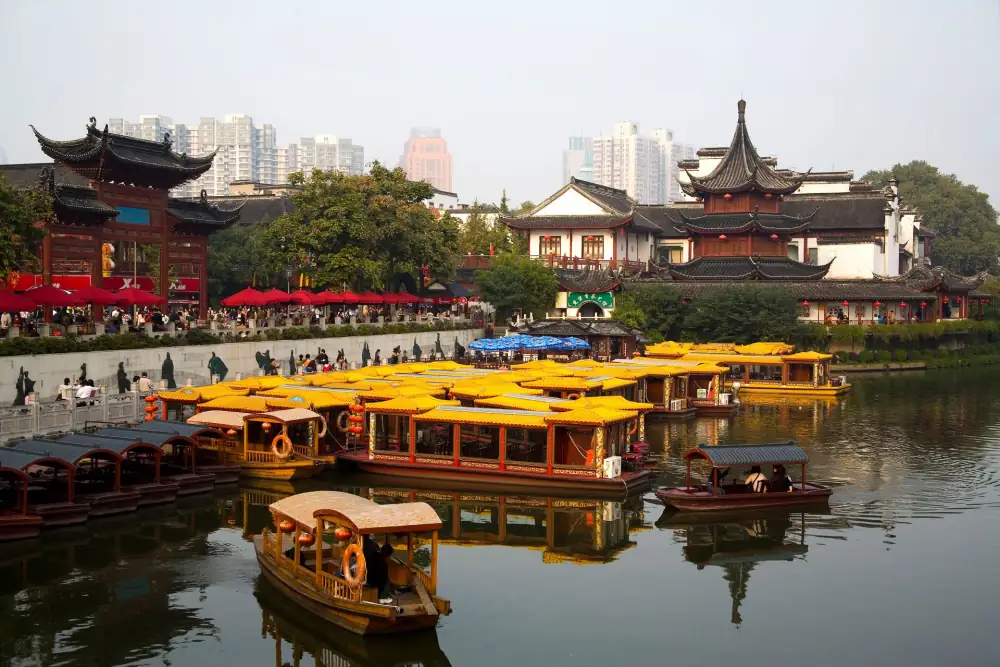
Few places in China stir the senses like the Confucius Temple (Fuzi Temple) quarter on the banks of the Qinhuai River. For more than a millennium this stretch of southern Nanjing has been simultaneously a seat of Confucian scholarship, an imperial pleasure garden, and the most atmospheric street-food corridor in the Yangtze Delta. Today the district draws millions of visitors who come to admire the lantern-lit reflection on the water, sample legendary snacks, and feel the weight of six dynasties pressing down on every cobblestone.
Understanding the Fuzi Temple Complex
The Temple Itself
The original temple was built in 1034 CE during the Northern Song dynasty to honour Confucius and to serve the Imperial Examination complex — the Jiangnan Gongyuan — that occupied land immediately to the east. At its height the examination halls could seat 20,000 candidates simultaneously, making this the largest examination compound in China.
What you see today is largely a Qing-era reconstruction; fire and war have repeatedly destroyed older structures. Enter through the graceful Lingxing Gate, cross the Dacheng Bridge over the Panchi reflection pool, and pass through the Dacheng Hall — its courtyard filled with the smell of incense and the sound of guqin music. A small museum inside traces the history of the keju (imperial examination) system and the careers it produced.
Admission: ¥30; combination tickets with the Jiangnan Gongyuan examination hall museum add ¥10. Hours: 8:00–21:00 (last entry 20:30).
Jiangnan Gongyuan Examination Hall
Adjacent to the temple, this painstakingly restored complex contains hundreds of tiny individual examination cells (less than 1.2 m × 0.9 m) where candidates sat for three-day continuous exams. The cells are claustrophobic even to look at; the experience contextualises the extraordinary pressure of the imperial civil-service system and the millions of men who dreamed of transformation through the brush.
The Qinhuai River District
Architecture and Atmosphere
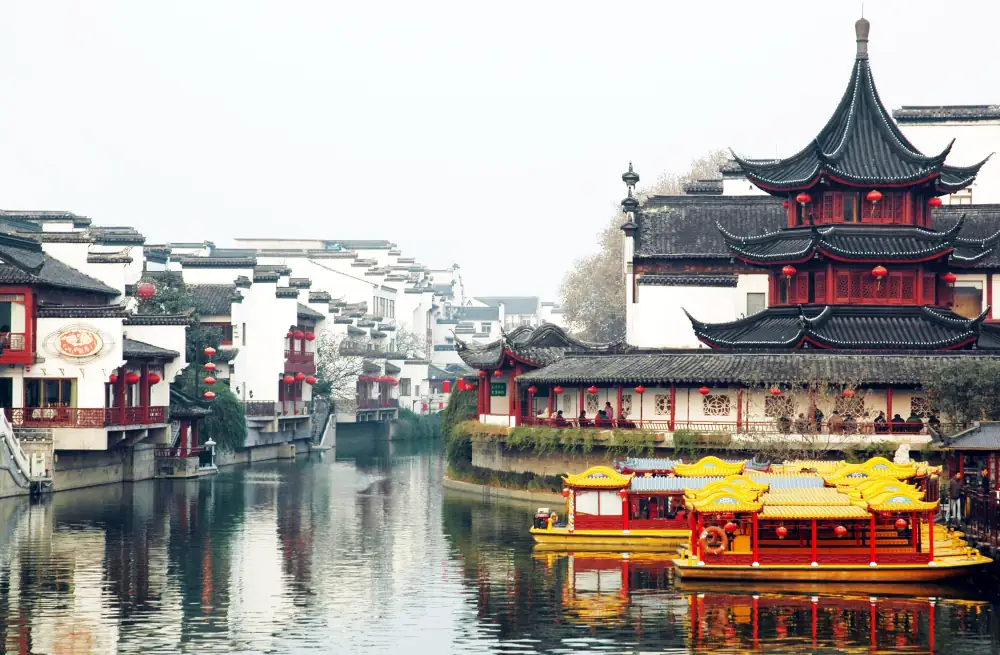
The riverbank on both sides of the Fuzi Temple — roughly 2 km of Ming-dynasty style whitewashed walls, upturned eaves, lacquered wooden balconies, and vermillion lanterns — forms one of China’s most photogenic townscapes. In fact much of what you see was rebuilt or restored between 1984 and 2009, but the reconstruction is meticulous and the atmosphere entirely convincing, especially after dark.
The northern bank (the main pedestrian strip) holds restaurants and shops; the southern Zhonghua Road embankment is quieter and offers better views of the lit-up northern façades.
Night Cruise on the Qinhuai River
An evening boat ride is the signature Fuzi Temple experience. Lantern-decorated wooden boats (fang) depart from the dock below the main gate and cruise a roughly 2 km loop past silk-lantern shopfronts, ornamental bridges, and the illuminated silhouette of the Zhenhuai Tower.
- Duration: 30–40 minutes.
- Price: ¥70–¥100 per person (shared boat); private charters from ¥500.
- Best time: After 19:00 when all lanterns are lit; Friday and Saturday evenings are busiest.
Fuzi Temple Street Food: The “Qinhuai Eight Delicacies”
No visit is complete without working through the legendary Qinhuai Bā Jué (秦淮八绝) — eight snack dishes that have been prepared in this district for centuries. Most can be found clustered along the main pedestrian street and inside the Yonghe Residential Quarter food hall.
| Snack | What It Is |
|---|---|
| Beef soup dumpling (牛肉汤包) | Thin-skinned xiaolongbao filled with a sloshing beef and ginger soup |
| Duck blood and vermicelli soup (鸭血粉丝汤) | Silky rice noodles in deeply flavoured broth with duck blood, intestine and tofu puffs |
| Five-spice tea egg (五香茶叶蛋) | Long-marinated egg with earthy, herbal undertones |
| Osmanthus lotus-root stuffed rice cake (桂花糕) | Fragrant white cakes filled with sweetened glutinous rice and fresh osmanthus flowers |
| Plum-flower cake (梅花糕) | Iron-mould mini cakes with sweet red-bean filling, caramelised top |
| Pan-fried dumplings (锅贴) | Golden-bottomed crescent dumplings, crisp below, steamy above |
| Salted duck bao (盐水鸭包) | Soft steamed bun filled with Nanjing’s famous brined duck |
| Sweet rice congee (甜粥) | Light, fragrant rice porridge sweetened with candied osmanthus |
Where to Eat
Yonghe (永和) and Qinhuai Renjia (秦淮人家) are the two heritage brands. Queues form early in the morning and again around dinnertime; arrive at 10:30 for a relatively relaxed experience.
For duck specifically, the cluster of braised-duck shops on Gongyuan West Street offers whole ducks and duck-neck for under ¥60 per bird.
Beyond the Fuzi Temple: Nearby Sights
Zhonghua Gate (中华门)
A 10-minute walk south, Zhonghua Gate is the most complex surviving Ming-dynasty city gate in the world. Its three separate gate towers, 27 hidden soldier caves, and multiple drawbridge channels were designed to trap and destroy any army that breached the first gate. The view from the top looks out over the entire southern Nanjing basin. Admission: ¥50.
Nanjing City Wall Walk
The city wall — 35.3 km, the longest surviving ancient city wall on earth — can be accessed at intervals near the Fuzi Temple. A paved path runs along the top; the southern section passes through vegetable gardens and old residential lanes largely untouched by tourism.
Nanjing Museum (南京博物院)
A 20-minute metro ride north (Line 2, Mingguling stop), this is one of China’s top-five museums. Its highlight is the Ming Tombs gallery and a superb collection of Yixing teapots. Free admission; bring your passport.
Practical Information
Getting There
- Metro: Line 1 or Line 3 to Fuzi Temple Station (夫子庙站). Exit 1 leads directly to the pedestrian zone.
- Taxi/Didi: About ¥20 from the Nanjing South High-Speed Rail Station.
When to Go
- Lantern Festival (元宵节): The Fuzi Temple Lantern Fair — usually in late January or February — is China’s most famous lantern festival. The whole district transforms into a forest of hand-painted silk lanterns; go early or on weekdays to avoid crushing crowds.
- Spring and Autumn: Mild weather and comfortable for walking; osmanthus blooms fragrant in September–October.
- Avoid: National Day Golden Week (October 1–7) when visitor numbers become unmanageable.
Accommodation
The district has a concentration of boutique guesthouses in restored Qing courtyard buildings priced ¥300–¥800/night. The youth hostel near Zhonghua Gate offers dorm beds from ¥80.
The Qinhuai River in Literature
The Qinhuai district has seduced poets and writers for a thousand years. Tang poet Du Mu wrote his famous couplet here: “The misty waters, the cold sand, the moonlit city” (烟笼寒水月笼沙) — a lament for the fallen Sui dynasty and, implicitly, a warning to the Tang. Nanjing’s own Kong Shangren set his masterpiece Peach Blossom Fan (桃花扇) in the courtesan houses of the Qinhuai district, dramatising the fall of the Ming.
Walking the embankment after dark, lanterns doubling in the dark water, it is easy to understand why generations of Chinese writers heard, in this place, both beauty and the echo of impermanence.
Best combined with: Nanjing Massacre Memorial Hall (sobering but essential), Zhongshan Mausoleum on Purple Mountain, and a day trip to Suzhou’s classical gardens.