
The Five Great Avenues — 230 European-style villas from 12 nations, the most concentrated colonial architecture in China
Tianjin sits 120 km southeast of Beijing, connected by a 30-minute high-speed rail link. It’s the most dramatically underrated day-trip destination from the capital — a city of 15 million people with an extraordinary architectural heritage from the treaty port era and a food culture centred on one of China’s most famous street foods.
Table of contents
Open Table of contents
The Five Great Avenues (五大道)
The most concentrated example of European colonial architecture in China — five parallel streets in the former British concession, lined with 230 European-style villas representing English Tudor, French neoclassical, Italian baroque, German Wilhelmine, and Spanish colonial styles.
The streets were built from the 1900s to 1930s as residences for foreign consular officials, business families, and wealthy Chinese who adopted European living standards. Today they’re preserved as a heritage district — a remarkably intact streetscape of century-old European architecture in the heart of northern China.
Walking route: Start at Chengdu Road (成都道) and walk the full Five Avenues circuit — Munan Road (睦南道), Changde Road (常德道), Dali Road (大理道), Chongqing Road (重庆道). Allow 2 hours. Several buildings have been converted into boutique hotels and cafés.
Mingyuan Football Stadium (民园广场): The 1930s sports ground at the circuit’s centre, converted into a public square with the original grandstands preserved — atmospheric and photogenic.
Autumn in the Five Great Avenues — the European residential streetscapes are especially beautiful in October
The Italian Concession (意大利风情区)
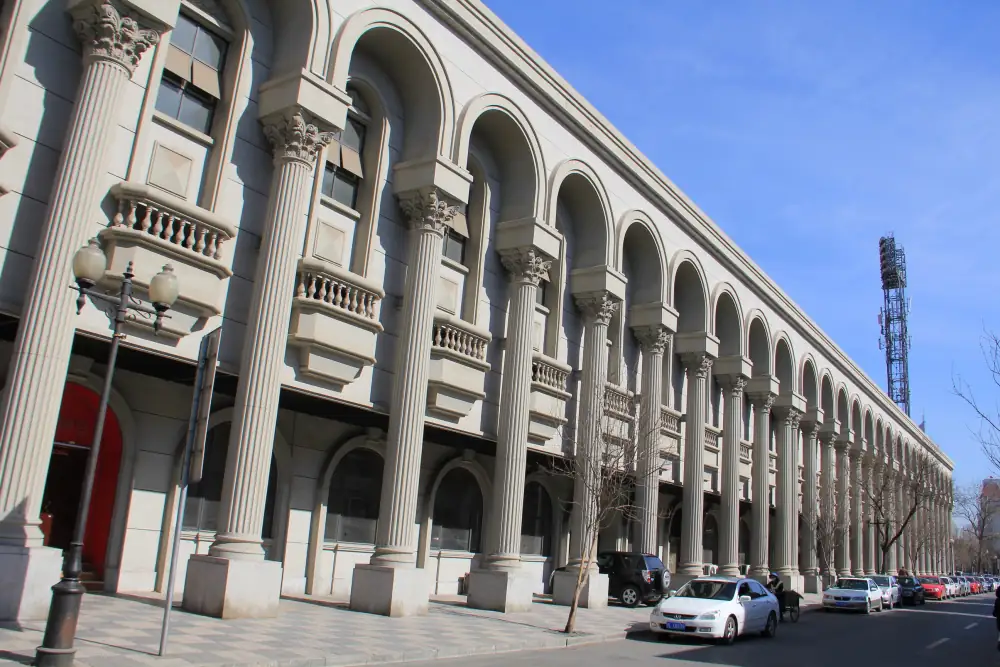
A concentrated Italian-style neighbourhood — the only surviving Italian concession in China. Piazzas, arcaded streets, Renaissance-style civic buildings. Genuinely coherent architecturally, particularly the area around Marco Polo Square (马可波罗广场).
Several Italian restaurants and cafés have positioned themselves here appropriately. The Cao Kun Former Residence (曹锟故居) is an extraordinary Italian-style mansion with period furnishings open to visitors.
Goubuli Steamed Dumplings (狗不理包子)
Tianjin’s most famous food — steamed pork dumplings that have been the subject of a brand story since 1858. The original legend: a boy named Gou Li (literally “nobody cares about the dog”) sold such good dumplings that customers crowded his stall and he couldn’t stop to talk to anyone — hence “the dog doesn’t care.”
Quality caveat: The Goubuli brand has expanded globally and the flagship Shandong Road location is expensive and tourist-oriented. The dumplings themselves are excellent — pork filling with a specific proportion of gelatinised broth that creates a soup-dumpling effect, 18 precise folds per dumpling. Worth eating once.
Better alternative: Numerous other steamed dumpling shops throughout Tianjin do equally good versions at half the price.
Jianbing Guozi (煎饼果子): Tianjin’s other famous street food — a folded savory crêpe with egg, crispy fried dough, bean paste, and chilli sauce. The Tianjin version is considered superior to Beijing’s jianbing. Available from street carts everywhere in the morning.
Goubuli steamed dumplings — Tianjin’s most famous food, each dumpling with exactly 18 folds since 1858
Haihe River (海河) Waterfront
The Haihe River runs through the heart of Tianjin — widened and landscaped into a 15 km urban waterfront with bridges of different architectural styles and the illuminated European-style buildings reflected in the water.
Evening boat tour: Several operators offer 1-hour evening cruises from the Liberation Bridge area. The combination of Baroque, Gothic, and Renaissance riverfront buildings illuminated at night, with the modern Tianjin Eye ferris wheel providing contemporary contrast, is spectacular.
Tianjin Eye (天津之眼): A 110-metre ferris wheel built over the Yongle Bridge — one of the world’s only ferris wheels mounted on a bridge. ¥100 per person; 30-minute circuit.
The Haihe River waterfront at night — Baroque and Renaissance facades illuminated along the river, with the ferris wheel on Yongle Bridge
Practical Tips
From Beijing: G-series high-speed trains every 15 minutes; journey 30–35 minutes; ¥55. Last train returns around 10 PM.
Getting around Tianjin: Metro system covers main attractions. The Five Avenues district is walkable from the concession area.
Best timing: Tianjin works well as a day trip (morning train, full day, evening return) or overnight. The evening Haihe riverfront is the strongest argument for staying overnight.
Last updated: May 2026