
Tashilhunpo Monastery — the largest functioning monastery in Tibet, home of the Panchen Lama since 1447, with golden rooftops rising above the city of Shigatse at 3,836 metres
Shigatse (日喀则, Xigazê) is Tibet’s second city — the seat of the Panchen Lama, the second-highest figure in Tibetan Buddhism after the Dalai Lama. At 3,836 metres, it’s the base for western Tibet exploration and the gateway to Mount Everest from the Tibetan side.
Table of contents
Open Table of contents
Tashilhunpo Monastery (扎什伦布寺)
The seat of the Panchen Lama — founded in 1447 by Gendun Drup, the first Dalai Lama, and continuously expanded into the largest functioning monastery in Tibet.
The scale: A self-contained monastic city covering 150,000 square metres — multiple assembly halls, chapels, monk residences (for 4,700 monks at peak, now approximately 800), and the extraordinary Maitreya Chapel.
The Maitreya Chapel (强巴佛殿): Houses a 26.7-metre seated Maitreya (Future Buddha) statue — the largest gilded bronze Buddha statue in the world, covered in 600 pounds of gold and 300,000 precious stones. The chapel is built around the statue, rising five stories; the devotional atmosphere inside, with butter lamp smoke and the scale of the figure, is overwhelming.
The Panchen Lama’s Throne Room: The main assembly hall contains the Panchen Lama’s throne, maintained exactly as it was in use. The Tibetan tradition of leaving the throne in readiness for a returning teacher is visible here in concentrated form.
Ticket: ¥80. Open 9:00 AM – 12:00 PM, 3:00 PM – 5:00 PM (closed midday).
Morning circumambulation: Walk the kora (circumambulation path) around the monastery wall at dawn (6:30–8:00 AM), alongside Tibetan pilgrims making their morning devotional circuits. The combination of mani wheel sound, morning light on the gold roofs, and the movement of the pilgrims is among the most atmospheric experiences available in Tibet.
Pelkor Chode Monastery (白居寺)
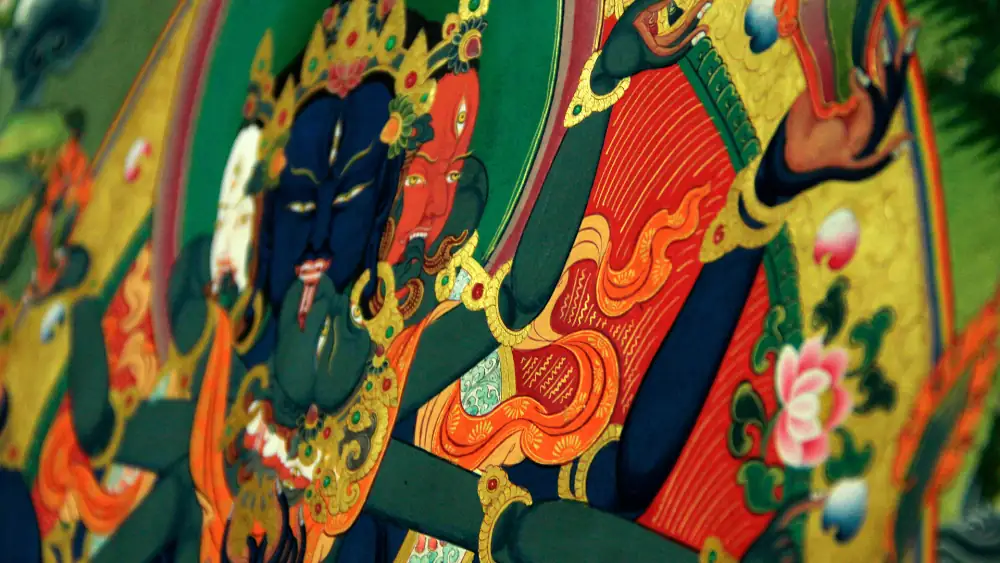
In Gyantse (江孜), 90 km southwest of Shigatse — a monastery complex notable for the Gyantse Kumbum (江孜白居塔), a 35-metre ten-story stupa with 77 chapels arranged in a complex mandala design. Built in 1427, it contains 100,000 images (the kumbum means “100,000 images”) — every surface of every chapel is covered in 15th-century Tibetan Buddhist murals.
The murals here are better preserved than almost anywhere else in Tibet because the monastery was never destroyed during the Cultural Revolution (due to its political significance to the town). The 15th-century painting quality is extraordinary — intricate, colourful, spiritually intense.
Everest north face from Tibet — the 8,848-metre summit pyramid above Rongbuk Monastery (5,094m), the world’s highest monastery, with prayer flags framing the view
Everest Base Camp (珠峰大本营) via Rongbuk
The Tibetan side of Everest offers a fundamentally different experience from the Nepal side. The approach road (to 5,200 metres) is accessible by vehicle — no trekking required, though the altitude demands genuine acclimatisation time.
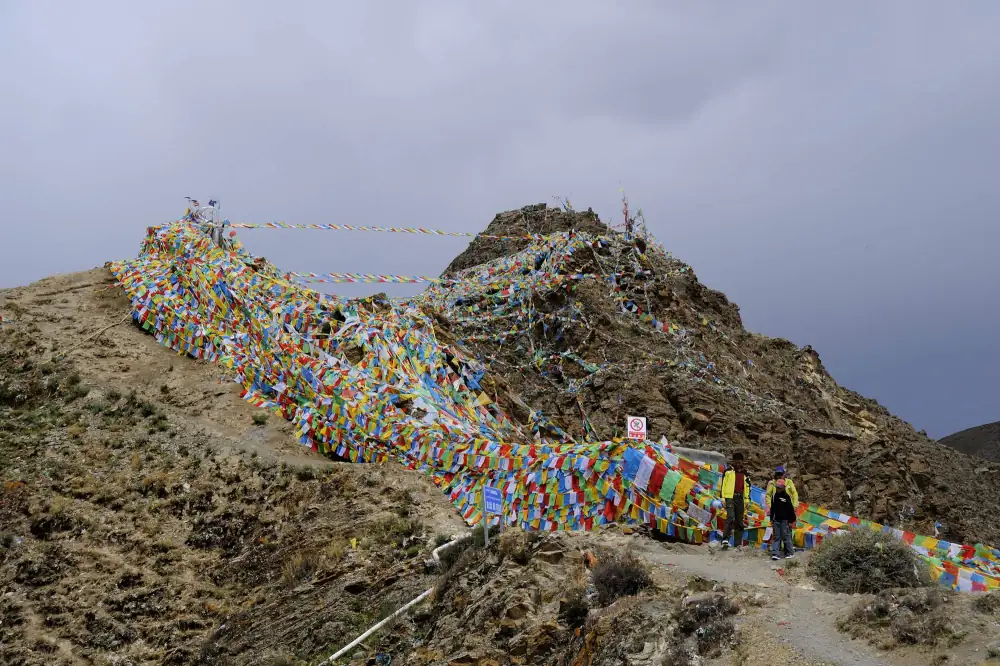
Rongbuk Monastery (绒布寺): At 5,094 metres, the highest permanent monastery in the world — a small, austere Nyingma monastery with direct view of the Everest north face. The combination of the monastery prayer flags and the mountain behind them is one of the most powerful images in Tibet.
The approach: Drive from Shigatse via Tingri (定日), staying at Tingri for acclimatisation, then continue to Rongbuk. The final section from the main road to Base Camp follows a valley with the Everest north face appearing gradually larger ahead.
The view from Base Camp: Everest (8,848 m) seen from Tibet’s north side shows the summit pyramid and the northeast ridge — the route attempted by Mallory and Irvine. In clear weather (best: April–May and October), the mountain is fully visible from morning until the afternoon clouds build.
Altitude: The base camp area is at 5,200 metres — oxygen is approximately 50% of sea level. Symptoms of altitude sickness (headache, nausea, fatigue) are normal. Allow 2–3 days of acclimatisation in Lhasa and Shigatse before proceeding.
Permit: The Mount Everest National Nature Reserve requires an additional permit (¥400, in addition to the Tibet Tourism Bureau permit required for all Tibet visitors).
The Road: Friendship Highway
The Lhasa-Kathmandu Friendship Highway (中尼公路) passes through Shigatse — travellers doing the overland Nepal-Tibet crossing or Tibet-Nepal crossing take this road. The scenery between Shigatse and Everest is among the best overland driving in Asia: high-altitude plains, turquoise glacial lakes, nomad camps, and the Himalayan panorama gradually resolving.
Practical Tips
Getting to Shigatse: Shigatse Peace Airport (RKZ) — limited connections (Lhasa, Chengdu). More practical: 3 hours by car from Lhasa; or the Lhasa-Shigatse high-speed train (1.5 hrs, 3,570 m altitude).
Tibet Tourism Bureau Permit: Required for all foreign visitors — apply through a licensed Tibetan travel agency. The permit takes approximately 5 working days; cannot be obtained on arrival.
Best season: April–June and September–October. July–August is monsoon (southern slopes of Himalaya collect heavy rain; Everest may be cloud-covered).
Last updated: May 2026