
Gyantse (江孜) sits in the Nyang River valley at 3,977 meters above sea level, roughly midway between Lhasa and Shigatse on the Friendship Highway. It was once the third most important city in Tibet, a major trading hub on the routes between Lhasa and British India, and the site of the last significant armed resistance to British imperial expansion into Tibet in 1904.
Today it’s a relatively quiet market town with perhaps 20,000 residents, dwarfed in significance by Lhasa and Shigatse. But it contains, in the Pelkor Chode Monastery complex and the Kumbum Stupa that anchors it, two of the most architecturally and spiritually remarkable sites in the Tibetan Buddhist world. Most Tibet tours pass through for half a day; the travelers who stay overnight and give the monastery proper time come away with a very different experience of the place.
Table of contents
Open Table of contents
Tibet Travel Permits — Essential Reading
All foreign visitors to Tibet require both a standard Chinese visa and a Tibet Travel Permit (TTB permit, 西藏旅游局批准书). Without the permit, you cannot board any transport to Tibet or enter the TAR (Tibet Autonomous Region).
The permit process:
- Must be arranged through a licensed Tibetan travel agency
- You cannot apply independently
- The agency will also book your accommodation and arrange required guides for the duration of your Tibet trip
- Processing time: typically 5–10 working days
- Cost: The permit itself is free; agency fees and required services add ¥1,500–4,000+ to your overall costs
Additional permits for Gyantse: Beyond the basic TTB permit, visiting areas outside Lhasa (including Gyantse and Shigatse) requires an Alien’s Travel Permit (ATP, 边境通行证) obtained locally through the travel agency. This is standard and your agency will arrange it automatically.
Permit windows and closures: Tibet periodically closes to foreign tourists, particularly around politically sensitive dates (March 10 Tibetan Uprising anniversary, October 1 National Day, and sometimes around Losar/Tibetan New Year). Always confirm current permit availability through your agency before booking flights.
Getting to Gyantse
From Lhasa:
- By road: Approximately 260km; 5–6 hours via the Southern Friendship Highway (G318) or the Northern Route via Yamdrok Lake
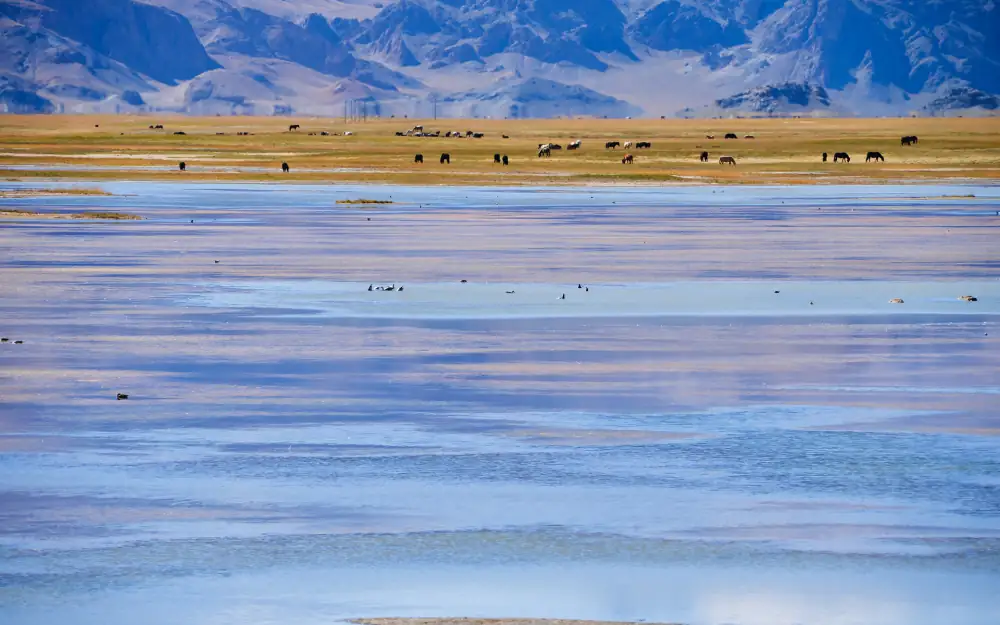
- The Northern Route passes Yamdrok Tso (羊卓雍错) — one of Tibet’s sacred lakes and a stunning sight at 4,441 meters; most tour buses take this route
- Private hired car or tour bus; public buses exist but foreigners may face difficulties using them without guide assistance
From Shigatse:
- About 90km; 1.5–2 hours by road
- Easy day trip or stop on the Lhasa-Shigatse circuit
Yamdrok Lake en route: The road from Lhasa crests the Kamba La pass (4,794m) and descends to the shore of Yamdrok Lake — a turquoise body of water visible from the pass in its entirety, surrounded by snow peaks. This view alone justifies the Northern Route.
Pelkor Chode Monastery (白居寺)
Pelkor Chode (Palcho Monastery) was founded in 1418 and is one of the most architecturally complex and ecumenical Buddhist monasteries in Tibet. It’s unusual in that it was historically used simultaneously by three different Tibetan Buddhist schools — Gelug, Sakya, and Butön — a rare instance of doctrinal coexistence under one complex.
The main assembly hall:
- Three stories with an exterior whitewashed facade and deep-red upper sections
- The ground floor contains the main prayer hall with large gilded statues of Sakyamuni, Maitreya, and other major figures
- Second floor contains chapels with intricate mandalas and thangka paintings
- Third floor (the golden roof) offers views across the monastery courtyard and the Gyantse valley
Monks and daily life: About 70–100 monks currently reside at Pelkor Chode. Morning puja (prayer) begins around 6:30–7:00am; the sound of drums, horns, and chanting carries across the courtyard. Attending morning puja (respectfully, without disrupting the ceremony) is one of the more atmospheric experiences available at the monastery.
Circumambulation route: A kora (ritual circumambulation path) circles the entire monastery complex and the Dzong fortress above, marked by whitewashed chorten (stupas). The full circuit takes about 1.5 hours on a good surface path; it’s a popular morning activity for local Tibetans.
Opening hours: 9:00am–6:00pm
Entry fee: ¥80 per person (includes entry to the Kumbum)
The Kumbum Stupa (班根曲登)
The Kumbum Stupa (literally “Hundred Thousand Images,” also called Payal Kumbum) is the masterpiece of Gyantse and one of the most significant buildings in Tibetan Buddhism. Built between 1427 and 1440, it is a nine-story mandala in three-dimensional architectural form — a stupa that is also a temple, and a temple that is also a cosmological map.
Architecture:
- Base diameter approximately 60 meters; total height about 35 meters
- The exterior is painted white with distinctive “eyes” on the upper section (a Newar Buddhist feature also found at Boudhanath in Nepal)
- Nine stories in a pagoda-like structure, with each story representing a level of the Buddhist cosmological system
- 77 chapels arranged around the stupa’s circumference and interior passages; each chapel is painted with elaborate murals and contains gilded statues
The interior chapels: The most remarkable thing about the Kumbum is that you can enter it and climb through its stories via narrow internal staircases. Each floor contains a ring of small chapels (between 8 and 16 per floor depending on the level), and each chapel is painted floor-to-ceiling with Tibetan Buddhist murals dating to the 15th century.
- Ground floor: Large chapels with major deity statues; murals in the Indo-Nepali Newari style showing Buddhas and bodhisattvas
- Middle floors: Smaller chapels with increasingly detailed mandala paintings; the variety of iconographic systems represented is staggering — scholars have counted over 100,000 individual painted figures
- Upper floors: The chapels become more esoteric in iconography; climbing to the upper levels requires squeezing through narrow passages
- The finial: Not accessible to visitors but visible from the exterior
Photography inside the Kumbum: Permitted in most chapels (no flash; tripod usually not allowed). The light inside is dim — bring a capable low-light camera or accept that phone cameras will struggle.
Spending time: Most visitors spend 45 minutes at the Kumbum. To actually absorb what you’re seeing — to take in the murals in individual chapels, to watch the light change through small windows in the upper stories, to sit in one of the small chapels with the incense and butter lamps — takes 2–3 hours minimum. The Kumbum is not a sight to rush.
Gyantse Dzong (江孜宗山古堡)
The Dzong (fortress) dominates the rocky outcrop above the town and was the site of the 1904 Battle of Gyantse, when a small Tibetan force using obsolete weapons held off a British expeditionary army for several months. The site is known in Chinese tourism largely through the patriotic narrative of Tibetan resistance.
The fortress:
- Partially restored structures including watchtowers, residential buildings, and a chapel
- The ascent is steep; allow 30–45 minutes for the climb
- Views from the top across the Gyantse valley, the monastery complex, and the surrounding mountains are excellent
Entry fee: ¥30 per person
The museum inside: Documents the 1904 British-Tibetan conflict with considerable propaganda lean; the actual historical artifacts (weapons, photographs) are interesting regardless.
Gyantse Town
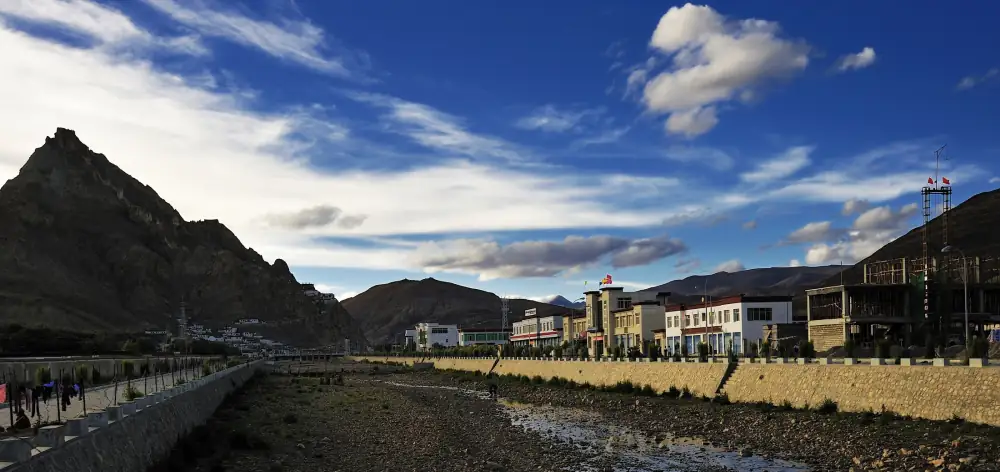
The old town of Gyantse below the Dzong has retained much of its traditional character — narrow lanes, whitewashed flat-roofed houses, and a market area where Tibetan traders sell wool blankets, tsampa (roasted barley flour), yak butter, and turquoise jewelry.
The Tibetan quarter: The area between the monastery and the Dzong has the densest concentration of traditional architecture. Walking these lanes in the early morning, when the monastery’s butter lamps are being lit and locals are beginning their circumambulation, is one of the more quietly affecting experiences in Tibet.
Gyantse carpet industry: Gyantse was historically famous for its handwoven carpets — thick wool pile with geometric Tibetan designs. Several workshops still produce traditional carpets; you can watch the weaving process and buy directly. Prices are negotiable: ¥500–3,000+ depending on size and complexity.
Where to Stay in Gyantse
Gyantse has a range of accommodation, mostly basic to mid-range:
- Wutse Hotel (乌孜大酒店): The most comfortable option in town; rooms ¥350–600/night; restaurant serves Tibetan and Chinese food
- Gyantse Hotel (江孜饭店): Government-owned, reliable; ¥250–400/night
- Guesthouses in the old town: Several family-run guesthouses in traditional buildings; basic facilities but atmospheric; ¥120–200/night
Note on altitude: Gyantse is at 3,977m. If you’ve arrived from Lhasa (3,650m), you’ve already acclimatized somewhat. If arriving from lower altitudes, be prepared for mild altitude symptoms — headaches and breathlessness are common for the first day or two. Rest, hydration, and avoiding strenuous activity for the first 24 hours.
What to Eat in Gyantse
Tibetan food:
- Tsampa: Roasted barley flour mixed with butter tea or water into a thick paste; the Tibetan staple food
- Thukpa: Noodle soup with yak meat and vegetables; warming and substantial
- Momos: Tibetan dumplings, usually filled with yak meat and onion; better here than in Lhasa’s tourist restaurants
- Butter tea (酥油茶): Strong black tea churned with yak butter and salt; an acquired taste, but an important social ritual — accepting a cup when offered is good manners
Restaurants: Small Tibetan and Chinese restaurants are found throughout the town center. Prices are low (¥20–50 for a full meal). The hotel restaurants are more consistent but not necessarily better.
Timing Your Visit
Best months: May to October
- May–June: Relatively dry, temperatures manageable (5–20°C daytime), crowds moderate
- July–August: Warmest but also the monsoon season; rains come mostly at night and roads can be affected by landslides
- September–October: Excellent clear weather, golden light, fewer tourists
Winter visits (November-April): Cold (nights regularly -15 to -20°C), but Tibet continues to receive visitors. The monastery and Kumbum remain open. The challenge is the cold and the increased risk of road closures due to snow.
Time allocation: One full day is the minimum to see the monastery and Kumbum properly; two days allows a more relaxed visit including the Dzong, old town exploration, and the carpet workshops.