
Lhasa sits at 3,650 meters above sea level. That single fact shapes every day of your visit — what you do on day one, how fast you walk, whether you sleep well, and how much energy you have for stairs. Get the altitude strategy right and Lhasa is extraordinary. Get it wrong and you spend your trip with a splitting headache wishing you were somewhere lower.
This itinerary is deliberately structured around acclimatization. The big physical exertions — the Potala Palace stairs, the monastery hikes — are placed on days three and four, when your body has had time to adjust. Resist the temptation to push ahead.
Table of contents
Open Table of contents
Permits & Logistics Before You Arrive
Tibet has restricted access for foreign visitors. You need:
-
Tibet Travel Permit (TTB) — mandatory for all foreign nationals (except Chinese citizens). Cost: ¥200. Must be arranged through a registered Tibetan travel agency — you cannot book independently. The agency will also arrange your required guide and vehicle.
-
Chinese visa — standard tourist visa, obtained before departure from China.
-
Aliens’ Travel Permit — required for destinations outside Lhasa such as Namtso Lake and Ganden Monastery.
Booking your tour: Contact a Lhasa-based travel agency at least 2-4 weeks ahead of your trip. Budget ¥2,000-4,000 for a 5-day guided private package (guide + vehicle + permits). Group tours are cheaper at ¥800-1,500 per person. The permit takes 5-7 business days to process.
Getting to Lhasa: Flying is the most common approach. Direct flights from Chengdu (2 hours, ¥500-1,200), Chongqing, Kunming, Beijing, Shanghai, and Xi’an. The Qinghai-Tibet Railway from Lhasa runs to Xining (22 hours) and Beijing (40 hours) — a famous journey in itself, and the train has oxygen supplementation in the carriages. Flying causes a more abrupt altitude change; the train allows more gradual adjustment.
Diamox (acetazolamide): Many doctors recommend starting Diamox 24-48 hours before arrival at altitude (125mg twice daily). Consult your doctor before traveling. Common side effects include tingling in the hands and feet and increased urination.
Day 1: Arrive & Rest — Barkhor Street Circuit
This day is for acclimatization. Do not push yourself.
On arrival: Check into your hotel. Drink plenty of water. Avoid alcohol for the first 48 hours (it impairs your body’s ability to acclimatize). Don’t shower with very hot water — it dilates blood vessels and can worsen headaches.
Common symptoms at 3,650m for new arrivals: mild headache, fatigue, light-headedness. These are normal and typically improve by day 2-3. If you experience severe headache, confusion, or difficulty breathing, seek medical attention immediately and consider descending.
Afternoon activity: Barkhor Street
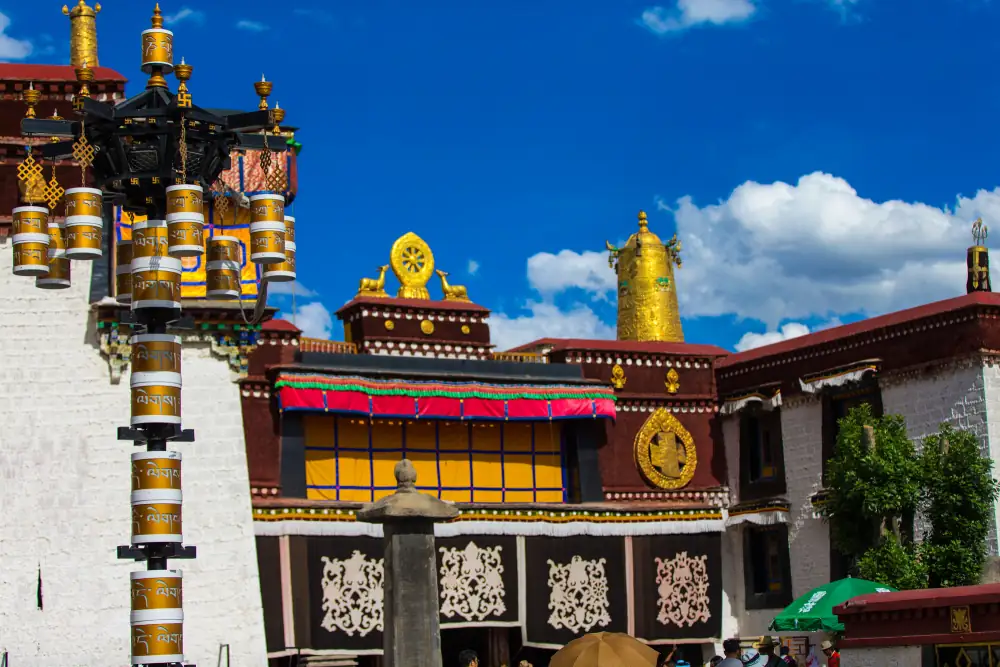
Barkhor Street (八廓街) is the circular pilgrimage route around the Jokhang Temple. Pilgrims walk it clockwise (always clockwise), spinning prayer wheels, prostrating on the ground, and chanting. The circuit takes about 20-30 minutes at a gentle walk and is one of the most atmospheric walks in Asia.
Walk it once, slowly. Watch the pilgrims. Sit at one of the teahouse windows facing the circuit and drink yak butter tea (酥油茶, ¥5-10) — it’s an acquired taste, salty and fatty, but helps in cold and high-altitude conditions.
Eat lightly tonight. Large meals at altitude can trigger nausea. Tibetan tsampa (roasted barley flour mixed with tea) and momos (Tibetan dumplings, ¥15-25) are appropriate first-night choices.
Day 2: Jokhang Temple & Barkhor Bazaar
By Day 2, most visitors feel noticeably better. Keep the morning gentle.
Jokhang Temple
Jokhang Temple (大昭寺, ¥85) is Tibet’s most sacred religious site — the center of Tibetan Buddhism and the destination that pilgrims from across the plateau have been walking toward for weeks or months. Built in the 7th century, it houses the Jowo Rinpoche — a 12-year-old image of Shakyamuni Buddha considered one of the holiest objects in Tibetan Buddhism.
The temple opens at 8am for pilgrims. Foreign tourists generally enter at 9am. Get there at opening — the morning crowds of pilgrims, the butter lamps, and the incense smoke create a genuinely moving experience. By afternoon it’s more crowded and less atmospheric.
Dress respectfully: shoulders and knees covered. Shoes off inside the shrine halls. Follow the pilgrims’ clockwise direction. Photography is restricted inside the main halls (signs will tell you where).
Allow 2-3 hours. The rooftop offers views of the Potala Palace across the valley — one of the most recognizable skylines in the world.
Afternoon: Barkhor Bazaar
The market surrounding Jokhang sells Tibetan goods: prayer wheels, singing bowls, thangka paintings, incense, jewelry, and yak wool textiles. Prices are negotiable. Good quality thangka paintings from reputable shops cost ¥300-2,000+; mass-produced tourist items start at ¥20. The difference in quality is obvious once you know what to look for.
Day 3: Potala Palace
Potala Palace (布达拉宫, ¥200) is the former winter residence of the Dalai Lamas — a 13-story, 1,000-room palace rising 117 meters above the valley floor. The red and white exterior is unmistakable. This is the icon of Tibet.
Booking: Potala Palace tickets must be booked in advance online (potalapalace.cn) or through your guide. Daily visitor numbers are strictly capped. Tickets often sell out a week or more ahead, especially April-October. Your travel agency will usually handle this.
Entry time: Most foreign tourist groups enter at 9am or 10am. The visit is self-guided but must follow a fixed route through the palace. Inside you’ll see the tombs of past Dalai Lamas, throne rooms, chapels, and thousands of religious artifacts. Allow 2-3 hours inside.
The stairs: The ascent involves 240+ steps to reach the palace entrance. At 3,650m, take them slowly. Descend carefully — people go down faster than they should and falls happen.
Photography: Allowed in most exterior areas but not inside the main chapels.
After the Potala, the afternoon can be spent exploring the Norbulingka Palace (罗布林卡, ¥60) — the Dalai Lama’s former summer residence, in a large park setting. Much less crowded and gives a sense of the more relaxed side of Tibetan royal life.
Day 4: Drepung & Sera Monasteries
By now you should be well acclimatized and can handle more physical activity.
Morning: Drepung Monastery
Drepung Monastery (哲蚌寺, ¥60) is 8km west of Lhasa — once the largest monastery in the world, with over 10,000 monks in its peak. Now home to around 600, it’s still massive and the whitewashed monastic buildings sprawl up the hillside impressively.
The morning is best — monks are actively doing their morning rituals. The Great Assembly Hall (措钦大殿) has a remarkable collection of thangka paintings and religious statuary. The walk between the main buildings involves significant uphill — take your time.
Getting there: Taxi from Lhasa ¥30-40, or tour vehicle with your guide.
Afternoon: Sera Monastery
Sera Monastery (色拉寺, ¥55) is northeast of Lhasa. Its famous Monk Debate takes place in the courtyard daily at 3:00-5:00pm (except Sunday). This is a genuine, active practice — monks engage in formal debate about Buddhist philosophy, punctuated by dramatic hand-clapping gestures. It’s completely open to visitors and is one of the most remarkable things to witness in Lhasa. Don’t miss it.
Between the two monasteries, visit the Tibet Museum (西藏博物馆, free) in the Norbulingka area — one of the better-organized museum presentations of Tibetan history and culture.
Day 5: Namtso Lake or Ganden Monastery
Option A: Namtso Lake
Namtso Lake (纳木错, ¥120) at 4,718m is one of the highest saltwater lakes in the world — a vast expanse of impossibly blue water framed by the Nyainqêntanglha mountain range. The scenery is stunning.
Requires: Aliens’ Travel Permit (your agency handles this). Departure from Lhasa by 7am, 4-hour drive each way. Full day trip.
The lake itself is cold and windy year-round. The main viewpoint at Tashi Dor Peninsula has tent accommodation if you want to stay overnight for the sunrise — extraordinary if weather cooperates.
Altitude at Namtso is 1,000m higher than Lhasa. Be very cautious about any altitude sickness symptoms; if you had trouble in Lhasa, skip this trip.
Option B: Ganden Monastery
Ganden Monastery (甘丹寺, ¥50) is 50km east of Lhasa, perched at 4,300m on Wangbur Mountain. It was founded by Tsongkhapa, founder of the Gelug school of Tibetan Buddhism. The kora (circumambulation path) around the monastery complex takes 2-3 hours and involves 300m of elevation gain — manageable if you’re acclimatized.
The views from the kora path over the Kyichu Valley are extraordinary. The monastery was almost entirely destroyed during the Cultural Revolution and much of what you see has been rebuilt since the 1980s, but the reconstruction has been careful and the site retains its sanctity.
Requires: Aliens’ Travel Permit. Depart 7:30am, 2-hour drive.
Practical Information
| Item | Cost |
|---|---|
| Tibet Travel Permit | ¥200 |
| Guided package (5 days) | ¥1,500-4,000 |
| Potala Palace | ¥200 |
| Jokhang Temple | ¥85 |
| Drepung Monastery | ¥60 |
| Sera Monastery | ¥55 |
| Namtso Lake entrance | ¥120 |
| Budget guesthouse | ¥150-300/night |
| Mid-range hotel | ¥400-700/night |
Best time to visit: May-October (the monastery kora paths are accessible and dry). July-August is peak season but also monsoon — expect afternoon rain. October has the most stable weather and clearest skies. Tibet is closed to foreign tourists between February and April (exact dates vary by year) around the Tibetan New Year period — check current access status before booking.
Health notes: Altitude sickness can affect anyone regardless of fitness level. Children, pregnant women, and people with heart or respiratory conditions should consult a doctor before visiting Lhasa. The best acclimatization strategy is to spend a night at a mid-altitude city (Chengdu, Chongqing, or especially Xining for the train route) before arriving.