
Table of contents
Open Table of contents
Understanding the Tibet Permit System
Visiting Tibet requires permits beyond a regular Chinese visa — this is non-negotiable. For Everest Base Camp specifically, you need three separate permits:
1. Tibet Travel Permit (TTB Permit / 西藏旅行许可证)
The foundational permit allowing any foreign visitor to enter the Tibet Autonomous Region. Must be obtained through a licensed Tibet travel agency — individual applications are not accepted.
- Cost: ¥200/person (the permit itself; agency service fees are additional)
- Processing time: Typically 5–10 working days after providing all required documents
- Required documents: Valid Chinese visa, passport copy, and other forms depending on your agency
- Where to get it: Through a Tibet-registered travel agency (required by regulation)
2. Alien’s Travel Permit (边境地区许可证)
Required for travel in Shigatse Prefecture, which includes the Everest area.
- Cost: ¥50/person
- Obtained: From Shigatse PSB (Public Security Bureau) or via your travel agency
- Timing: Must be obtained after arriving in Tibet, before proceeding to Shigatse area
3. National Park Permit (自然保护区许可)
Required to enter the Qomolangma Nature Preserve, which covers the Everest area including Base Camp.
- Cost: ¥180/person
- Obtained: At the Rongbuk checkpoint before the final approach to Base Camp
Total permit costs: approximately ¥430 per person in official fees, plus agency service fees that typically range ¥800–2,000 depending on the agency and group size.
Important 2026 note: Permit regulations and costs change periodically. Always verify current requirements with a licensed Tibet travel agency before booking. Some agencies in Lhasa, Chengdu, and Beijing specialize in Tibet and Everest permits and can manage the entire process.
When Can You Visit?
The Tibetan Base Camp has two main visiting windows:
Spring (April–June): The main climbing season for expeditions attempting the summit, which makes Base Camp more atmospheric — you’ll see high-altitude tents, equipment, and possibly expedition teams. Weather can be good but variable. Views of the north face are generally excellent. May is particularly popular.
Autumn (late August–October): After monsoon season, the skies clear and become arguably the most spectacular. September and October see the clearest conditions for photography. Fewer expeditions but equally dramatic scenery.
Closed seasons:
- July–August: Monsoon season brings frequent cloud and snow. The road can flood.
- November–March: Extreme cold and the national park may restrict tourist access for environmental restoration. Check current policies.
In 2026, the Everest Base Camp area has implemented a daily visitor cap of approximately 300 people and requires advance reservations through your travel agency. Don’t show up without confirmed permits and bookings.
The Route: Lhasa to Everest Base Camp
Most visitors approach EBC via Lhasa, which allows for essential acclimatization time.
Lhasa Acclimatization (2–3 days minimum)
Arriving in Lhasa at 3,650m from sea level (or even from Chengdu’s modest elevation) requires adjustment. Symptoms of mild altitude sickness (headache, fatigue, poor sleep) are normal the first 1–2 days. Do NOT push through and drive immediately toward Everest.
Day 1: Rest. Short walk around your hotel neighborhood. Drink lots of water. Day 2: Visit lower-elevation Lhasa sites (Jokhang Temple at 3,649m). Short outings. Day 3: If feeling strong, Potala Palace (requires advance ticket booking). Some uphill walking.
Lhasa to Shigatse (~250km, 3–5 hours)
The Friendship Highway runs southwest from Lhasa. First major stop is the Yamdrok Lake viewpoint (羊卓雍错, 4,441m) — one of Tibet’s holy lakes, brilliantly turquoise.
Continue to Gyantse (江孜, 3,990m) for the Pelkor Chode Monastery and the famous Kumbum stupa (the “ten-thousand Buddha pagoda”). Worth a half-day stop.
End the day in Shigatse (日喀则, 3,836m), Tibet’s second-largest city and home of Tashilhunpo Monastery (扎什伦布寺), the traditional seat of the Panchen Lamas.
Accommodation in Shigatse: Several decent hotels, from budget guesthouses (¥100–150/night) to mid-range options (¥250–400/night). The Shigatse Hotel and Qomolangma Guesthouse are reliable choices.
Shigatse to Tingri (~190km, 3–4 hours)
From Shigatse, the road climbs toward the Himalayan range. Tingri (定日, 4,390m) is the last town of any size before Base Camp. Most groups spend a night here.
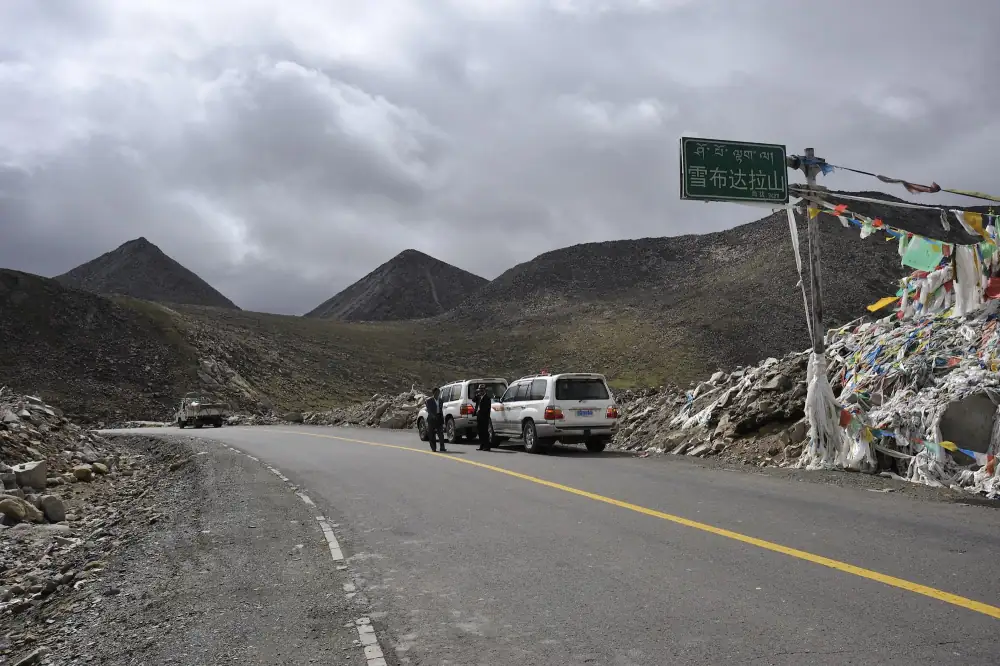
The road passes Lalung Leh Pass (拉龙拉山口) at 5,050m — acclimatization is essential before crossing this. Views back toward Shigatse and forward toward the Himalayas are spectacular.
In Tingri: Very basic guesthouses (¥80–120/night per person), simple restaurants. Don’t expect comfort — this is true frontier accommodation. The stars on a clear night at this altitude are extraordinary.
Tingri to Everest Base Camp (~100km, 2–3 hours)
The final approach. The road deteriorates in quality but the views improve dramatically. You pass the checkpoint where the Nature Reserve permit is checked (carry your paperwork).
Then, as the road makes a long descent, Everest appears. The first view of the north face is one of the genuine jaw-drop moments in Chinese travel — a triangle of ice and rock rising above everything else on earth, impossibly tall.
The road ends at Rongbuk Monastery (绒布寺, 4,980m), the world’s highest monastery, which was established in 1899 and has been a base for Everest expeditions since the British first attempted the mountain in 1921. A few minutes’ drive further, eco-buses or yak transport covers the final 4km to Base Camp at 5,200m.
At Everest Base Camp (5,200m)
What You’ll Find
The Tibetan Base Camp has a small permanent settlement of guesthouses (石屋和帐篷旅馆) and the famous tent camp for expeditions (used April–June). The “tourist” area has a viewpoint, souvenir stalls, and the eco-shuttle terminus.
From the Base Camp viewpoint, the north face of Everest fills your entire upper field of vision. The scale is difficult to comprehend — the mountain’s summit at 8,849m is 3,649 meters directly above you. Glaciers hang from the ridges. The air is thin enough that walking 100 meters requires deliberate pacing.
The Sunrise Experience
The most famous moment at Tibetan EBC is sunrise: first the sky lightens from black to deep blue, then the summit pyramid of Everest catches the first light and turns burning gold while everything below is still in deep shadow. This “alpenglow” effect on the north face is one of the great spectacles in high-altitude photography.
To catch sunrise, you need to be at a viewpoint (either Base Camp or the higher viewpoint near Rongbuk Monastery) about 45 minutes before the calculated sunrise time. Sunrise times at this latitude vary from about 7:20am in October to 6:45am in May. Your guide will know the exact timing.
Staying at Base Camp
A small number of guesthouses and tent camps operate at the Base Camp area. Accommodation is basic but functional — sleeping bags on beds, simple meals. The experience of waking at 5,200m and stepping outside to see Everest above you is worth any discomfort.
- Budget option: Basic guesthouse rooms ¥100–150/person/night
- All-inclusive tent camp (spring only): ¥500–800/night including meals — better insulation and organization during expedition season
Book in advance through your travel agency — capacity is limited.
Photography Guide for Everest
Technical Challenges
- Cold: Even in May, nighttime temperatures around -10°C. Batteries drain fast. Keep cameras/batteries warm in your sleeping bag or inner jacket until needed.
- Altitude: Moving quickly with heavy equipment is difficult. Plan your movements.
- Light: Golden hour is when you want to shoot. The midday light flattens everything.
Best Shots
- Dawn over the north face: Position yourself at the Base Camp viewpoint or the Rongbuk Monastery terrace. The monastery terrace gives a slightly higher angle that shows more of the approach valley.
- Rongbuk Monastery with Everest behind: The monastery’s white walls and prayer flags with the dark pyramid of Everest in the background is an iconic composition.
- Yaks at Base Camp: If expedition season, yaks are used to carry loads. The combination of these ancient beasts and the modern mountain backdrop is powerful.
Physical Fitness and Health
You don’t need to be a climber or even a serious hiker to reach the Tibetan EBC. The “hike” at Base Camp itself is just walking on flat ground. What you need:
- Adequate acclimatization time (minimum 5–7 days in Tibet before EBC)
- Good cardiovascular fitness — exertion at 5,200m is much harder than at sea level; a 15-minute walk feels like serious exercise
- No recent respiratory illness — your lungs need to be at full capacity
- Willingness to turn back if you feel unwell — ego has no place at high altitude
Altitude sickness medications (Diamox) and supplemental oxygen should be discussed with your doctor before travel. Your travel agency can provide portable oxygen at Base Camp.
Budget Planning
The Tibetan EBC trip is not cheap. Realistic budget:
| Item | Approximate Cost |
|---|---|
| Tibet Travel Permit | ¥200 |
| Agency service fee | ¥800–2,000 |
| Alien’s Travel Permit | ¥50 |
| Nature Reserve Permit | ¥180 |
| Private Land Cruiser from Lhasa to EBC (4 days) | ¥3,000–4,500 |
| Accommodation (4 nights en route + 1 at EBC) | ¥800–1,500 |
| Meals | ¥400–600 |
| Total minimum budget | ¥5,400–9,000 (~$750–1,250) |
This is per person. Small groups (3–5 people) can share vehicle costs significantly.
Budget package tours from Chinese agencies in Lhasa or Chengdu start around ¥4,500–6,000 per person for a 6-day Lhasa–EBC tour.
Practical Tips
Book 2–3 months ahead for spring season — May especially gets booked up by April.
Test your altitude tolerance before committing to EBC. Spend a few days in Lhasa or similar altitude and see how you respond.
Dress in layers: Base layer, insulating layer, windproof shell. The change from windless to even light wind at 5,200m makes a 10°C difference in felt temperature.
Respect the mountain and the culture: Chomolungma (Goddess Mother of the World) is sacred to Tibetan Buddhists. The Base Camp area contains shrines and prayer flags. Behave with respect.
There’s nothing else like it. Whatever you spend to get to Tibetan Everest Base Camp — in money, logistics effort, and physical challenge — you will not feel you paid too much.