
Table of contents
Open Table of contents
The Pagoda That Stood for Xuanzang’s Journey
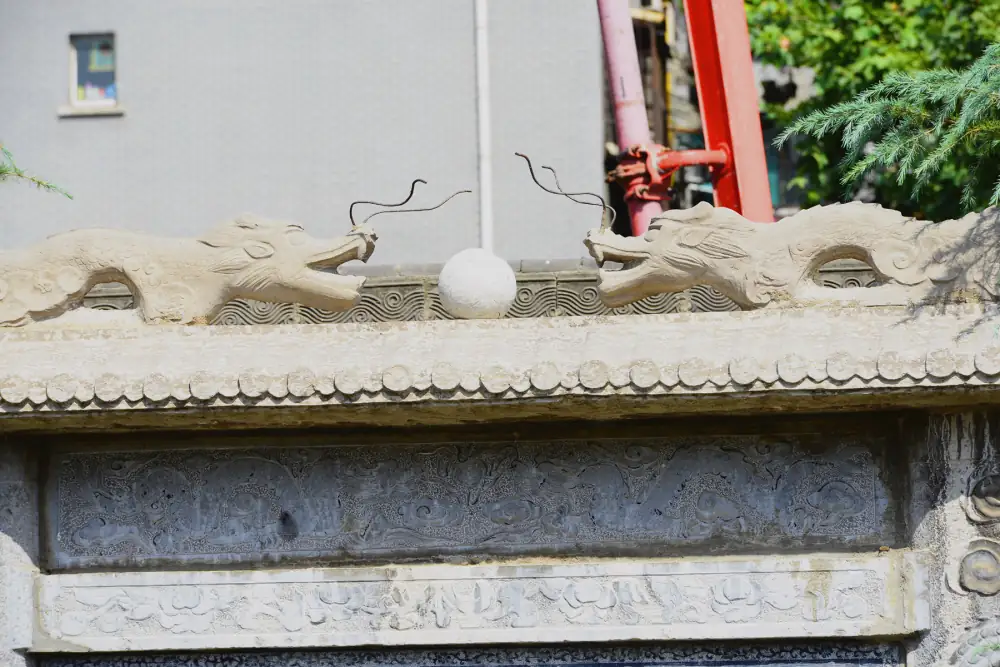
In 629 AD, a young Buddhist monk named Xuanzang slipped out of Tang dynasty China without official permission and embarked on one of the most extraordinary journeys in history. He walked and rode by horse across Central Asia to India, studying at the great Nalanda University and collecting hundreds of Buddhist sutras. Seventeen years later he returned with 657 texts, and the Emperor Taizong — who had tried to stop him leaving — received him as a national hero.
To house those sacred texts and protect them for study and translation, Xuanzang petitioned for the construction of a purpose-built pagoda. Construction began in 652 AD. The result was the Big Wild Goose Pagoda (大雁塔, Dà Yàn Tǎ) — seven storeys of Tang dynasty brick rising from the grounds of the Ci’en Temple, 64 metres above the flat plain south of the Tang capital Chang’an.
Xuanzang spent the remaining 19 years of his life in Xi’an translating the 657 sutras he had brought back — an intellectual achievement of breathtaking scope. The pagoda he built has stood through the centuries, repaired and reinforced multiple times, as perhaps the most tangible symbol of the Tang dynasty’s openness to the world, its cultural confidence, and its Buddhist piety.
Today the pagoda is Xi’an’s most famous single monument after the Terracotta Warriors. Unlike the Warriors, which are outside the city, the Big Wild Goose Pagoda is in the heart of Xi’an’s modern south city and easily combined with other attractions.
History of the Big Wild Goose Pagoda
Tang Dynasty Origins (652 AD)
The original pagoda was built with five storeys on Xuanzang’s personal request, modelled on a Buddhist stupa he had seen in India. It was constructed of rammed earth faced with fired brick. Within fifty years, Empress Wu Zetian ordered the rebuilding and expansion to ten storeys. Subsequent seismic damage reduced it to the current seven storeys.
The Name: Why “Wild Goose”?
The name has two origin stories. One holds that during Xuanzang’s journey through India, a group of monks at a monastery that had relaxed its vegetarian rules saw a wild goose fall from the sky — interpreted as a sign from the Bodhisattva Guanyin condemning the meat-eating. The monks buried the goose and erected a stupa at the spot, calling it the Wild Goose Stupa. Xuanzang modelled his pagoda on this Indian precursor.
A second explanation, more prosaic, suggests the name derives from a Tang idiom likening high-achieving examination candidates to wild geese flying in formation.
The Examination Tradition
During the Tang dynasty, successful candidates in the imperial examinations had the honour of inscribing their names on the pagoda’s base. This tradition, called “recording names on the Wild Goose Pagoda” (雁塔题名), became one of the great honours of scholarly achievement. The practice elevated the pagoda’s cultural significance beyond its religious function.
Visiting the Pagoda: Practical Information
Tickets and Opening Hours
Da Ci’en Temple Grounds (大慈恩寺): ¥30 entry to the temple complex including the pagoda exterior and temple buildings. Pagoda Climbing Ticket: An additional ¥30 allows entry inside and climbing to the upper floors. Combined ticket: ¥50 for temple and pagoda climbing.
Opening hours: 9:00 AM – 6:30 PM (peak season to 8:00 PM). The evening fountain show operates until 10 PM.
Climbing the Pagoda
Narrow stone staircases inside lead to upper-level windows with panoramic views over Xi’an. The city spreads flat in every direction from the top — on clear days (more frequent in autumn and winter when wind disperses the haze) you can see the ridge of Qin Ling mountains to the south.
The interior of each level has display cases with Buddhist relics, sutras, and explanatory materials about Xuanzang’s journey. The English explanations are better than average for a Chinese historical site.
Note: The staircases are narrow and steep. The climb involves low headroom in sections. Not suitable for those with mobility issues.
The Temple Grounds
Da Ci’en Temple surrounding the pagoda is an active Buddhist monastery with monks in residence. The main halls house impressive Tang-style Buddhist statuary. The incense smoke is genuine rather than theatrical — this is a working religious site.
Xuanzang Memorial Hall: A dedicated exhibition in the temple grounds covering Xuanzang’s life, his 17-year journey, and his translation work. Well-curated with English text.
The Evening Fountain Show
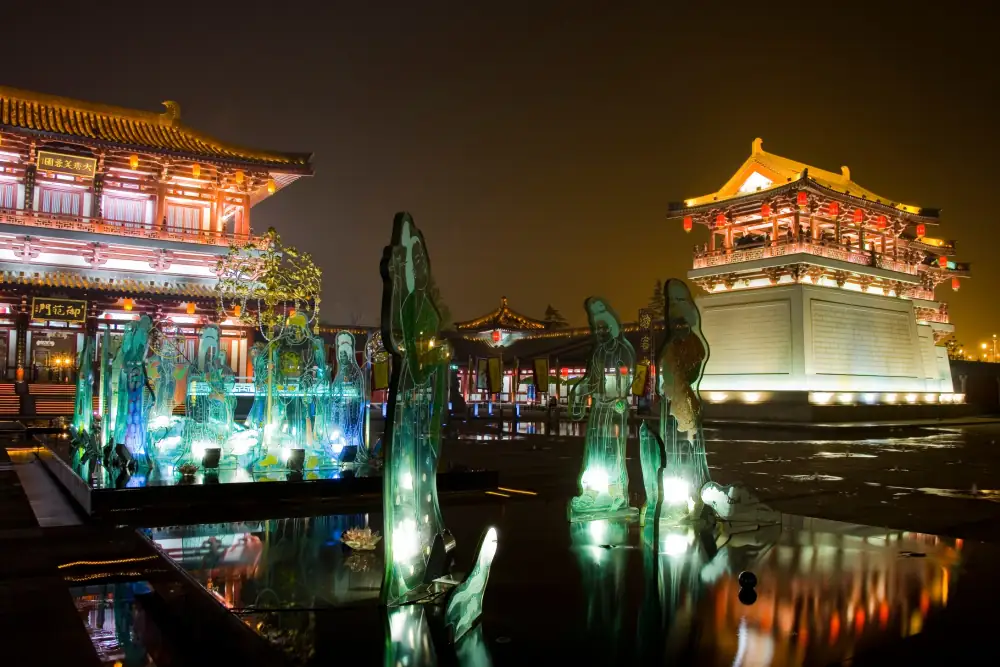
The large North Square (北广场) in front of the pagoda hosts what is claimed to be Asia’s largest musical fountain — a fact that cannot be fully verified but is certainly among the more dramatic fountain spectacles on the continent.
Show schedule: Daily in spring–autumn season. Shows typically at 8:00, 8:30, and 9:00 PM. Winter schedule may be reduced. Entry: Free to watch from the square
The fountain combines choreographed water jets up to 40 metres high with coloured lights and music ranging from Chinese orchestral pieces to pop music. The pagoda, illuminated behind the fountain, creates an extraordinarily photogenic backdrop. The show draws enormous crowds — arrive 30 minutes early for a good position.
Photography tip: Use a wide-angle lens to capture both the fountain and the illuminated pagoda together. The water droplets catch light beautifully with a telephoto lens for detail shots.
Little Wild Goose Pagoda (小雁塔)
About 2.5km northwest of the Big Wild Goose Pagoda, the Little Wild Goose Pagoda (小雁塔, Xiǎo Yàn Tǎ) is the Big Pagoda’s less famous sibling and, in some ways, its more intimate counterpart.
Built in 707 AD — 55 years after the Big Pagoda — it stands 43 metres and once had 15 storeys. A 16th-century earthquake cracked it vertically in two, and subsequently the earthquake that killed the most people in Chinese history (the 1556 Shaanxi earthquake) vibrated the pieces back together, partially sealing the crack in what locals call the “earthquake miracle.”
Entry ¥30. The surrounding Jianfu Temple complex is well-preserved and peaceful. Also on the grounds is the Xi’an Museum (西安博物院) with an excellent archaeological collection. Entry to the museum is free.
Surrounding Area: Tang West Market and More
Tang West Market (唐西市)
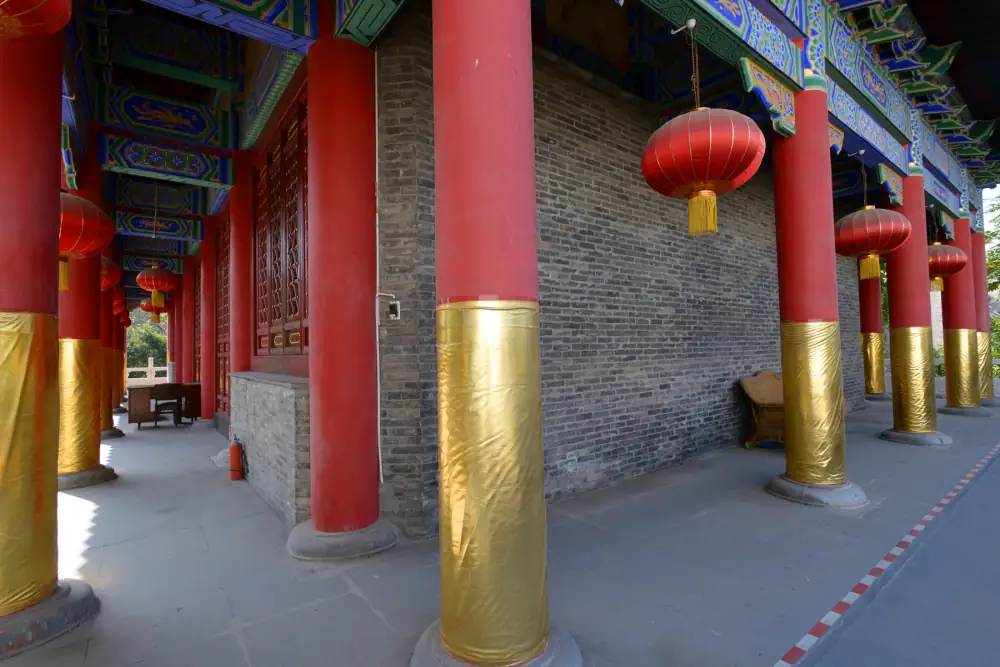
Walking distance west of the Big Wild Goose Pagoda, the Tang West Market is a modern recreation of the Tang dynasty’s western market district — one of the great commercial hubs of the ancient Silk Road. The shopping complex houses traditional craft vendors, restaurants, and the Silk Road Museum. More commercial than historical, but atmospheric on evenings with street performances.
Muslim Quarter Direction
Xi’an’s famous Muslim Quarter (回民街) is in the northwest of the old city, approximately 5–6km from the Big Wild Goose Pagoda. Combine the two with a day itinerary — pagoda in the afternoon, Muslim Quarter for dinner.
Getting There
Metro
Xi’an Metro Line 3 has a station at the Big Wild Goose Pagoda (大雁塔站). From Xi’an Railway Station, take Line 3 south approximately 20 minutes. From Bell Tower (钟楼), take Line 2 or Line 3.
Bus
Multiple bus lines serve the pagoda area. Buses 610, 21, 402, and others stop near the main entrance.
Taxi/Didi
From Xi’an Railway Station: approximately 20 minutes, ¥20–30. From the Bell Tower/Muslim Quarter area: 15 minutes, ¥15–25.
Practical Tips
Best day to visit: Weekday afternoons are most comfortable. Saturday evening for the full fountain show experience, arriving by 7:30 PM to position yourself.
Combine with: The Shaanxi History Museum (陕西历史博物馆) is 500 metres northwest. The museum houses extraordinary Tang dynasty artifacts and is arguably China’s finest provincial history museum. Free entry (reservation required). Allow 2–3 hours.
Xiaoyan Pagoda vs Dayan Pagoda: Some visitors prefer the quieter, more atmospheric Little Wild Goose Pagoda over its more famous sibling. If you only have time for one pagoda, the Big Wild Goose Pagoda offers more to do; but if you have time for both, the combination tells a richer story of Tang Buddhism.
Food near the pagoda: The North Plaza area has numerous restaurants. For local Xi’an specialities, look for restaurants serving biang biang noodles (biangbiang mian), roujiamo meat sandwiches, and cold noodle salad (凉皮). Prices in this tourist-heavy area run slightly higher than the city average.