
Table of contents
Open Table of contents
Tickets and Access
Entry ticket: ¥54/adult (wall access only) Bicycle rental: ¥45/hour for standard bikes; ¥50/hour for tandem bikes; ¥80/hour for electric bikes Single-bike unlimited time package: ¥180/day (good deal if you plan to cycle the full circuit and linger)
Access points: There are multiple entry ramps to the top of the wall. Main ones:
- South Gate (南门, Yongning Gate): The most impressive and most visited gate, with a drawbridge and the largest gate complex. Metro Line 2, South Gate Station (南门站).
- North Gate (北门): Less crowded, convenient if you’re in the old city northern section
- East Gate (东门) and West Gate (西门): Access from the respective sides of the old city
- Small Nanmen (小南门): A smaller access point near the Muslim Quarter
Opening hours:
- Peak season (March–November): 8am–10pm
- Off-season (December–February): 8am–6pm
The wall is illuminated at night (after sunset) and the evening light show at South Gate with its colored lanterns and projection mapping runs April–October, usually starting around 7:30pm.
Cycling the Full Circuit
Cycling the full 13.7km perimeter is the signature activity. On a standard rental bike, it takes about 1.5–2 hours to complete the circuit at a comfortable pace, including stops.
Starting Point
Most cyclists start at South Gate because it’s the easiest metro access and the most impressive entry point. The gate complex itself is worth exploring on foot first — the archery towers, ramparts, and the working portcullis mechanism are all preserved and explained with English signs.
Circuit Description (Clockwise from South Gate)
South Gate → East Gate (SE section, 3.4km) This section passes several corner towers and overlooks the southeastern part of the old city. Views of the city on the left (interior side) and the moat on the right (exterior). The moat has been landscaped into a pleasant park below.
East Gate → North Gate (NE section, 3.4km) The northeastern stretch is the most untouristed section — fewer food stalls, fewer other cyclists, more authentic experience. The wall here is especially wide and the feeling of being on an ancient fortification is strongest.
North Gate → West Gate (NW section, 3.4km) Near the North Gate, views of the Bell Tower and Drum Tower are visible inside the old city. The West Gate area overlooks the train station.
West Gate → South Gate (SW section, 3.5km) The final section, passing the Small South Gate. Near the South Gate approach, the skyline of modern Xi’an comes into view beyond the old city walls — the juxtaposition of ancient rampart and glass-and-steel office towers is striking.
Tips for the Cycling Circuit
- Best time: Dawn (6:30–8am) and dusk (6:30–8pm). Morning gives the clearest air and fewest visitors. Dusk gives illuminated wall views and the sunset backdrop.
- Direction: Most cyclists go counterclockwise (east from South Gate). Going clockwise puts you moving against the flow and gives different photographic angles.
- Allow extra time: The rental includes the bike; there’s no pressure to rush. Stop at every corner tower, take photos, eat at the small food stalls (noodle shops along the wall from around 9am).
- Electric bikes: If you want a more leisurely experience, the electric bike rental at ¥80/hour covers the full circuit in under an hour and lets you look around rather than pedal.
The Gate Towers: What to See
The city wall has four main gates (South, North, East, West) and several smaller gates, each with a complex of towers:
Main Gate Structure (at each major gate):
- Outer gateway (闸楼): Controls the drawbridge and outer defense
- Inner gateway (城楼): The main gate tower, used for ceremonial and defensive purposes
- Arrow Tower (箭楼): Forward tower positioned to allow archers to defend the gate approach
- Enclosed courtyard between towers (瓮城): A killing ground where attackers who breached the outer gate could be trapped
South Gate (永宁门) is the only gate where all three tower elements are accessible to visitors and fully furnished with historical exhibits. Entry to the gate tower complex is included in the wall ticket. Allow 30–45 minutes.
The Bell Tower (钟楼) and Drum Tower (鼓楼) are not on the wall itself but in the center of the old city — accessible on foot or by metro. Entry ¥35 each. The Drum Tower is in the heart of the Muslim Quarter (回民街) and gives excellent views of that area.
Night Views and Light Show
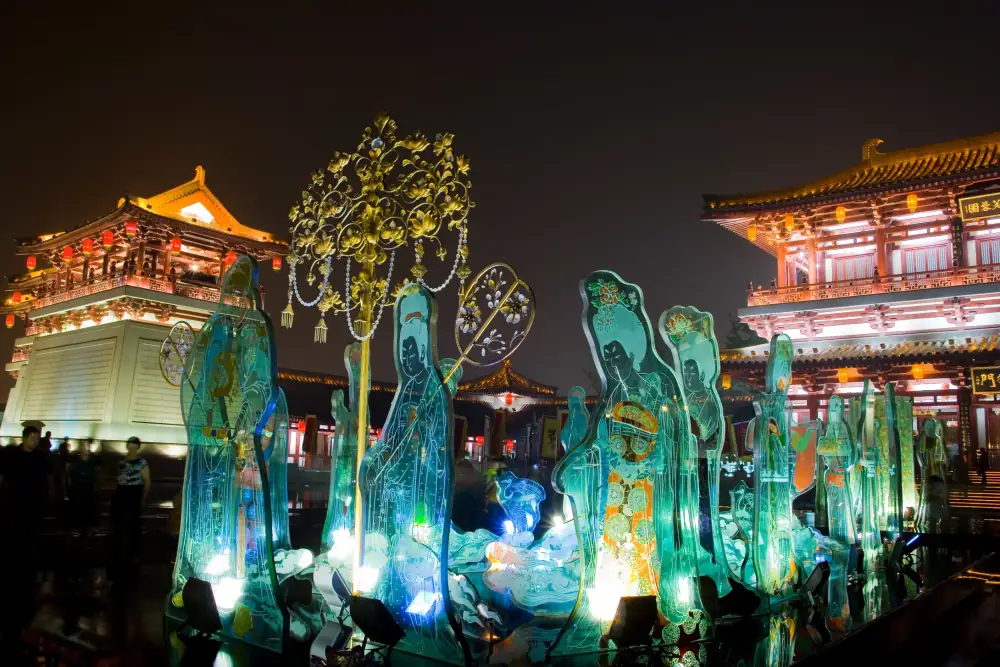
The Xi’an City Wall at night is one of the city’s great spectacles. The entire 13.7km perimeter is lit with traditional lantern-style lighting after dark, turning the wall into an amber glowing ribbon visible from much of the city.
South Gate Light Show: From April to October, the South Gate area hosts a multi-media show using projection mapping on the gate towers, synchronized music, and colored lighting. Free to watch from outside the gate. Running times vary; check current schedule on arrival.
Night cycling: The wall can be cycled at night (until 10pm). The lit wall with the city glowing on one side and the dark moat park on the other creates an extraordinary nighttime cycling experience. Less crowded than daytime except around South Gate during the light show.
Combining with Xi’an Old City Attractions
Muslim Quarter (回民街, Huimin Jie)
The most atmospheric part of Xi’an’s old city — a dense network of lanes centered on the Great Mosque (清真大寺, the 8th-century mosque that’s architecturally Chinese rather than Arab), surrounded by street food stalls, lamb restaurants, and the bustle of a working Muslim community.
Essential food here:
- Yang rou pao mo (羊肉泡馍, ¥25–35): Crumbled flatbread soaked in lamb broth — Xi’an’s signature dish
- Rou jia mo (肉夹馍, ¥12–18): The Xi’an “hamburger” — braised pork or lamb in a sesame flatbread
- Liangpi (凉皮, ¥8–12): Cold rice noodles in chili sauce
- Rou jia mo + suan plum juice: The local combo that everybody has
Terracotta Warriors (兵马俑)
The main reason most visitors come to Xi’an. Located 40km east of the city (30 minutes by metro Line 9 from Zhuque Gate South Station, or tour bus). Entry: ¥120 adults. Buy tickets online in advance to avoid the ticket line.
The warriors warrant a half-day minimum. The three pits have completely different characters — Pit 1 is the overwhelming scale experience; Pit 2 has the most interesting individual figures; Pit 3 is the command headquarters.
Shaanxi History Museum (陕西历史博物馆)
One of China’s best provincial museums, covering the full sweep of Shaanxi history from Neolithic through Tang Dynasty. Free entry (book online). Allow 2–3 hours. The Tang Dynasty section, covering Xi’an as Chang’an (capital of the known world in the 7th–8th centuries), is particularly strong.
Where to Stay
The best base is inside the city wall — the old city within the walls.
Budget (¥80–180/night): Multiple guesthouses near the South Gate and Muslim Quarter. The Shuyuan Youth Hostel (书院国际青年旅舍) on Shuyuan Lane is a classic backpacker spot in a Ming-era building.
Mid-range (¥200–450/night): Several boutique hotels in renovated old city buildings. The Sofitel Xi’an on Renmin Square from ¥380/night is the most central upscale option.
Recommended boutique: Han Tang Hui Hotel near the wall, from ¥250/night — Tang Dynasty architectural elements, central location, good breakfast.
Practical Information
Getting to Xi’an:
- From Beijing: 4.5–5 hours by high-speed train (¥220–400)
- From Shanghai: 5.5–6 hours by high-speed train (¥360–500)
- From Chengdu: 3.5–4 hours by high-speed train (¥190–280)
- Xi’an Xianyang Airport (XIY): Direct flights from all major cities
Getting around: Metro Lines 1, 2, 3, and 4 cover the main attractions. Taxi base fare ¥8.
Best season: Spring (April–May) and Autumn (September–October). Summers are hot (35°C+) but manageable with early morning starts. Winters (November–February) are cold but the wall is dramatically less crowded.
The Xi’an city wall is a place where the phrase “living history” is not hyperbole. Stand on these ancient ramparts and look south from the South Gate tower — the same view that Tang Dynasty soldiers and Ming Dynasty officials looked at. The weight of continuity is real.