
Dunhuang Yardang: China’s Most Alien Landscape
One hundred and eighty kilometres northwest of Dunhuang, in the hyperarid flatlands where the Lop Desert meets the Gobi, wind erosion has sculpted pale yellow clay into formations that look nothing like anything on Earth. The Yardang National Geopark (雅丹国家地质公园) — locally nicknamed Moon City (魔鬼城, Devil City) — contains over 150 km² of these formations, ranging from smooth whale-back ridges to jagged vertical towers to collapsed cave systems.
This is one of the most photographed landscapes in China’s northwest, and one of the most disorienting to stand in — the silence is absolute, the scale is incomprehensible, and the formations cast shadows that move continuously as the sun tracks across the flat sky.
What Is a Yardang?
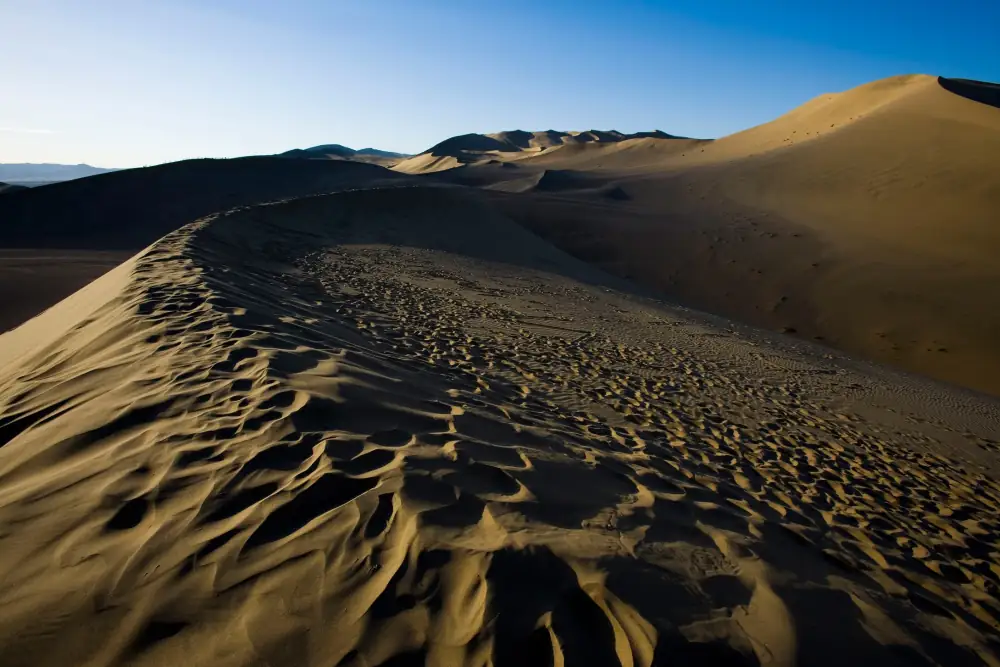
A yardang (a Uyghur word meaning “steep bank”) is a formation produced when wind erodes unconsolidated sedimentary rock (typically lake-bed deposits or loess) that was laid down in a former wet period. The Dunhuang yardangs were originally lake sediments deposited approximately 12,000 years ago during the post-glacial humid period when the Lop Nur basin was a substantial inland sea.
As the climate dried and the lake retreated, the exposed sediments were eroded by the prevailing northwest wind. The erosion pattern is not random: softer clay layers erode faster, harder layers slower, producing the stepped and undercut forms visible today.
The wind still blows constantly from the northwest at 40–80 km/h on average; the formations are still changing, though too slowly to observe in a human lifetime.
The Landscape
The Main Formation Areas
The accessible portion of the geopark is divided into three connected zones serviced by shuttle buses from the entrance:
Zone 1 (孔雀区): Lower, more rounded formations — whale-back ridges and smooth dome shapes. Less dramatic than Zone 2 but better preserved surfaces.
Zone 2 (Moon City 月亮城): The core of the park — tall vertical formations, narrow alleys between ridges, occasional natural arch formations. This is the most photogenic area for wide-angle landscape photography.
Zone 3 (日落区): The furthest from the entrance; a viewing platform for late-afternoon and sunset photography when the low-angle light paints the formations orange-gold.
The Colours
The colour palette is extraordinary: pale yellow in flat overhead light; deep amber to burnt orange in late afternoon; chalk-white to silver in early morning. The formations contain horizontal bands of slightly different sediment compositions — these bands show different colours, creating natural striped patterns across vertical surfaces.
Photography
The Yardang geopark is one of China’s great landscape photography destinations, drawing both professional photographers and serious amateurs.
Best Photography Conditions
Golden hour (1 hour before sunset): The standard advice for good reason — the low-angle northwest light illuminates the vertical faces with warm colour and deep shadows that emphasise the formations’ three-dimensionality. This is the most photographed window.
Blue hour (20–40 minutes after sunset): The sky turns deep blue while the formations retain warmth from the day’s sun; a very brief window but produces images with unusual colour tension.
Overcast days: Diffuse light eliminates harsh shadows but also flattens the colour range; generally less effective for yardang photography than clear-sky conditions.
Dusty conditions: The frequent northwest wind carries fine desert dust that reduces visibility but also creates atmospheric haze layers in the middle distance — sometimes producing landscape photographs of extraordinary depth and mood.
Technical Notes
- Tripod is essential for evening and blue-hour work; the light drops fast.
- Graduated ND filter helps balance the bright sky against the formations.
- Dust protection for camera equipment is non-negotiable — the wind is persistent and the dust is fine enough to enter camera bodies without adequate sealing.
Combining Yardang with the Dunhuang Region
The Yardang geopark is 180 km from Dunhuang city — approximately 2 hours by road each way. Most visitors combine the trip with other sites along the same road:
Jade Gate Pass (玉门关) and Han Dynasty Great Wall
En route to the Yardang, the ruins of the Jade Gate Pass (玉门关) sit alone in the flat desert — a crumbled rammed-earth fort from approximately 121 BCE, marking the western extent of the Han dynasty empire and the point where the Silk Road split into its northern and southern branches.
The adjacent Han Great Wall (汉长城) — older than the Ming-dynasty wall that most visitors associate with “the Great Wall” — is visible as a low earthen ridge running across the desert. Made from compressed layers of reed grass and clay rather than stone, it is less dramatic than the Ming wall but has the weight of greater antiquity: this was built 2,000 years ago by Emperor Wu’s soldiers.
Admission: ¥40 (combined Jade Gate Pass + Han Great Wall site).
Yang Pass (阳关)
Further southwest from the Jade Gate, Yang Pass was the gateway to the Silk Road’s southern branch (passing south of the Taklamakan Desert through Hotan and Kashgar). Tang dynasty poet Wang Wei wrote the most famous farewell poem in Chinese literature here: “Don’t say there are no friends beyond Yang Pass / Among the flowers of the western wind” (勸君更盡一杯酒,西出陽關無故人).
Practical Information
Getting There
From Dunhuang City:
- Shuttle buses leave from the Dunhuang Scenic Area bus station in the morning (approximately 8:30 AM); return trips in the afternoon. Cost: ¥80–¥120 round trip.
- Chartered taxi/car: ¥400–¥500 for a full-day circuit covering Jade Gate Pass, Yang Pass, and the Yardang.
No public transport reaches these sites independently.
Admission
¥100 (Yardang geopark; includes shuttle buses within the park). Often sold as combination tickets with Jade Gate and Yang Pass: ¥150–¥180 for all three sites.
Time Required
A comfortable visit to the Yardang alone requires 3–4 hours on-site. The full-day circuit (Jade Gate Pass + Yang Pass + Yardang) is 8–10 hours including travel.
What to Bring
- Water (minimum 2 litres per person): No water available within the park.
- Sunscreen and full sun protection: UV exposure in the desert is extreme.
- Warm layer for evening visits: Desert temperature drops rapidly after sunset.
- Dust mask or scarf: The wind is constant.
The Yardang landscape asks you to recalibrate your sense of scale. You are standing in a former lake bed. The tallest formations — 20, 30 metres high — were once buried under water. The wind made this, not in a human lifetime but in a geological one. That scale of time, made visible in pale yellow clay, is what the landscape actually is.