
Maiji Mountain Grottoes: China’s Fourth Great Grotto Complex
The shape of the mountain explains its name: Maiji (麦积) means “wheat stack” — a massive cone of red sandstone rising abruptly from the Qinling mountain foothills of southeast Gansu, so dramatically shaped that it looks artificial. Into this cone, carved from the 4th century CE through the Song dynasty (a span of nearly 800 years), Buddhist artists created 194 surviving caves, 7,200 clay sculptures, and 1,300 square metres of murals.
Unlike the Mogao Caves at Dunhuang (flat cliff, linear arrangement), Maiji’s caves are carved into a vertical face and connected by a network of ancient wooden walkways and scaffolding staircases that zigzag across the rock. Visiting Maiji means climbing these platforms, peering into cave interiors, and looking out across a landscape of green mountains — the atmosphere is dramatically different from any other Buddhist grotto site in China.
Why Maiji Stands Apart
The Sculpture Medium
Most of China’s great grotto complexes — Yungang in Shanxi, Longmen in Henan — carve their figures directly from the living rock. Maiji’s sandstone is too soft and crumbly for detailed rock carving; instead, artisans built up figures using clay reinforced with straw and wooden armatures, then painted with mineral pigments.
This medium produces a different aesthetic result: the Maiji figures are more rounded, warmer, more expressive than stone-carved equivalents. The best Northern Wei figures here have a melancholy gentleness that stone cannot easily achieve; the best Sui and Tang figures have a sensuous, human quality that makes them feel less remote from the viewer.
The Setting
The setting at the base of the wheat-stack cone — surrounded by bamboo and pine forest, with a stream running through the valley floor — is among the most beautiful of any Chinese heritage site. Many visitors arrive expecting to rush through the caves and leave; many end up spending longer than planned simply sitting by the stream.
The Historical Phases
Northern Wei (386–534 CE): The Founding Vision
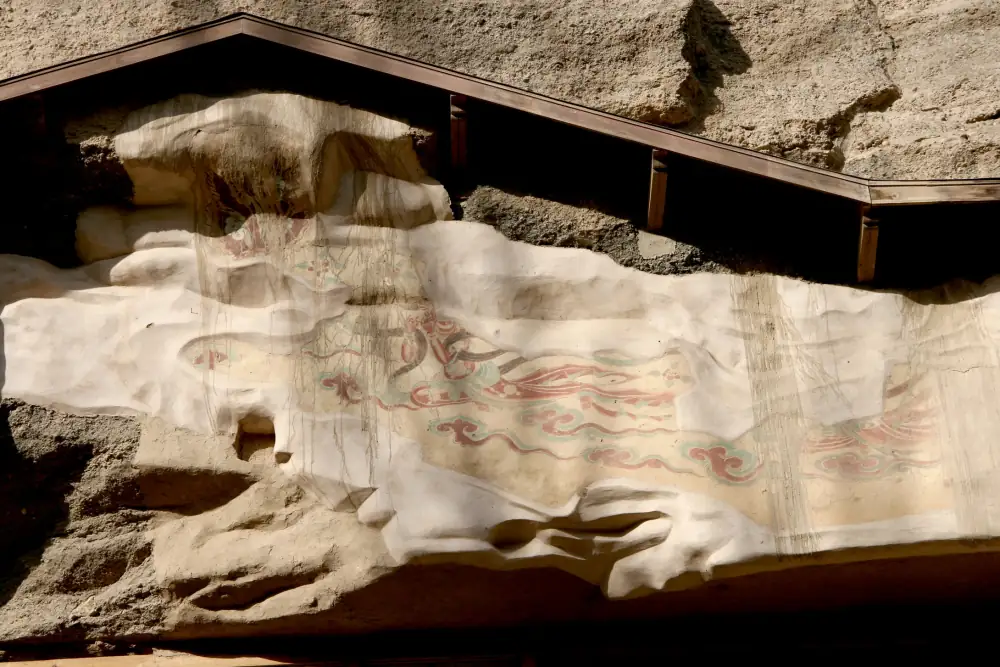
The earliest and smallest caves, concentrated in the southeast face, contain elongated, severe figures reflecting the Central Asian Buddhist artistic tradition arriving via the Silk Road. The drapery folds are stylised; the faces austere and spiritually remote.
Cave 133 (The Master Cave): A large Northern Wei cave with 18 surviving small carved stones (stelae) containing relief sculptures of exceptional quality, each depicting a different scene from Buddhist cosmology.
Western Wei (535–557 CE): Chinese Integration
A brief but artistically significant period when Empress Dowager Yifu directly patronised Maiji; the caves from this period show the rapid Sinicization of Buddhist art — figures become more Chinese in facial type, garments, and posture.
Sui Dynasty (581–618 CE): Monumental Scale
The Sui emperors invested heavily in Buddhism and in Maiji specifically. The two colossal standing Buddhas on the east cliff — 15 and 16 metres tall — were carved in this period. These figures, visible from the valley floor, are the most immediately dramatic sight at Maiji.
Tang Dynasty (618–907 CE): Mature Synthesis
Tang-period figures at Maiji represent the mature synthesis of Indian Buddhist form and Chinese aesthetic sensibility. The bodhisattvas from this period — with S-curve posture, jewelled headdresses, and serene half-smiles — are among the finest small-scale Buddhist sculptures in China.
Cave 5 (Niu Er Cave): A Tang-era pavilion cave with a particularly outstanding set of attendant bodhisattvas.
Song Dynasty (960–1279 CE): Folk Religion
Later additions reflect the Sinicization of Buddhist iconography — figures increasingly resemble Chinese court officials and aristocratic women; the divine remoteness of the Northern Wei has given way to familial warmth.
The Scaffold Walkways
The experience of walking the wooden walkways at Maiji is unique. The main scaffold structure — rebuilt and maintained continuously since the original Tang-dynasty construction — zigzags up the cliff from the valley floor to the highest accessible cave at approximately 80 metres.
The view from the highest walkway over the valley is extraordinary; the sense of height and exposure varies depending on your tolerance for heights (the walkways have handrails but the exposure is real).
Note for visitors with height anxiety: Several major caves can be accessed from ground-level walkways without ascending the upper scaffold sections.
Visiting Maiji Mountain
Access
Tianshui City (天水) is the gateway to Maiji Mountain — a 35 km, 50-minute bus ride from the city to the scenic area.
From Xi’an: High-speed train to Tianshui (1.5 hours, ¥95). Tianshui is also a worthwhile destination in its own right — the Fuxi Temple (伏羲庙), dedicated to the mythological ancestor-deity of the Chinese people, is one of the largest and most active traditional religious sites in northwest China.
From Lanzhou: High-speed train to Tianshui (45 minutes, ¥65).
Admission and Tours
Admission: ¥90 (general entrance); Special permission caves (six highly significant caves viewable only on escorted tours): ¥30–¥50 additional per cave. Guided art history tours in Chinese available at the scenic area office (¥100–¥200).
Note: Photography within the caves is restricted — no flash, limited to certain caves. The scenic area enforces this policy more strictly than some other grotto sites.
Hours: 8:30–17:30 (summer); 9:00–17:00 (winter). Closed certain Monday mornings for maintenance.
Best Season
- Spring (April–June): Mountain forests in full leaf; rhododendrons blooming on the hillsides; atmospheric but potentially rainy.
- September–October: Clear skies; autumn colours on the surrounding mountains; best overall conditions.
- Summer (July–August): Warm and lush; occasional fog on the mountain (adds atmosphere for some photographers).
Combining Maiji with the Silk Road
Maiji Mountain sits at the eastern end of the Silk Road’s Gansu corridor — the portion of the ancient trade route that ran from Xi’an through Tianshui, Lanzhou, and Wuwei to Dunhuang and the western regions.
A logical itinerary combines:
- Xi’an (terracotta warriors, Tang dynasty capital) → Tianshui/Maiji (Buddhist art, Silk Road beginning) → Lanzhou (Yellow River capital) → Zhangye (Danxia rainbow mountains, Marco Polo’s city) → Jiayuguan (western end of the Ming Great Wall) → Dunhuang (Mogao Caves, Singing Sand Dunes).
This 8–10 day journey follows the Silk Road from its Chinese capital to the gateway of Central Asia — and Maiji, the first major Buddhist art site on the route heading west, sets the context for everything that follows.
Maiji Grottoes are not the most famous of China’s great Buddhist cave complexes — that distinction belongs to Dunhuang. But for the traveller who values intimacy over fame, the smaller scale, the green mountain setting, and the warm clay figures that seem almost alive make Maiji the most personally affecting of the four.