
Table of contents
Open Table of contents
Mingsha Shan — Singing Sand Dunes (鸣沙山)
Why the Dunes “Sing”
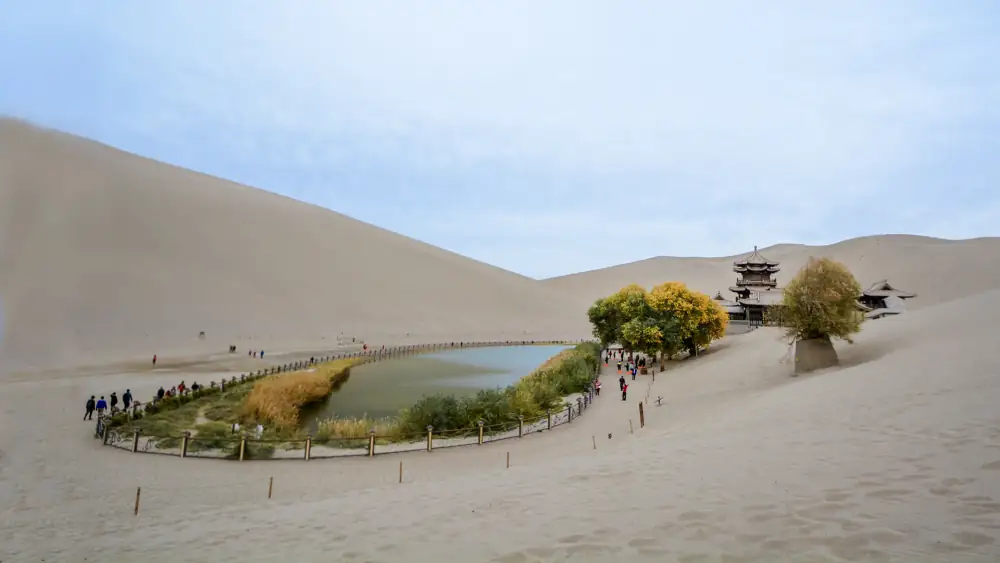
Under certain conditions — usually when wind moves across the crescent-shaped dune crests — the sand emits a low resonant sound, somewhere between a drone and a hum, sometimes rising to a roar. The effect is caused by the rapid movement of fine, uniform sand particles creating standing pressure waves. Ancient travellers were understandably unnerved.
The dunes cover an area of about 40 square kilometres immediately south of Dunhuang city. The highest point of the main dune ridge is 250 metres above the valley floor; the main dune crest runs for about 45 km east-west.
Crescent Lake (月牙泉)
The lake is roughly 218 metres long and 54 metres wide. Its crescent shape exactly mirrors the bowl shape of the surrounding dune crest above it, suggesting that the dune topography controls the groundwater emergence that feeds the lake. Despite the encroaching desert, the water level has been artificially maintained since 2000 after it dropped critically in the 1990s — a combination of groundwater pumping and direct supplementation.
The water is clear and brackish; reflected light from the surrounding sand gives it an emerald-turquoise colour that varies dramatically depending on the angle of sunlight.
Activities at Mingsha Shan
Sunset Viewing (Highly Recommended)
The most popular and, genuinely, the best way to experience Mingsha Shan is to climb the main dune crest for sunset. The climb takes 40–60 minutes via a wooden stairway up the windward face of the main dune. The view from the crest takes in the full crescent lake below, the Dunhuang oasis spreading into the north, and the Qilian Mountains on the horizon 200 km away.
In the last hour before sunset, the dune face turns from gold to deep amber to rose, while the lake below reflects the changing sky. It’s one of the genuinely great sunsets in Asia.
Arrive at the park by 16:00 for a comfortable sunset climb. The dunes are busiest on weekends and Chinese holidays; even then, the sheer scale means you can find space.
Camel Riding
Camel riding along the base of the dunes is the signature tourist activity and is genuinely enjoyable — the camels are calm, the pace relaxed, and the views of the dune face from camel-back give a different and better-scaled perspective than viewing from the ground.
Price: ¥100–¥130 per person for the standard 40-minute circuit. Prices are set; politely decline offers to add on additional segments.
Best time: Morning (07:00–10:00) for soft light and fewer other riders in the scene; or as part of the sunset experience.
Sand Boarding and Sand Sliding
Rental sand boards and sleds are available at the park entrance for ¥30–¥50 ($4–$7). The steep face of the main dune provides good runs. Going up requires effort; coming down very much doesn’t.
The Crescent Lake Walk
A wooden walkway circles the lake, allowing a full circuit at water level — about 30 minutes of walking, with constant changing perspectives on the lake and dune face above. Photography from the northern end of the lake with the main dune reflected in the water is the classic shot.
Ticket Information
Mingsha Shan and Crescent Lake entrance: ¥120 ($17) April–November; ¥80 ($11) December–March. Open daily 06:00–21:00 (extended hours in summer).
Camel riding: ¥100–¥130 per person (additional to entrance). Not included.
Cable car (alternative ascent to dune crest): ¥30 per person up; stairs down for free.
Mogao Caves (莫高窟)
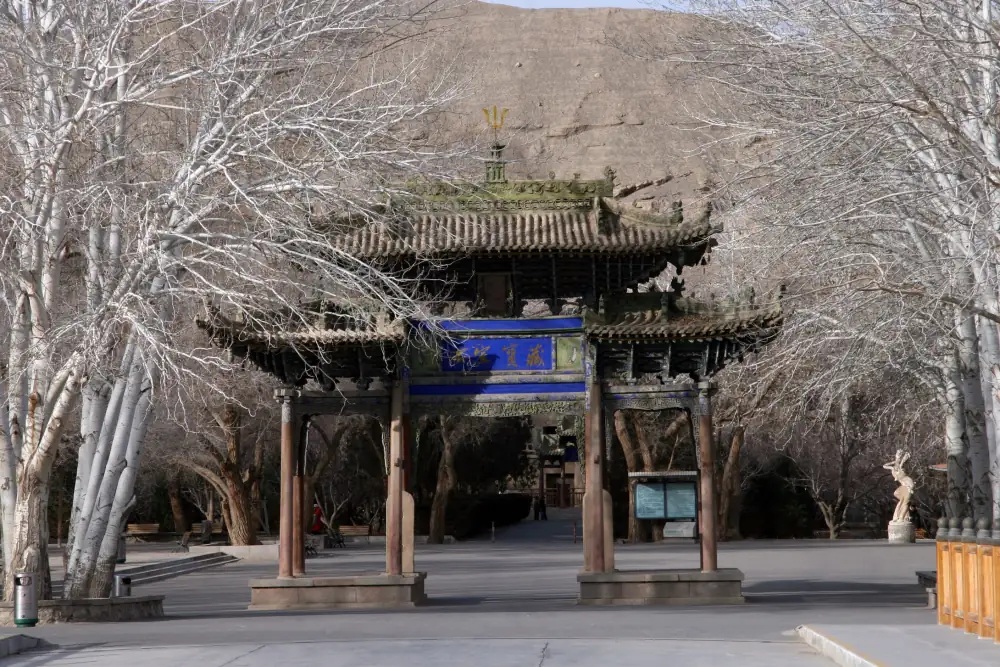
No visit to Dunhuang is complete without the Mogao Caves — a cliff-face complex of 735 Buddhist cave temples carved and painted over a period of 1,000 years (4th to 14th century CE). The scale and quality of the paintings and sculpture inside make it one of the world’s greatest cultural heritage sites.
Given the length of the Mogao Caves experience, we cover it in full in a separate guide. Key logistics:
Booking is mandatory: Online booking through the official Mogao website is required weeks in advance for standard visits (tickets: ¥238, $33, including 8 caves). The “Mogao Special Experience” tickets (¥298–¥398, $42–$56) offer more caves with fewer visitors.
Best approach: Combine Mogao (morning) + Mingsha Shan sunset (afternoon-evening) as a single day in Dunhuang. Two full days covers both properly.
Getting to Dunhuang
From Jiayuguan (End of the Great Wall)
High-speed rail: Jiayuguan to Dunhuang by high-speed train, approximately 1.5–2 hours; tickets ¥80–¥130 ($11–$18). The 2022 Jiayuguan-Dunhuang high-speed rail extension dramatically improved access.
Regular train: Jiayuguan to Dunhuang, approximately 4 hours on regular services.
From Lanzhou
High-speed rail: Lanzhou West to Dunhuang North, approximately 3.5–4 hours; tickets ¥200–¥320 ($28–$45).
By Air
Dunhuang Airport (DNH) has direct flights from:
- Lanzhou (1 hour; from ¥200)
- Xi’an (2 hours; from ¥400)
- Urumqi (2 hours; from ¥500)
- Chengdu and Beijing (seasonal)
Flying is often the most practical option given Dunhuang’s remoteness.
Getting Around Dunhuang
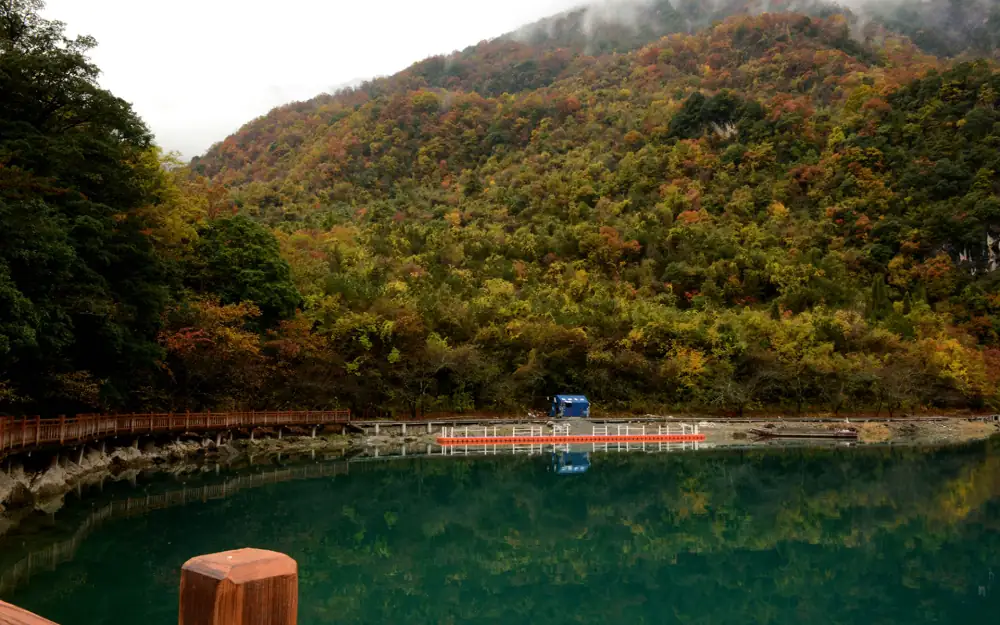
Dunhuang is a small oasis city and the main attractions are within 5–15 km of the centre.
- Taxi: Metered; ¥10–¥20 ($1.4–$3) to most sites
- Bicycle hire: Available widely from ¥20–¥40/day ($3–$6); pleasant way to reach the dunes
- Electric scooter hire: ¥50–¥80/day ($7–$11); practical for covering more ground
- Tourism shuttles: Regular shuttle buses serve the Mogao Caves from the city centre (¥8, 20 minutes)
Where to Stay
Dunhuang has a compact but well-developed tourism hospitality sector.
Budget (¥100–¥200 / $14–$28): Several guesthouses and hostels near the main Shazhou Night Market area. Yha Dunhuang Silk Road Hostel is a backpacker favourite with good common areas.
Mid-range (¥280–¥600 / $39–$84): Silk Road Dunhuang Hotel — a compound of Silk Road-themed buildings near the dunes; ¥350–¥550/night. Excellent location and ambience.
Upscale (¥800+ / $112+): Dunhuang Impressions Hotel and The Silk Road International Hotel are the flagship properties. Both have pools and spa facilities — very welcome after a day on the dunes.
Best Time to Visit
Spring (April–early June): Excellent. Temperatures are warm (20–30°C), the dune light is beautiful, and it’s before peak summer crowds. Strong desert winds are possible in April.
Autumn (September–October): My personal favourite. Post-monsoon dust has settled, skies are very clear, temperatures are perfect. October is the best month if you can avoid the October 1 Golden Week crowds.
Summer (July–August): The most popular season despite the heat (35–40°C at noon). Spectacular sunsets; the dunes are at their most dramatic in summer afternoon light. Avoid midday outdoor activities.
Winter (November–March): Cold (-10 to 5°C) but the dunes are quiet and hauntingly beautiful. The lake can develop ice at its edges. Flights are less frequent.
Shazhou Night Market (沙州夜市)
Dunhuang’s famous night market runs along Shazhou Road in the city centre and is one of the best night markets in northwest China. Dozens of vendors sell:
- Dunhuang noodles (驴肉黄面 — yellow noodles with donkey or beef)
- Roasted lamb skewers (羊肉串)
- Apricots, melons and dried fruit from the oasis orchards
- Craft items, Silk Road souvenirs
The market is best from 18:00–23:00 in summer. A filling meal from multiple vendors costs ¥30–¥60 ($4–$8).
Practical Tips
- Footwear: Sand shoes or closed trail shoes for dune climbing; sandals pack with sand, flip-flops are useless on a steep dune face. Bring a bag to carry shoes if you want to go barefoot on the warm sand.
- Heat management: The dune surface temperature on a summer afternoon can reach 60°C. Walk on the shaded sides; use the dune wooden walkways where provided.
- Photography: A polarising filter dramatically improves sand and sky contrast. Shoot into the sun at golden hour (1 hour before sunset) for the most dramatic dune shadows.
- Sand and cameras: Wind-blown fine desert sand is extremely damaging to camera mechanisms. Use a camera bag in windy conditions; keep lenses capped when not shooting.
- Water: Carry at least 1.5 litres per person for a dune climb. Dehydration comes fast in the desert heat.
- Booking ahead: Summer weekends see full accommodation; book Dunhuang hotels at least 2 weeks in advance in July–August, and Mogao tickets 3–4 weeks in advance year-round.
A Perfect 2-Day Dunhuang Schedule
Day 1:
- 09:00: Mogao Caves tour (pre-booked)
- 13:00: Lunch and rest through the hottest afternoon hours
- 16:00: Head to Mingsha Shan
- 17:00–19:00: Dune climb and sunset
- 19:30: Camel ride at base of dunes
- 20:30: Shazhou Night Market dinner
Day 2:
- Morning: Dunhuang Museum and Han Dynasty Great Wall ruins (Yumen Pass and Yang Pass, 80 km west)
- Afternoon: Western Thousand Buddha Caves (西千佛洞) — less visited than Mogao but still impressive
- Evening: Depart or another night
Final Word
Dunhuang is one of those places where the landscape, the history and the culture coalesce into something that feels genuinely irreplaceable. The dunes alone would justify the journey. The Mogao Caves alone would justify the journey. Together they make a destination that belongs on every serious China traveller’s list — however remote it seems from Beijing or Shanghai.