
Table of contents
Open Table of contents
The Jiayuguan Fort Complex
The Jiayuguan Fort (嘉峪关关城) is the undisputed centrepiece of any visit. Built over the course of the Ming dynasty, the fort complex comprises inner and outer walls, watchtowers, garrison buildings, and the iconic gate towers that have featured in so many photographs of the western Great Wall. Unlike the more famous sections near Beijing, this section is not just a wall — it’s a complete military installation designed to control movement across the critical Hexi Corridor.
What you’ll see:
The outer fortification wall encloses a large area with the inner citadel at its heart. The main gate towers (Guanghua Lou facing east, Rouyi Lou facing west) are architecturally spectacular — three-storey wooden gate towers perched on the thick rammed-earth walls, painted in Ming-era colours that have been carefully restored. The western gate, opening toward the Gobi, is particularly atmospheric: this was literally the last gate Chinese travellers passed through heading west.
Inside the inner walls, there are exhibition halls covering the history of the fort and the western Great Wall, the lives of the garrison soldiers, and the broader Silk Road context. The multi-level wall-top walkways give excellent views over the surrounding desert landscape.
Tickets: ¥120 per person (combined ticket with Overhanging Great Wall and First Beacon Tower). Open 8:00am–7:00pm in summer, 8:30am–5:30pm in winter.
Allow 2–3 hours for a proper visit to the fort complex itself.
The Overhanging Great Wall (悬壁长城)
Eight kilometres north of the city, the Overhanging Great Wall climbs steeply up the rocky Black Mountain face — the northern anchor point of the Jiayuguan defensive system. The restored section follows the original Ming alignment, rising at a dramatic angle up the hillside that gives the section its name.
The climb to the highest point takes about 20 minutes and offers sweeping views south across the Hexi Corridor to the snow-capped Qilian Mountains. This is one of the most photogenic sections of any Great Wall in China — the combination of the steep wall angle, the bare desert landscape, and the mountain backdrop on clear days is genuinely stunning.
Included in the ¥120 combined ticket. About 30–45 minutes for the visit.
The First Beacon Tower (悬壁长城 第一墩)
Seven kilometres south of the city, on the banks of the Taolai River gorge, stands the First Beacon Tower — the southernmost point of the Jiayuguan defensive system, anchoring the wall to the natural barrier of the river canyon. The tower itself, partially eroded but still substantial, stands on the edge of a dramatic cliff above the rushing river. The gorge here is genuinely spectacular, with layered canyon walls dropping sharply to the water.
The surrounding area has been developed into a scenic park with viewing platforms, a suspension bridge, and an archaeological dig area where excavations have revealed sections of Han dynasty wall predating the Ming construction. There’s also a small but interesting museum about the beacon fire communication system used along the Great Wall.
Included in the ¥120 combined ticket. Allow 1–2 hours.
Jiayuguan Museum and Great Wall Cultural Centre
A large modern museum complex in the city covers the history of the Hexi Corridor from prehistoric times through the Silk Road period and into the present. It’s well-curated by Chinese museum standards, with good English labelling in the main permanent galleries. The Great Wall section is particularly strong, with architectural models, excavated artifacts, and documentation of the construction techniques.
Separate admission: ¥30. Open Tuesday–Sunday 9am–5pm.
Wei Jin Period Tombs (魏晋壁画砖墓)
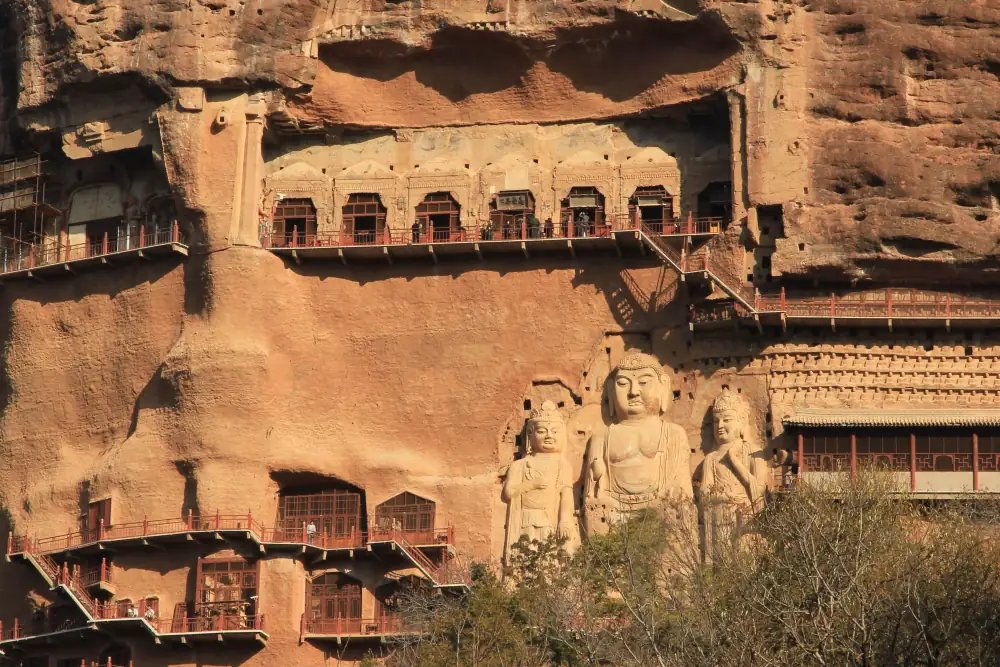
About 20km east of the city, the Wei-Jin Tombs (3rd–4th century CE) contain some of the most extraordinary surviving examples of early Chinese figure painting — 1,460 painted bricks depicting life scenes from the period in a style quite different from the court art of the same era. These are working-class people going about their daily lives: farming, cooking, hunting, playing music. The archaeological site is genuinely remarkable, and one tomb (Tomb No. 6) is open for visitors to walk through.
Ticket: ¥31. The site is best reached by taxi (¥30–40 from the city centre) as public transport is infrequent.
Silk Road Context
Jiayuguan’s significance extends beyond the wall itself. For the entire period of the Silk Road (roughly 200 BCE to 1400 CE), the Hexi Corridor — the narrow strip of habitable land between the Qilian Mountains and the Gobi — was the primary route for trade and cultural exchange between China and Central Asia, the Middle East, and ultimately Europe. Jiayuguan controlled the narrowest and most strategically critical point of this corridor.
Evidence of this history is everywhere: the coins, silks, papers and goods in the museum; the cosmopolitan figures in the Wei-Jin tomb paintings; the place names in the surrounding area (towns named for Sogdian traders who settled here in the Tang dynasty). This context transforms what might otherwise seem like a collection of historical buildings into something much richer — a physical encounter with global history.
Getting to Jiayuguan
By High-Speed Train: Jiayuguan Nan (South) station is on the Lanzhou–Urumqi high-speed rail line, one of the world’s longest and most spectacular rail journeys. Connections include:
- Lanzhou: approximately 2.5–3 hours, tickets ¥150–250 (second class)
- Zhangye: approximately 50 minutes, tickets ¥60–90
- Dunhuang South (via connecting train to Dunhuang): transfers required, total journey 3–4 hours
By Conventional Train: Jiayuguan station (on the original Lianhuo rail line) connects to more destinations but at slower speeds. Useful for budget travellers taking overnight sleeper trains.
By Air: Jiayuguan Airport (JGN) has flights to Lanzhou, Xi’an, Beijing, and Urumqi. Limited services — check availability in advance.
Getting around the city: Taxis (¥8 starting fare) and Didi. The three main historical sites (Fort, Overhanging Wall, First Beacon Tower) require transport — they’re not walkable from the city centre. A full day taxi charter for all three sites typically costs ¥150–250, which is good value for groups.
Where to Stay
Jiayuguan has a functional range of accommodation centred around the main commercial areas near the fort and the station areas.
Budget: Budget chains (7 Days, Hanting) near the city centre, ¥130–220 per night.
Mid-range: Three-star hotels in the central area, ¥250–450 per night. The Jiayuguan Silk Road Hotel and similar properties offer good value and convenient location.
Upscale: The Jiayuguan Grand Hotel and Hongda Hotel offer four-star standards at ¥450–800 per night.
Local Food in Jiayuguan
Gansu cuisine here draws on the Northwest Chinese tradition — robust, warming, and built around wheat and lamb.
Niurou Lamian (牛肉拉面): Hand-pulled beef noodles in a clear broth — Gansu’s most famous contribution to Chinese food. The version here uses the Lanzhou style, but with subtle regional variations. A full bowl costs ¥12–16 at local shops; avoid tourist-area versions that charge ¥20+ for inferior quality.
Lamb dishes: Roasted whole lamb (全羊), braised lamb (红焖羊肉), and lamb on flat bread are all worth trying. A lamb hotpot (羊肉火锅) for 2 costs ¥80–150.
Pita bread variations: Various flatbreads with fillings are sold at street stalls near the old market area. ¥5–12 each.
Where to eat: The area around the pedestrian shopping street (步行街) near the city centre has the highest concentration of restaurants. The night market near the Fort road is good for local street food.
Practical Tips for 2026
Sunscreen and sunglasses: Essential. The desert air is clear and the UV radiation at altitude (1,740m) is intense. Most visitors from other parts of China are noticeably more sunburned here after a day outdoors.
Wind: Jiayuguan is famously windy, particularly in spring (March–May). The locals call it “a land where a stone can be blown away.” A scarf or buff is useful.
Best season: Late April–early June and September–October. Summer is hot (35°C+) but manageable. Winter sees temperatures dropping below -15°C and the fort has a dramatic quality in snow.
Combined itinerary: Jiayuguan + Zhangye (Rainbow Mountains) + Dunhuang is the classic Gansu Hexi Corridor itinerary, covering 3–5 days. High-speed rail connects all three. Lanzhou as a starting point adds 1–2 more days for the city’s beef noodles and Yellow River waterwheel scenery.
Photography: The Fort complex at sunset, with the Qilian Mountains to the south and the wall glowing golden, is exceptional. The western gate with the desert stretching beyond is one of China’s most powerful historical photographs.
The historical weight of Jiayuguan — the last gate of Chinese civilization, the beginning of the wilds — is genuinely palpable here. This isn’t a reconstructed heritage experience; it’s a direct encounter with one of history’s great chokepoints, still standing in its desert setting, still staring out across the Gobi.