
Table of contents
Open Table of contents
The Lanzhou Beef Noodle Legend
Let’s start with the food because it defines the city. Lanzhou Beef Noodle Soup (兰州牛肉面, 兰州拉面) is arguably the most widely eaten breakfast in China. Some estimates suggest over 1 billion bowls are served annually across the country. Every Chinese city has Lanzhou noodle restaurants, but the soup they serve is rarely the same as the original.
The authentic Lanzhou version adheres to specific principles: “一清 二白 三红 四绿 五黄” — clear broth, white radish, red chili oil, green coriander/garlic shoots, yellow noodles. The five-color rule.
The broth: Beef and bone-based, simmered for hours, entirely clear — no cloudiness, no fat visible. The flavor is clean and deep simultaneously.
The noodles: Hand-pulled to order, in the specific thickness and shape you choose. Standard widths from finest (毛细, hair-thin) to widest (大宽, wide ribbon). The cook pulls an individual serving of dough, stretching it through a specific sequence of cross-body movements that produce the required shape. Watching this is worth arriving early.
The chili oil: A separate red oil added to taste — don’t skip it even if you’re cautious about spice; without it the soup is incomplete.
Where to Eat Lanzhou Noodles
Most restaurants open by 5:30–6am and close when the day’s broth is finished (usually by 10am for breakfast crowds; some reopen for lunch).
- Ma Ji Beef Noodles (马记牛肉面): Often cited as one of the best in the city. Near Zhangye Road (张掖路) area. Queue by 7am on weekdays.
- Chen Jiaju Niurou Mian (陈记钧牛肉面): Another well-regarded option near Guangchang area.
Price: ¥8–14 for a bowl, depending on size. This is daily food, not tourist food — no markup.
Yellow River Riverside
The North Riverside Park (北滨河路)
The north bank of the Yellow River through Lanzhou has been developed into a continuous riverside walkway and park that stretches for over 20km. Walking or cycling sections of this is the best way to experience the city’s relationship with the river.
Character of the Yellow River here: In Lanzhou, the Yellow River is already substantial — about 300m wide — but still running through a confined valley. The sediment load that gives the river its name hasn’t fully built up yet (that happens downstream in the Loess Plateau), so the water at Lanzhou is sometimes more greenish-brown than full yellow. The river runs fast and deliberately through the canyon, with a force that explains why the ancient ferries required such skill.
Sunsets over the river: The west-facing riverside gives sunset views over the river gorge that are genuinely dramatic — the combination of water, sandstone cliffs, and pollution-filtered light (honest assessment: Lanzhou has air quality issues from its basin geography) can produce vivid oranges and reds.
Sheepskin Raft Rides (羊皮筏子)
The traditional Yellow River ferry of the Lanzhou region — a sheepskin raft made from inflated goatskins lashed together — is one of China’s most unusual traditional transport methods. The operator lies flat on the raft, using a small paddle, and drifts with the current while guiding toward the opposite bank.
Sheepskin raft rides for tourists now operate on a section of the riverside. Cost: ¥30–50 for a short river crossing experience. This is tourism, not the genuine traditional crossing, but the experience of being on the Yellow River on a sheepskin raft at water level is still memorable.
Operational season: Mainly May–October.
Waterwheel Park (水车博览园)
Lanzhou was historically famous for its enormous wooden waterwheels (水车) that lifted Yellow River water for irrigation — similar in principle to the Hama waterwheels of Siria. At their peak in the early 20th century, over 150 wheels operated along the Lanzhou riverfront.
The Waterwheel Park at the western section of the riverside has reconstructed examples of these traditional wheels. Entry: ¥20. The wheels are still functional — watching them turn and lift water is genuinely pleasant.
White Pagoda Mountain (白塔山)
The distinctive White Dagoba (白塔, a Tibetan-style Buddhist stupa) on the north bank of the river at the Zhongshan Bridge area is Lanzhou’s most recognized landmark. The mountain park has viewpoints looking south over the entire city and river from various elevations.
Getting up: Walking stairs (30 minutes) or cable car (¥30). The view from the top at sunset is probably the best urban view in Lanzhou.
Entry: ¥30/person.
Zhongshan Bridge (中山桥)
The Yellow River Bridge at Zhongshan Road, built in 1909 during the late Qing Dynasty by a German engineering firm. It was the first modern iron bridge across the Yellow River and for a period was the longest railway bridge in Asia. Now a pedestrian bridge, it remains in daily use and is the most atmospheric crossing of the river in Lanzhou.
Walk the bridge at dawn and dusk — the river and mountain light from the bridge’s midpoint is excellent.
Free, 24 hours access.
Gansu Provincial Museum (甘肃省博物馆)
The Gansu Provincial Museum is home to the “Flying Horse of Gansu” (马踏飞燕, also called “Galloping Horse Treading on a Swallow”) — a Han Dynasty bronze sculpture that has become China’s national tourism symbol. The original horse is extraordinary; a copy appears on Chinese tourism signage everywhere.
Beyond the famous horse, the museum has an exceptional Silk Road collection covering the Buddhist art, agricultural tools, and daily life artifacts of ancient Gansu’s trade route position.
Entry: Free; book online. Open Tuesday–Sunday 9am–5pm. Allow 2–3 hours.
Day Trip from Lanzhou: Bingling Temple Grottoes (炳灵寺石窟)
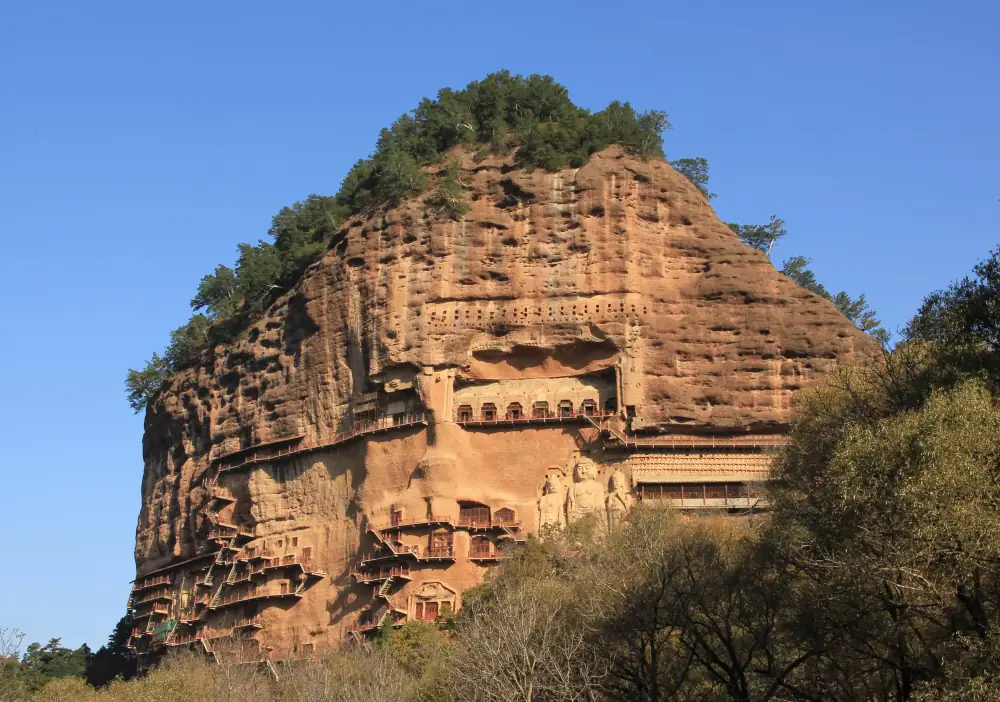
The Bingling Temple Grottoes (75km from Lanzhou, accessible by boat across the Liujiaxia Reservoir) are one of Gansu’s great Buddhist cave art sites — 183 caves with sculptures and murals dating from the Western Qin Dynasty (385 CE) through the Ming Dynasty. The setting, with the caves embedded in red sandstone cliffs above a turquoise reservoir, is spectacular.
Access: Morning boats from Liujiaxia town (刘家峡, 75km from Lanzhou) at 8am and 9am. Return afternoon. Tour packages from Lanzhou: ¥150–200/person including boat and entry.
Entry: ¥50/person plus boat fees.
Getting to Lanzhou
By Train:
- From Xi’an North: 1.5 hours by high-speed train, ¥100–150
- From Zhangye (Rainbow Mountains): 2.5 hours by HSR, ¥100–130
- From Beijing West: 6.5 hours by HSR
- From Chengdu: 4 hours by HSR via Guangyuan
Lanzhou has two main train stations: Lanzhou Station (兰州站) in the center and Lanzhou West Station (兰州西站) for high-speed rail, 30 minutes west of center.
By Air: Lanzhou Zhongchuan International Airport (LHW) has connections to all major cities. Airport to city center: 60–70 minutes by bus (¥30) or 40 minutes by taxi (¥80–100).
Gansu Silk Road Connections
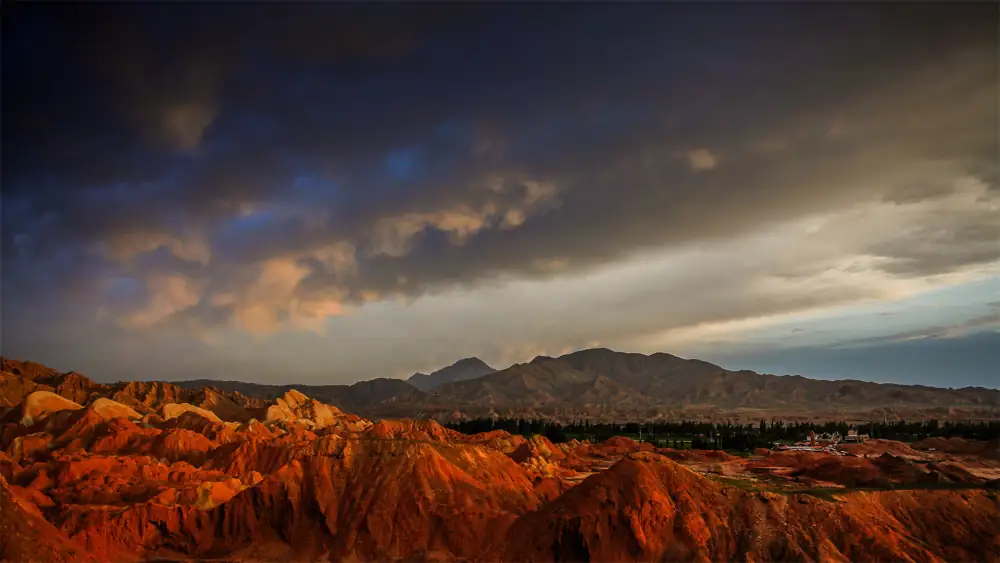
Lanzhou’s significance is as much as a departure point as a destination. From here, the Silk Road extends northwest through the Hexi Corridor:
- Zhangye (张掖, Rainbow Mountains): 2.5 hours by HSR. The Zhangye Danxia Rainbow Mountains are one of China’s most visually spectacular geological attractions — layered red, yellow, orange, and green sandstone formations.
- Jiayuguan (嘉峪关): 3 hours by HSR. The western end of the Great Wall at the Jiayuguan fortress — the “First Pass Under Heaven.”
- Dunhuang: 6+ hours by train. The Mogao Caves with their extraordinary Buddhist murals are one of the world’s greatest cultural heritage sites.
- Xiahe (Labrang Monastery): 4 hours by bus (see separate guide).
Where to Stay
Budget (¥100–200/night): Several hostels and guesthouses near the Zhongshan Bridge area and the train station.
Mid-range (¥200–400/night):
- Crowne Plaza Lanzhou (兰州皇冠假日酒店): Well located, reliable quality, from ¥350/night
- Jincheng Hotel (金城宾馆): A Lanzhou institution, from ¥200/night
Practical Information
Best season: Spring (April–May) and Autumn (September–October). Summers are hot but dry. Winters are cold (-10°C) but the city remains fully operational.
Air quality: Lanzhou sits in a basin and historically has had significant air pollution. Air quality has improved substantially with industrial relocation policies since 2015, but can still be poor on still days. Check AQI before sensitive outdoor activities.
Altitude: Lanzhou sits at 1,520m — noticeable but not a problem for most visitors.
Language: Lanzhou dialect is distinctive but Mandarin universally understood. Local people are characteristically direct and unpretentious.
Lanzhou is the right kind of unglamorous. It doesn’t market itself, doesn’t try to be something it isn’t, and the bowl of noodles you eat here at 7am — with the Yellow River visible through the steam — will be better than any “Lanzhou noodle” restaurant outside the city has ever produced.