
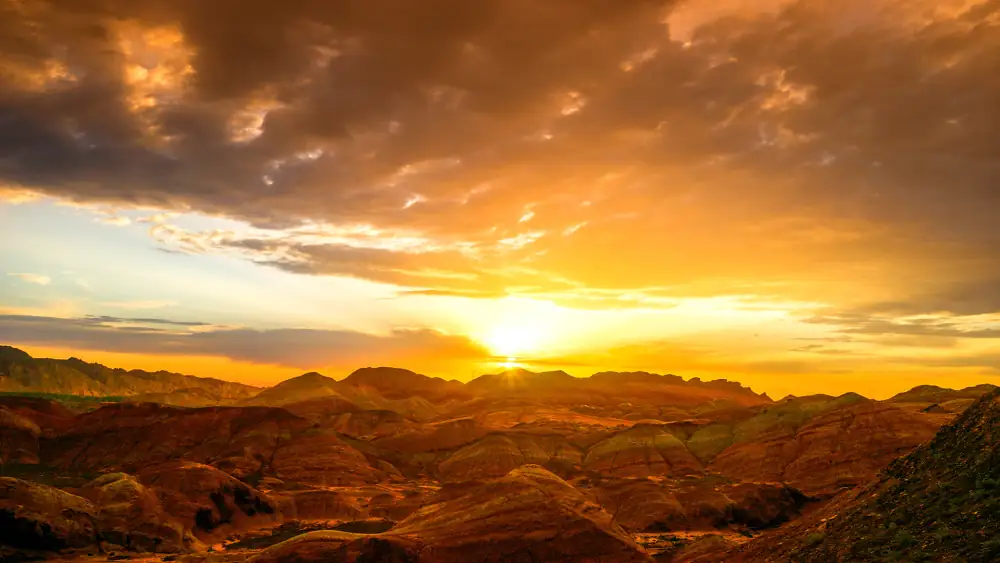
The Zhangye Danxia National Geopark in Gansu Province contains the most vibrantly colored geological formations in the world — layered sedimentary rock strata in reds, oranges, yellows, greens and purples that create landscapes resembling an abstract painting scaled to mountain dimensions. The colors were deposited over 24 million years as iron oxide, manganese dioxide and other minerals settled in alternating layers; subsequent tectonic uplift, wind erosion and water erosion have sculpted the exposed bands into flowing ridges, rounded peaks and sharp pinnacles.
For photographers, Zhangye Danxia offers some of the most rewarding landscape photography in Asia — particularly in the 30 minutes before and after sunset, when low-angle light intensifies the warm tones and throws the ridgelines into sharp relief.
The Viewpoints
The geopark has four main scenic areas (景区), each with multiple viewing platforms:
Qicai Danxia (七彩丹霞 — Seven Color Danxia)
The most famous and most photographed section. Three major viewpoints are connected by a shuttle bus and walkway system:
Viewpoint 1 (一号观景台): The classic panoramic view. The widest angle; the viewpoint looks out over a broad sweep of colored ridges with no obstructions. This is where most postcards and stock photos are taken.
Viewpoint 2 (二号观景台): Lower elevation; more intimate; the colors here have stronger green and purple bands than the red-dominant Viewpoint 1.
Viewpoint 3 (三号观景台): The “palette” view — named for the multi-colored horizontal bands most clearly visible here. The colors here are at maximum complexity.
Viewpoint 4 (四号观景台): Elevated plateau; the most dramatic terrain shapes (eroded peaks and spires); less vivid color than the lower three but more three-dimensional.
Bing Gou (冰沟丹霞 — Ice Valley Danxia)
A different section with larger, more angular formations. The name refers to the ice-sculpted valleys between the sandstone pillars. Less crowded; the formations are more impressive for their scale and drama but less brilliant in color.
Golden Hour and Photography Strategy
Sunset: The undisputed best time. The sun sets to the northwest; the warm orange and red light falls directly onto the southwest-facing ridges of Viewpoints 1 and 2, intensifying the iron-oxide reds to an almost supernatural intensity. The window of best light is approximately 30 minutes before sunset to 15 minutes after.
Actual times (Gansu summer): Sunset around 20:00 local time (Beijing time) in July. The geopark nominally closes at 19:00 but many visitors stay until actual sunset.
Strategy: Take the shuttle bus to Viewpoint 3 on arrival; work backward to Viewpoints 2 and 1 as the light improves. Position yourself at Viewpoint 1 for sunset.
Morning light: Less dramatic than sunset (the sun rises behind the mountains from the east, creating front light on the northeast faces rather than the main viewpoints). Still worth an early visit for cooler temperatures, morning mist and fewer crowds.
Cloud: Partial cloud cover often enhances the shot — shafts of light creating patterns across the ridges, and clouds with flat bottoms at ridge height reflecting color downward.
Camera Settings Recommendations
Aperture: f/8–f/11 for maximum depth of field (you want sharpness from foreground to horizon)
ISO: Start at ISO 100; increase as light fades in the final 15 minutes before dark (ISO 400–800)
Shutter speed: Dictated by lighting; use a tripod in the final 30 minutes of golden hour
Filters: A circular polarizer reduces sky glare and can intensify the color saturation; be careful not to over-polarize (this creates an artificial look). A 3-stop ND filter for long exposures is overkill here — you want the colors, not motion blur.
White balance: Shoot RAW for maximum post-processing flexibility. If shooting JPEG, set Kelvin temperature manually at 4,800K–5,200K rather than Auto WB (which will try to neutralize the warm golden light).
Focal length: A wide-angle (16–24mm) captures the full panoramic sweep; a short telephoto (70–135mm) compresses the layers into abstract bands of color. Bring both.
Getting There
Nearest city: Zhangye (张掖市)
By high-speed train:
- From Lanzhou West: 2 hours, ¥100–150
- From Xining: 1.5 hours, ¥90
- From Dunhuang: 3 hours, ¥140–200
From Zhangye:
- The Danxia geopark is 40 km southeast. Shuttle buses from Zhangye bus station (¥20 return); or Didi (¥60–80).
- Many travelers join organized day trips from Zhangye (¥100–200 including transport, not entry).
Entry fee: ¥75; geopark shuttle bus ¥20
Hours: 08:00–18:30 (with many visitors staying later for sunset; enforcement varies)
When to Visit
Best months: July–September for most vivid colors after summer rain saturates the minerals; October for clearest skies and fewer tourists.
Avoid: Major Chinese national holidays (October 1–7 Golden Week) when the platforms are extremely crowded. Weekday July and August visits are much more manageable.
Rain: A brief rain followed by clearing is actually ideal — the wet surface makes the colors more saturated and the departing clouds create dramatic skies. But heavy rain makes the clay paths dangerous.
The Silk Road Context
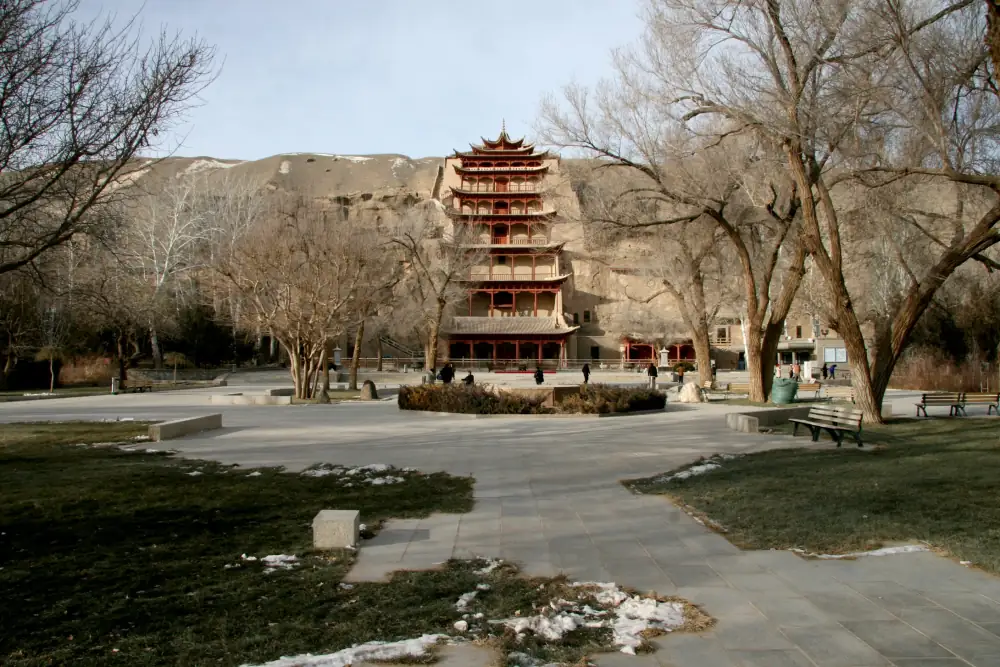
Zhangye sits in the Hexi Corridor — the historical Silk Road route through Gansu, the narrowest viable passage between the Tibetan Plateau and the Gobi Desert. The Mogao Caves in Dunhuang, the Jiayuguan Fortress (far western end of the Great Wall) and the Bingling Temple Buddhist cave are all within a few hours’ travel. A Hexi Corridor itinerary combining these sites with Zhangye Danxia is one of China’s great undiscovered travel routes.
Two-day combined stay: Day 1: Arrive Zhangye; Danxia geopark sunset; overnight. Day 2: Zhangye Giant Buddha Temple (West Dafo Temple — the largest reclining Buddha in China, at 34.5m, in the city center; ¥41 entry); afternoon travel toward Jiayuguan or Dunhuang.
The Zhangye Danxia formations are one of those places that make you question whether you’re looking at a natural phenomenon or a work of art. The answer, of course, is that the question dissolves when faced with something genuinely extraordinary — and these mountains, at sunset, in their full color, are genuinely extraordinary.