
The karst landscape of Guilin and Yangshuo is one of those places that looks exactly like its photographs — steep green limestone towers rising from flat rice paddies, rivers reflecting the sky, water buffalo standing in the shallows. It earned its reputation. The classic question travelers wrestle with is how much of the tourist infrastructure to engage with, because there’s a lot of it. This itinerary tries to give you honest answers.
Spend one day in Guilin, two in Yangshuo — the Li River cruise connects the two. That’s the right distribution.
Table of contents
Open Table of contents
Before You Arrive
Getting there: Guilin Liangjiang International Airport (KWL) receives direct flights from most major Chinese cities and some international routes. High-speed trains connect Guilin to Guangzhou (2.5 hours, ¥190), Shenzhen (3 hours, ¥235), and Chengdu (5 hours). Note there are two train stations: Guilin Station and Guilin North Station — most HSR trains use Guilin North.
Logistics: The itinerary flows Guilin → Li River → Yangshuo, then back to Guilin by bus for departure. Don’t try to reverse it; the cruise only runs one direction.
Money: Take more cash than you think you need. Yangshuo is card-friendly now with WeChat Pay and Alipay, but smaller villages and boat operators sometimes prefer cash.
Day 1: Guilin — Elephant Trunk Hill & Seven Star Park
Morning: Reed Flute Cave
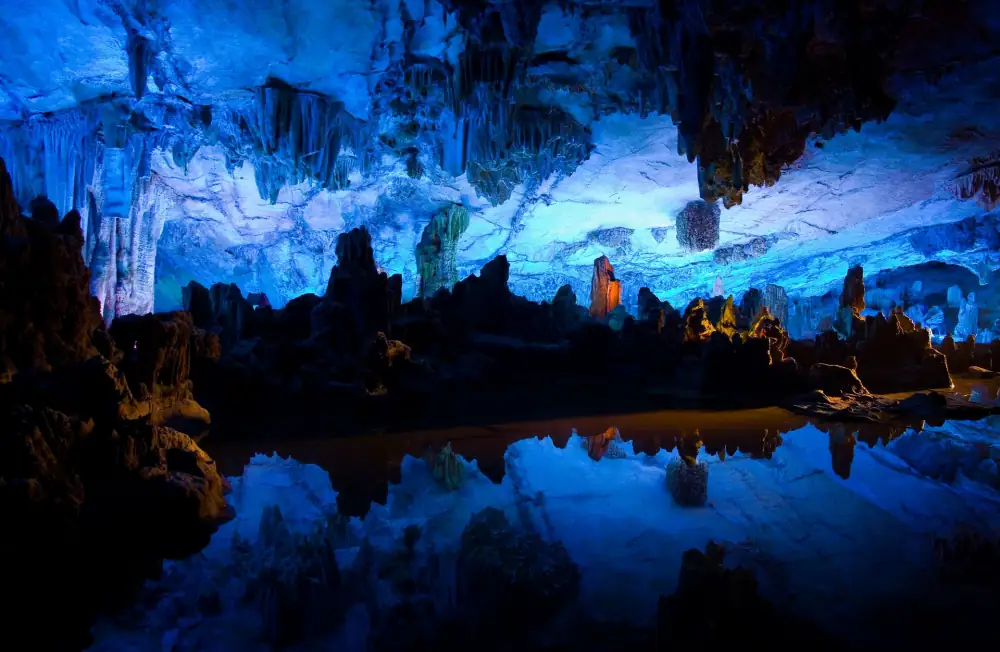
Start the day underground. Reed Flute Cave (芦笛岩, ¥80) is a 240-meter-long limestone cavern with colorful illuminated stalactites and stalagmites. It’s touristy — the colored lighting is over-the-top — but the formations themselves are genuinely impressive. Allow 1 hour.
Getting there: Bus 3 from city center or taxi (¥25-30, 10 minutes).
Afternoon: Elephant Trunk Hill
Elephant Trunk Hill (象鼻山, ¥75) is Guilin’s symbol — a hill that looks exactly like an elephant drinking from the Li River. The resemblance is uncanny. The surrounding park is nicely maintained and the walk around it takes 45-60 minutes. Worth the ticket price for the main photo.
From here, walk along the Li River waterfront — the 2-3km stretch between Elephant Trunk Hill and the city center has pleasant walking paths. The views of karst peaks reflected in the river are available at every turn without paying additional entry fees.
Evening: Zhengyang Pedestrian Street
Zhengyang Street (正阳步行街) is Guilin’s main night food street. Worth visiting for dinner: try beer fish (啤酒鱼, ¥50-80 per portion) — a local Guangxi dish of fresh river fish cooked with beer and chili. It’s also everywhere in Yangshuo, but Guilin’s version has slightly less tourist tax on the price.
Seven Star Park (七星公园, ¥75) is good if you have extra time in the afternoon — the karst formations within the park include the famous Camel Hill and Dragon Hide Cave.
Day 2: Li River Cruise to Yangshuo
Morning-Afternoon: The Li River Cruise
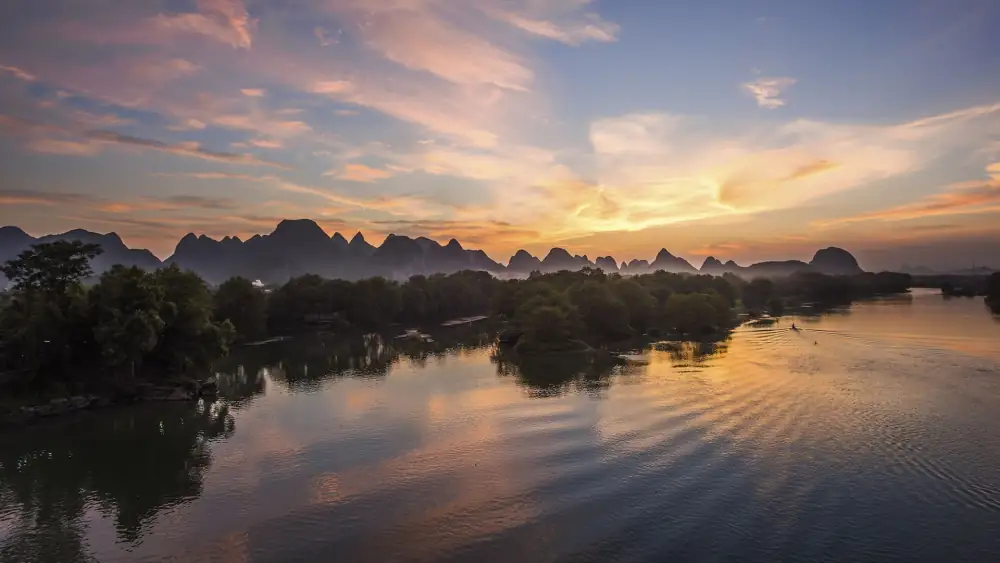
The Li River cruise (漓江, ¥235-490 depending on boat class) departs from Zhujiang Wharf (竹江码头), 20km south of Guilin city center. This is not a departure from central Guilin — arrange a taxi or the tourist bus (buses depart from the CAAC hotel in central Guilin at 7:30am, ¥20).
Booking: Book at your hotel or through the official Guilin Li River Tourism (桂林漓江旅游). The cruise runs daily unless water levels are too low (typically not an issue May-October). Economy class boats (¥235) get you from A to B with meals. Better boats (¥490+) have upper deck seating and better food. For the views, the deck is what matters — any boat with good upper deck access is fine.
The 83km journey takes about 4.5 hours, arriving at Yangshuo around 2-3pm. The most scenic section is between Xingping and Yangshuo — particularly the view near Yellow Cloth Shoal (黄布倒影), which is the landscape on the Chinese 20-yuan note. Ask the crew when this section is coming up.
Honest take: The cruise is crowded and the boats are noisy. The scenery from the deck is extraordinary. It’s worth doing once. If you’ve done it before, skip it and take the bus to Yangshuo instead (¥25, 1.5 hours).
Afternoon: Arrive Yangshuo
Check into your accommodation and explore West Street (西街) — the main tourist strip. It’s loud and commercial (think bars named “Hard Rock” and souvenir shops selling the same T-shirts), but the surrounding countryside visible from every angle redeems everything.
The real Yangshuo is in the villages and valleys outside the town center. West Street is for eating and having a drink in the evening. The rest of the time, get outside.
For dinner: Beer Fish again, this time at one of the canal-side restaurants. ¥60-90 per dish. Yangshuo river fish is particularly good because the Li River is clean and cold — the fish is fresh.
Day 3: Yulong River Cycling & Longji Rice Terraces (Choose One)
Option A: Yulong River Cycling (Recommended)
Rent a bicycle (¥20-30/day) from your guesthouse or from shops along West Street and spend the morning cycling the Yulong River (遇龙河) valley. This is where Yangshuo earns its reputation.
The route from town to the Yulong River bridge (遇龙桥) takes 20-25 minutes. From there, continue cycling south along the river through villages, rice paddies, and bamboo groves for as long as you want — the circuit to Jiuxian village and back is about 15-20km and takes 3-4 hours with stops.
At Shawan village, the old stone bridge is one of the most photographed spots in the area. A bamboo raft punt down the Yulong River (遇龙河漂流, ¥120-150 for 1-2 people, 1.5 hours) is a gentler alternative to cycling — you sit on a bamboo raft while the boatman poles you downstream.
The countryside here is what the Li River cruise was previewing. Getting into it on a bicycle is the better experience.
Option B: Longji Rice Terraces Day Trip
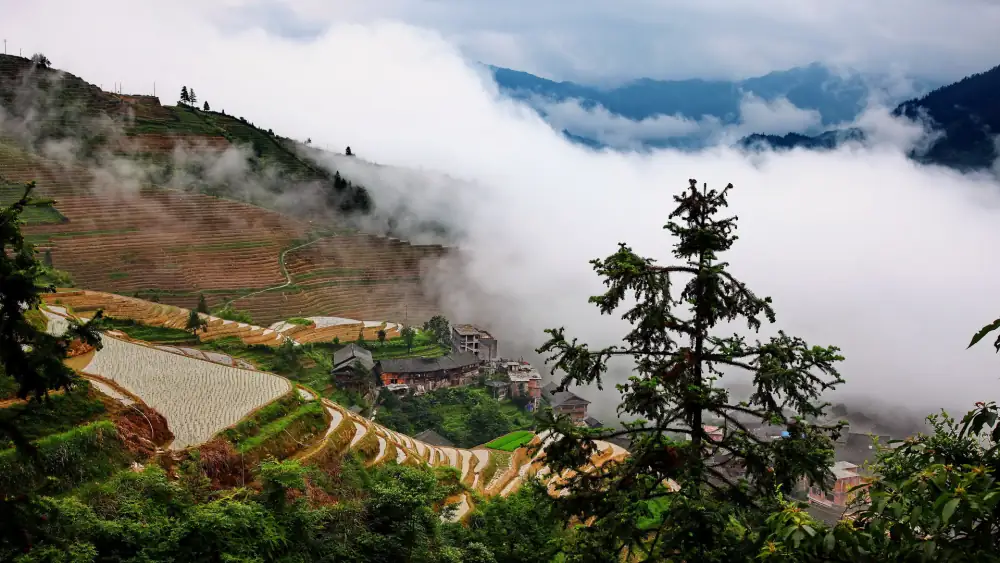
Longji Rice Terraces (龙脊梯田, ¥100 entrance) are 2 hours north of Guilin — which means 3+ hours from Yangshuo. Doable as a day trip, but it’s a long day.
The easiest way from Yangshuo: take the bus back to Guilin (¥25, 1.5 hours), then bus or taxi from Guilin to Longji village (¥30 direct bus from Guilin Bus Station, 1.5 hours).
The terraces at Ping’an village (平安寨) and Dazhai village (大寨) both offer dramatic views, especially in late spring and autumn when water fills the paddies or the harvest is in. The Jinkeng section at Dazhai has the most dramatic tier stacking. Allow 3-4 hours at the terraces.
Best time for terraces: May-June (flooded, mirror-like), September-October (golden harvest). The terraces are accessible year-round but the most striking views require those windows.
The Longji trip requires adjusting your Yangshuo base day — consider doing this as your Day 2 and cycling on Day 3 instead.
What’s Worth It and What’s a Tourist Trap
Worth paying for:
- The Li River cruise (at least once) — the scenery is genuinely world-class
- Bicycle rental in the Yulong valley — best money you’ll spend
- Longji Rice Terraces if it’s the right season
Skip or be skeptical:
- Impression Liu Sanjie (印象刘三姐, ¥238-338) — Zhang Yimou’s famous nighttime river show. It’s spectacular but expensive and feels passive. Only go if outdoor performance art genuinely interests you.
- The “local village experiences” sold by tour touts — overpriced and staged
- Motorboat rides on the Li River in Yangshuo — noisy and you’re missing the point
- Yangshuo’s “ancient streets” outside West Street area — most are modern reconstructions
Practical Information
| Item | Cost |
|---|---|
| Li River Cruise (economy) | ¥235 |
| Elephant Trunk Hill | ¥75 |
| Reed Flute Cave | ¥80 |
| Longji Rice Terraces | ¥100 |
| Bicycle rental | ¥20-30/day |
| Yulong raft ride | ¥120-150 |
| Beer fish dinner | ¥60-90 per dish |
| Yangshuo guesthouse | ¥100-200/night |
| Yangshuo mid-range hotel | ¥300-500/night |
Best time to visit: April-June and September-October. The monsoon season (June-August) makes rivers swell impressively but also brings heavy rain. December-February is cold but dramatically misty — the landscape looks like a Song Dynasty ink painting.
Getting back to Guilin: Buses from Yangshuo to Guilin run frequently (¥25, every 30 min, 1.5 hours). From Guilin North Station you can connect to the rest of China by HSR.