
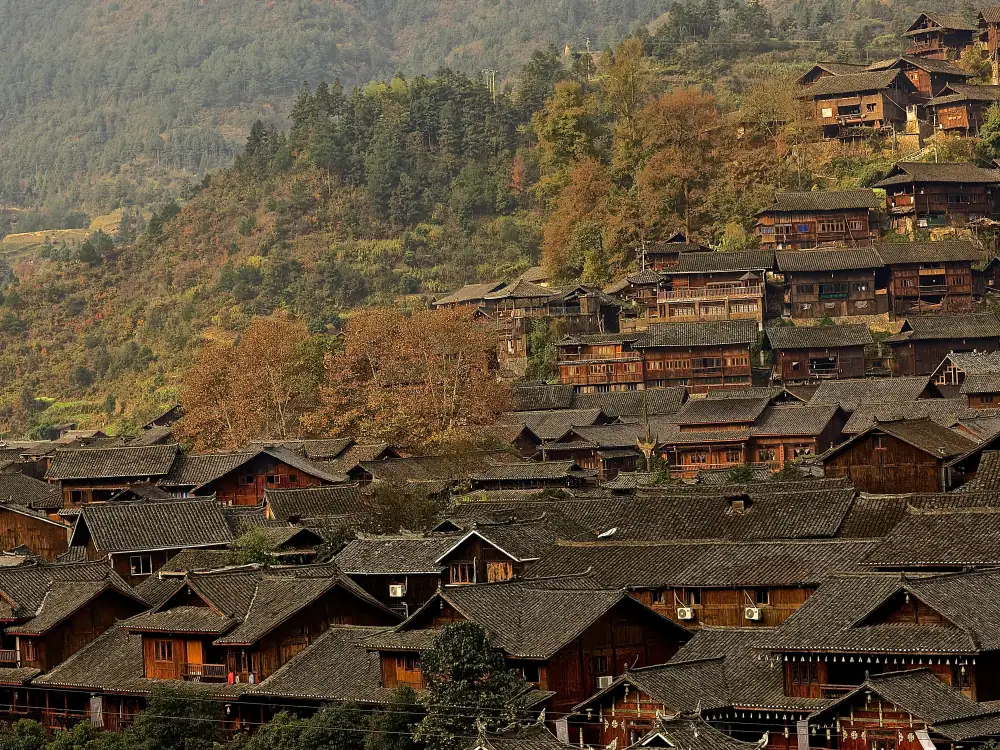
Zhaoxing — China’s largest intact Dong village, with five drum towers (one per family clan) rising above centuries of wooden architecture in a mountain valley
The Qiandongnan Miao and Dong Autonomous Prefecture (黔东南苗族侗族自治州) in southeastern Guizhou contains some of China’s most extraordinary minority culture heritage — wooden villages unchanged in structure since the Ming Dynasty, drum towers that function as the civic centre of Dong village life, and the most elaborate folk costume tradition still in active use in China.
This is genuinely remote rural China — the kind of place where elderly women wear traditional costume daily, not for tourists, and where the weekday village market brings together people from different ethnic subgroups who haven’t seen each other since the last market.
Table of contents
Open Table of contents
Dong Villages: Drum Towers and Wind-Rain Bridges
The Dong people (侗族) are master carpenters and architects. Two structural types define Dong village architecture:
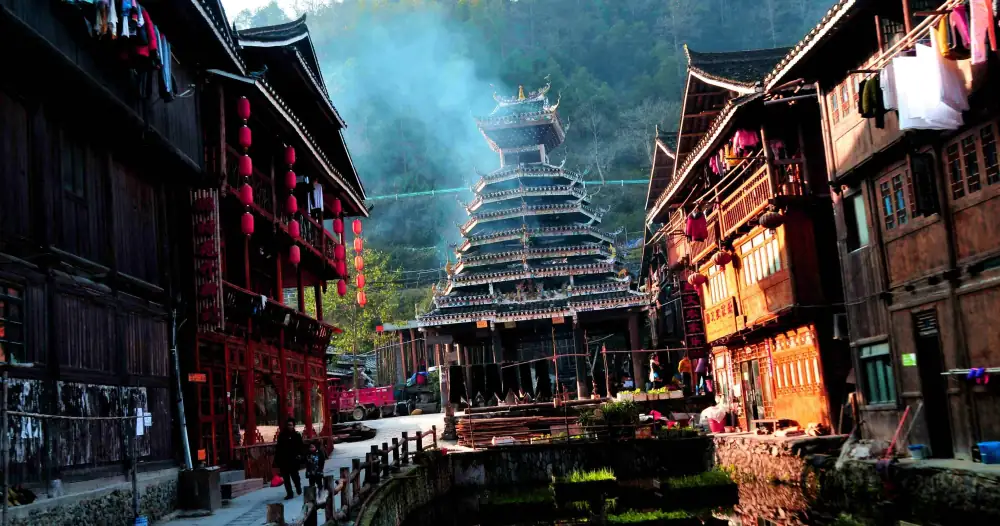
Drum towers (鼓楼): Multi-tiered wooden towers at the centre of each Dong village, built without nails using only timber joinery. The towers serve as community gathering spaces — traditionally for resolving disputes, for evening gatherings, and as the stage for grand song (大歌, a UNESCO-recognised Dong polyphonic singing tradition). Each village has its own unique tower design.
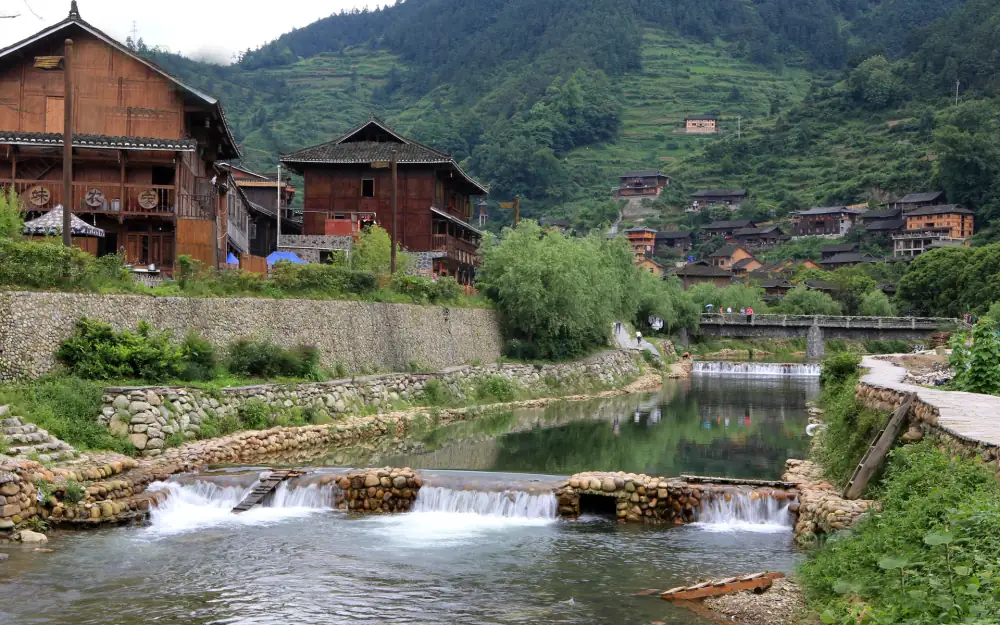
Wind-rain bridges (风雨桥): Covered wooden bridge-temples spanning the streams that border Dong villages — with timber pavilions built on stone piers, offering shelter from rain and serving as a social gathering point at the village edge. The Chengyang Wind-Rain Bridge (程阳风雨桥) near Sanjiang is the most famous, but dozens of equally beautiful examples exist throughout the region.
Dong wind-rain bridge — a covered wooden bridge-temple built without nails using only traditional timber joinery, a UNESCO-recognised architectural tradition
Zhaoxing Village (肇兴村)
The largest intact Dong village in China — 800+ households, 5 drum towers (one per family clan), and a valley setting that creates natural borders between the old wooden village and the surrounding terraced fields. Each drum tower serves a different clan; the social geography of the village is visible in its architecture.
What to see:
- The five drum towers and their adjacent singing stages
- The village market (every 5 days, early morning) when people from surrounding villages converge
- The evening Dong song performances (traditional communal singing after dark)
Getting there: 3 hours by bus from Kaili (凯里) or 2 hours from Guilin.
Sanjiang Dong Culture (三江侗族自治县)
Just across the border in Guangxi — the Chengyang Village group contains 8 Dong villages and the famous Wind-Rain Bridge. The Chengyang Bridge (程阳桥) is 78 metres long and 200 years old — still functioning as a pedestrian bridge.
Xijiang Miao Village — China’s largest Miao village, with 1,400 households of wooden stilt-houses spread across three hillsides above the Bala River
Miao Villages
The Miao people (苗族) of southeastern Guizhou are distinct in several subgroups, each with its own costume, festival, and village architecture.
Langde Shang (朗德上寨)
A “living museum” Miao village — 100 households on a hillside, with a mandatory performance system that welcomes arriving visitors with rice wine (12 cups of different home-brewed grains) and traditional dance. The performance is orchestrated but the hospitality is genuine.
Short skirt Miao (短裙苗) and Long skirt Miao (长裙苗): Different Miao subgroups in the same valley wear completely different traditional costumes — the visual contrast on market days is striking. The pleated skirts of the Short Skirt Miao are elaborately embroidered; the Long Skirt Miao variants reach the ankle.
Xijiang Miao Village (西江苗族村寨)
The largest Miao village in China — 1,400 households of wooden stilt houses covering multiple hillsides above the Bala River. At dusk, when the kitchen fires start and the wood smoke fills the valley, and the illuminated village spreads across the darkening hillside, the visual effect is extraordinary.
The village has substantial tourist infrastructure now; staying at a guesthouse in the old village section and walking the back lanes early morning gives access to the genuine daily life.
Kaili (凯里): The Regional Base
Kaili Sour Fish Soup (凯里酸汤鱼): The most distinctive dish in Guizhou — river fish in a bright red/orange fermented tomato and rice bran soup, with fresh herbs. The fermented sourness is unique; the soup is deeply flavoured and complex.
Kaili Weekend Market: The Monday-market tradition in Kaili draws Miao people from surrounding villages in traditional costume — one of the best people-watching opportunities in China for genuine rather than staged traditional dress.
Miao ceremonial costume — the silver headdress and embroidered textiles that encode centuries of cultural history in visual language
Practical Tips
Getting to Kaili: High-speed rail from Guiyang (1.5 hrs), Chongqing (4 hrs). Guiyang Longdongbao Airport (KWE) has good connections.
Best time to visit:
- Spring (April–May): Miao New Year and various festivals
- Autumn (September–October): Harvest festivals and the best weather
- Avoid: July–August can see extreme rainfall and flash floods in the narrow valleys
Language: In the most traditional villages, elderly residents may speak only their minority language. A local Guizhou guide adds significant value.
Last updated: May 2026