
Zhangjiakou: Great Wall Hiking Beyond the Tourist Routes
Two hours northwest of Beijing by high-speed train, Zhangjiakou was the site of China’s alpine skiing and biathlon events at the 2022 Winter Olympics. But the city’s more enduring claim on travellers is its position at the strategic heart of the northern frontier — the narrow gap through the Yan Mountain range where Beijing’s defensive wall made its most critical stands against northern nomadic invaders.
The Great Wall sections north and west of Zhangjiakou are among the least-visited and most dramatically sited in northern China — partly because they require effort to reach, and partly because most visitors to the Wall go to the heavily-restored (and heavily-crowded) sections near Beijing. What you find here instead is wild, crumbling, and extraordinary.
Understanding “Wild Wall” vs. Restored Wall
The phrase “wild wall” (野长城) describes sections of the Great Wall that have not been restored for tourism — where the original Ming-dynasty bricks are tumbling from their foundations, where weeds grow from the rampart walkways, and where you are likely to be entirely alone.
The tradeoff is straightforward:
- Restored wall (Badaling, Mutianyu, Jinshanling tourist sections): Smooth walkways, handrails, full safety infrastructure, excellent views — but hundreds or thousands of fellow visitors.
- Wild wall: Crumbling, physically demanding, potentially dangerous in sections — but genuinely atmospheric, historically authentic, and often empty.
The sections near Zhangjiakou fall largely in the wild wall category.
Key Wall Sections Near Zhangjiakou
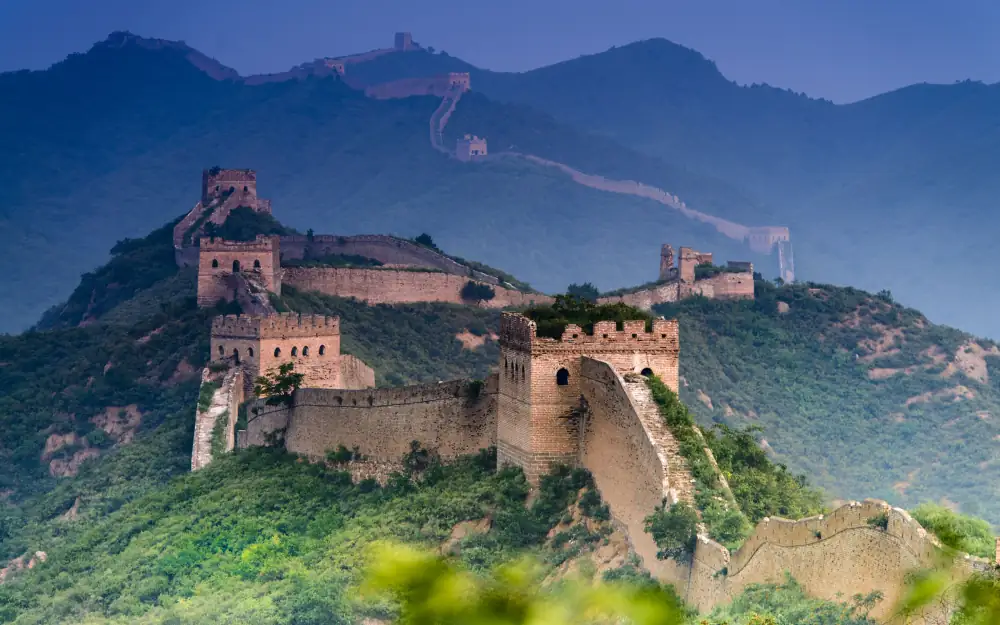
Panlongshan (盘龙山长城)
A remarkably well-preserved wild wall section 25 km north of Zhangjiakou city, winding along a ridge above a farming valley. The wall here sits at approximately 1,200 m elevation with views north toward Inner Mongolia.
Character: Better preserved than most wild wall sections — the Ming brickwork is largely intact on the outer faces, though the inner walkway has collapsed in several places. The towers, spaced approximately 500 m apart, retain their original shapes.
Access: Minibus from Zhangjiakou to Panlongshan village; 15-minute walk to the wall base. A local guide (¥100–¥150) from the village improves the experience significantly.
Difficulty: Moderate — several sections require hands-and-feet scrambling over collapsed sections; good hiking shoes essential.
Bashang Grassland Wall (坝上长城)
80 km northeast of Zhangjiakou, where the wall emerges from the forest onto the Bashang grassland plateau — a surreal landscape where the Great Wall runs across open steppe rather than the mountain ridges it typically follows.
In this section, the wall is largely a grass-covered earthen mound rather than a brick structure; the surrounding grassland extends to the horizon, with Mongolian-style nomad encampments visible in summer.
Best season: Late August to October when the grass turns amber and the sky is intensely blue. Wildflowers in late June–July.
Jiming Posthouse (鸡鸣驿)
Not strictly the wall itself, but the best-preserved post station on the entire Great Wall system — a complete Ming-dynasty garrison town, walled, with original post house buildings, a temple, and residential structures largely intact within its walls.
Located 50 km east of Zhangjiakou on the historical road to Beijing. The site is UNESCO-listed; admission ¥30.
Yanmenguan Pass (雁门关)
Three hours south of Zhangjiakou (in Shanxi Province), Yanmenguan is the most historically significant mountain pass on the entire northern frontier — the primary invasion route of Xiongnu, Khitan, and Jurchen armies through 2,000 years of northern history. The pass is partly restored; the adjacent wild wall sections require a short hike.
A museum at the pass traces its military history, which includes legendary general Yang Ye (杨业) of the Northern Song dynasty — a figure whose resistance at this pass inspired centuries of Chinese literary and operatic tradition.
The 2022 Winter Olympics Legacy
Zhangjiakou hosted the Alpine Skiing, Biathlon, Cross-Country Skiing, and Ski Jumping events at the 2022 Winter Olympics. The National Ski Center (国家跳台滑雪中心) — nicknamed “Snow Ruyi” for its resemblance to the traditional jade sceptre — remains open for public visits and limited ski jumping observation.
The Taizicheng Olympic Village in the hills above Zhangjiakou is now a resort complex with ski facilities open to the public from December through March.
Practical Information
Getting There
High-speed train: Beijing Qinghe Station to Zhangjiakou South Station: 60 minutes on the dedicated Olympic train (G-class, ¥110–¥140). This line was built specifically for the 2022 Winter Olympics and is remarkably efficient.
From Zhangjiakou, local buses, taxis, or rental vehicles reach the wall sections.
Best Season for Wall Hiking
| Season | Conditions |
|---|---|
| Spring (April–May) | Snow may still cover high sections; vegetation sparse; best visibility |
| Summer (June–August) | Grass covers wall base making access easier; some sections slippery |
| Autumn (Sept–Oct) | Best season — clear skies, autumn colour, dry conditions |
| Winter (Nov–March) | Cold; some sections snow/ice-covered; dramatic photography |
Safety Considerations for Wild Wall Sections
- Tell someone your plan before setting off on wild wall sections.
- Good hiking boots with ankle support are essential — the crumbling brick surface is treacherous in regular shoes.
- Carry water — no facilities exist on wild wall sections.
- Do not enter collapsed tower sections where floors may be unsafe.
- Weather can change rapidly on exposed ridgelines; carry an extra layer.
Zhangjiakou City
The city itself has a modest but interesting old Muslim quarter (清真寺街) — Zhangjiakou sits on the historical trading route between China and Mongolia and has a significant Hui Muslim community. The Friday mosque is active; halal restaurants cluster around the old quarter.
Lamb hotpot and hand-grabbed lamb (手抓羊肉) are the local specialities — the Inner Mongolia influence is pronounced in Zhangjiakou’s food culture.
The wild wall sections near Zhangjiakou require you to do something increasingly rare in Chinese tourism: to work for the view. The crumbling brick under your hands, the empty ridgeline in both directions, the total silence except for wind — these things cannot be accessed from a tour bus, and they are precisely what makes the Great Wall worth building.