
Turpan: China’s Lowest, Hottest, and Most Ancient Desert City
Turpan (吐鲁番, Tǔlǔfān) is an extraordinary place on multiple dimensions. China’s lowest point (-154m below sea level at Aydingkol Lake); one of the world’s hottest inhabited places (summer temperatures regularly exceed 47°C); one of the Silk Road’s most important ancient cities; and the source of China’s most celebrated grapes, raised in an underground water system (karez) that dates to at least 2,000 years ago.
This combination of extremes creates a destination unlike anywhere else in China — or anywhere else in the world.
Understanding Turpan

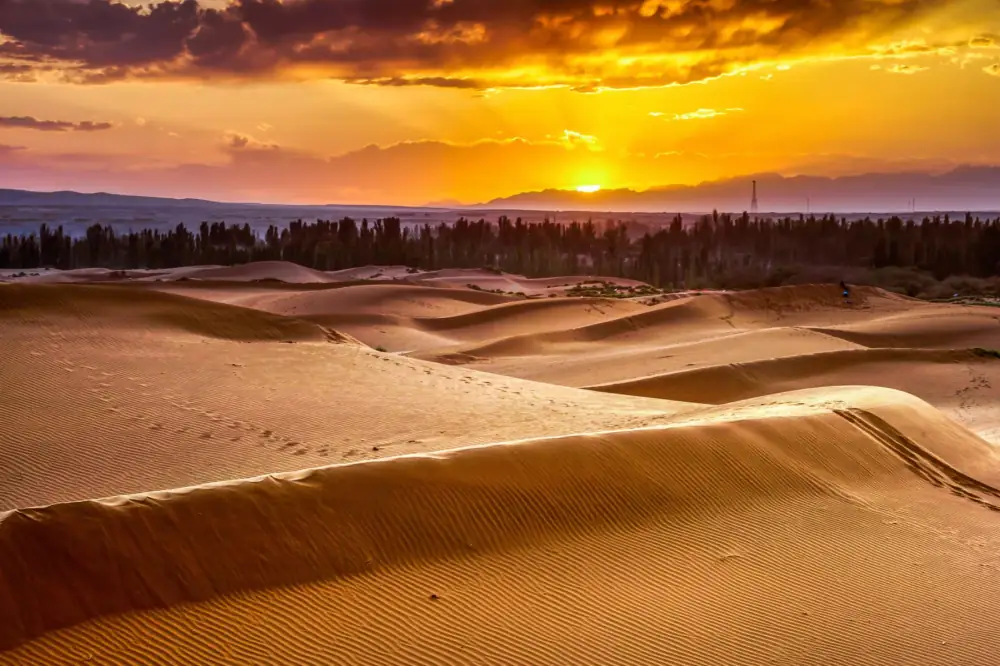
The Turpan Depression (吐鲁番盆地) sits in the center of Xinjiang, surrounded by mountains that trap heat and exclude moisture. The depression’s geology, combined with its latitude, creates climate conditions comparable to Death Valley in the American Southwest — except that Turpan has been continuously inhabited for at least 4,000 years, making it one of history’s most persistent human adaptations to extreme environment.
The ancient solution to desert living: the karez (坎儿井, kǎn ér jǐng) — a system of underground irrigation channels that transport snowmelt from the Tianshan Mountains to the depression’s fields and towns without evaporation losses. There are over 1,000 km of karez in the Turpan area, built by generations of Uyghur farmers. The system functions today, watering the vineyards that produce Turpan’s famous grapes.
The Flaming Mountains (火焰山)
The Flaming Mountains (火焰山) are a range of eroded red sandstone hills northeast of Turpan, named for their appearance in the intense summer heat — the reddish-brown rock radiates heat so intensely that the air above shimmers, creating the visual impression of flames.
For Chinese readers, the Flaming Mountains are legendary territory: in the classic novel Journey to the West (西游记, 16th century), the monk Xuanzang and his companions encounter the Flaming Mountains and must obtain a cooling fan from the Princess Iron Fan to continue their pilgrimage.
Visitor experience: The Flaming Mountains Scenic Area (entry: ¥40) has a viewing area, temperature sensor (the highest measured surface temperature was 83.3°C), and some Journey to the West-themed decorations.
The honest assessment: The Flaming Mountains are visually striking (the red rock and the heat shimmer create an other-worldly visual) but the official scenic area is primarily a backdrop for photos. The more interesting activity is exploring the landscape actively — hiking some of the canyon systems that cut through the mountains, visiting the karez system at the base of the mountains, and imagining the ancient Silk Road travelers who crossed this terrain.
Best time: The Flaming Mountains are most impressive in summer when the heat shimmer effect is maximum. This requires tolerating extreme heat (47-50°C is possible). Autumn and spring visits are more comfortable but less visually dramatic.
Jiaohe Ancient City (交河故城)
Jiaohe is one of the best-preserved ancient cities in Central Asia — an administrative and military center occupied from approximately 200 BCE to the 14th century CE, when it was abandoned after Mongol invasion. The city was built on a natural mesa between two rivers (hence “jiaohe” — “river intersection”), providing natural defense.
Unlike many “ancient cities” with significant reconstruction, Jiaohe is an archaeological site presented in relatively raw form — mudbrick walls, collapsed into geometric mounds; temple footprints visible in the dust; streets still clearly readable in the urban grid. The scale is surprising: the city covers 47 hectares and housed thousands of residents.
The combination of the desert light (harsh and shadowless in summer; gentler in morning and evening), the mudbrick ruins, and the silence creates a particularly powerful atmosphere.
Entry: ¥70. Open year-round. Time needed: 2-3 hours. Combine with: Gaochang Ancient City (高昌故城), 45 km to the east, is larger and more elaborate ruins from the same general period.
Gaochang Ancient City (高昌故城)
Gaochang (高昌) was the capital of the Gaochang Kingdom (460-640 CE), later a major Tang dynasty administrative center on the northern Silk Road route. It was the largest city in the Turpan area and served as a critical node for the exchange of goods, religions, and ideas between China and the Western regions.
The ruins cover 200+ hectares and preserve significant walls, temple foundations, and the basic urban structure. The site is larger than Jiaohe but less dramatically positioned (flat desert rather than mesa formation).
Archaeological significance: Numerous Buddhist manuscripts, Manichaean texts, and administrative documents were discovered at Gaochang in the early 20th century by Western archaeologists; many are now in German and Japanese museum collections.
Entry: ¥45. Camel carts operate within the site for visitors not wanting to walk the full area.
Bezeklik Thousand Buddha Caves (柏孜克里克千佛洞)
Cut into the cliff face above the Mutou River canyon east of the Flaming Mountains, Bezeklik (贝孜克里克) contains some 77 cave temples dating from the 6th-14th centuries CE. The caves were used continuously through Buddhist, Manichaean, and Islamic periods, reflecting the religious diversity of ancient Turpan.
The painful history: The most spectacular frescoes were cut from the walls by German archaeologist Albert von Le Coq between 1902-1914 and are now in the Museum of Asian Art in Berlin. The German removals were followed by Russian and British removals from other sites, and by subsequent local destruction. The remaining caves have significant frescoes but are shadows of what they were.
Still worth seeing: Despite the losses, the setting — caves in red sandstone cliffs above a dry canyon — is extraordinary. The surviving frescoes in some caves are beautiful. The historical context (imagining the monks, merchants, and pilgrims who used these caves over 800 years) adds depth.
Entry: ¥30.
Grape Valley and Turpan Wine Culture
The vineyards of the Turpan area are extraordinary — rows of grapevines stretching across the desert, fed by the karez system. Turpan’s extreme heat, high altitude (despite the low basin), and long growing season produce grapes of unusual sweetness and concentration.
Grape Valley (葡萄沟): A scenic valley outside the city where historical vineyards are maintained and visitors can sample fresh grapes in season. The valley is particularly beautiful in late summer-autumn when grapes hang densely from the overhead trellises.
Raisin production: Turpan’s raisins are a major Chinese agricultural product. Specialized drying houses (shade-dried using natural air movement rather than sun-dried) produce the characteristic Turpan raisin with distinctive sweetness.
Turpan wine: The local wine industry has developed significantly; several wineries produce red and white wines from the local grape varieties. Turpan’s wine is not internationally acclaimed but is interesting in context.
Harvest season (August-September): The best time to visit Grape Valley is during harvest, when activity is maximum and fresh grape tasting is at its best.
Practical Information
Getting to Turpan:
- High-speed train from Urumqi: 45 minutes (G-class, multiple daily)
- From Urumqi airport by taxi to Turpan: approximately 2 hours (90 km)
- Note: The main high-speed rail station (Turpan North Station 吐鲁番北站) is 50 km from the city center; take the shuttle bus to town.
Getting Around Turpan:
- The city is small and walkable for the center
- All major sites are outside the city; organized tours (widely available) or taxi hire is most practical
- “Turpan all-day tour” taxis: ¥150-250 for a driver taking you to the main sites
Weather and Timing:
- Summer (June-August): Extreme heat (45-50°C maximum). The heat itself is an experience; go early morning and evening; avoid midday outdoors. The grape harvest is in August-September.
- Autumn (September-October): Excellent — 25-35°C, harvest season, clear skies, magnificent light for ruins photography
- Spring (April-May): Good, warm (25-35°C), wildflowers in the less-extreme areas
- Winter (December-February): Cold (can drop to -20°C), most sites open, very few visitors
Accommodation: Turpan has several mid-range hotels and a growing boutique hotel sector. The Silk Road-themed accommodations in the older part of the city center are atmospheric.
Food: Uyghur cuisine — lamb preparations (grilled skewers, roasted whole lamb, lamb soups), various bread types (nang flatbread), hand-pulled lagman noodles (拉条子), and fresh or dried fruit. The food is exceptional and completely halal.
Turpan operates in a different register from the grand historical sites of eastern China. It’s a place of extremes — temperature, geographic, historical — that demands engagement with those extremes rather than cushioning from them. The ruins are genuine, the landscape is dramatic, and the cultural continuity (the karez still works; the grapes are still grown; the Uyghur culture that maintained all this is still present) is deeply moving.