
The Temple of Heaven is the most architecturally perfect site in Beijing. Unlike the overwhelming scale of the Forbidden City or the grandeur of the Great Wall, the Temple of Heaven achieves its power through geometric precision: a series of perfectly circular and square structures arranged along a 1.2-kilometre axis, designed to embody the cosmological relationship between Heaven (圆, circular) and Earth (方, square).
But the Temple of Heaven has a second identity that most tourists miss: as a vast, ancient park that Beijingers use every morning for tai chi, traditional music, card games, sword practice, and group singing. Arriving before 8 AM means you walk through both worlds simultaneously — the mathematical perfection of Ming Dynasty cosmology, surrounded by retired couples waltzing between 400-year-old cypress trees.
Table of contents
Open Table of contents
Essential Information
| Detail | Info |
|---|---|
| Address | Tiantan East Road, Dongcheng District, Beijing |
| Park opening | 6:00 AM – 9:00 PM (park); 8:00 AM – 5:30 PM (buildings) |
| Tickets | ¥15 (park only); ¥34 (combined: park + all buildings) |
| Metro | Line 5 to Tiantan Dongmen (East Gate) or Line 8 to Tiantan Nanmen (South Gate) |
| Best time to visit | Early morning (6–8 AM) for the park atmosphere; before 10 AM to avoid peak crowds |
| Recommended duration | 2–3 hours |
A Brief History
Construction began in 1420 — the same year as the Forbidden City — under the Yongle Emperor of the Ming Dynasty. The complex served as the site for the most important annual ceremony in the Chinese imperial calendar: the Winter Solstice sacrifice, when the emperor and his retinue would travel here in an enormous procession, fast for three days, then perform elaborate rituals to pray for good harvests in the coming year.
The Emperor of China was considered the “Son of Heaven” — the mediator between the human world and the celestial forces that governed the seasons and harvests. The architecture of the Temple of Heaven expressed this cosmological role with extraordinary precision. Every measurement, every proportion, every spatial relationship was calibrated to specific astronomical and numerological principles.
The site was used for its original ceremonial purpose from 1420 until 1914, when Yuan Shikai — having just declared himself Emperor of the Republic of China in an abortive attempt to restore the imperial system — performed the last ever imperial Heaven sacrifice. He died shortly after.
The Main Structures
The Hall of Prayer for Good Harvests (祈年殿)
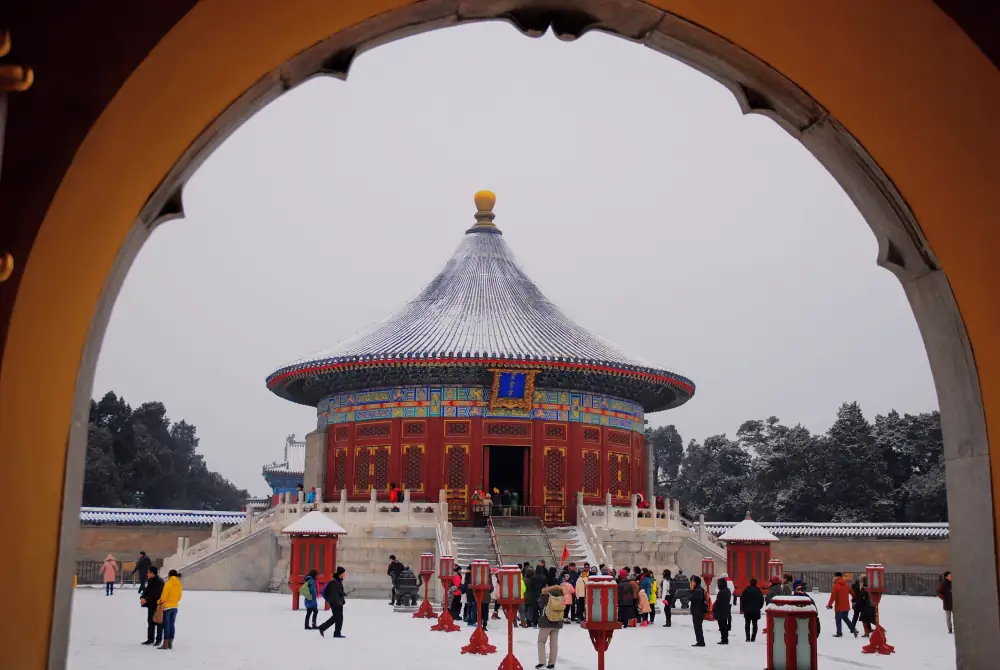
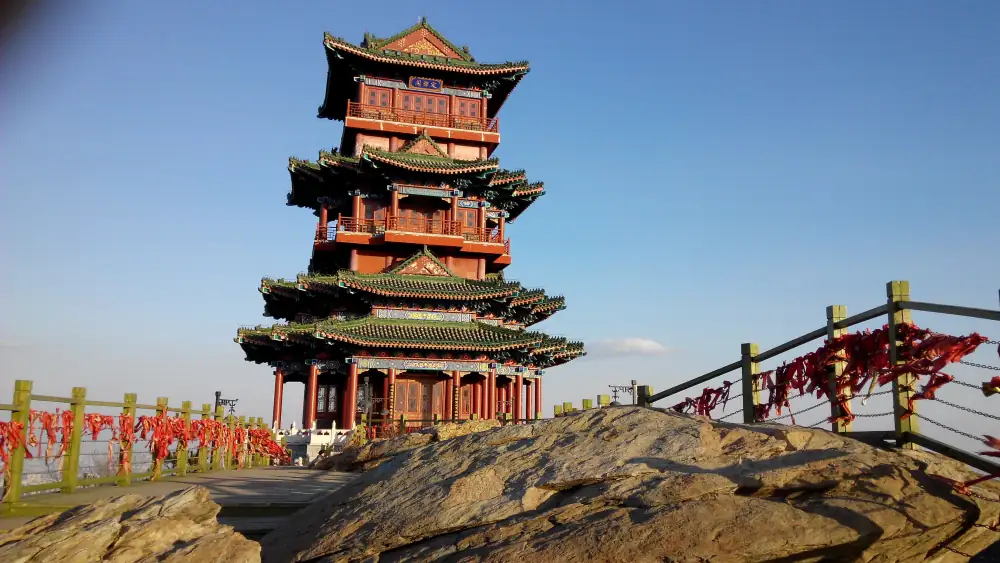
The icon of Beijing. The triple-eaved circular hall with its deep blue glazed roof tiles stands on a three-tiered white marble circular terrace — visually arresting from any direction. Built in 1420, burned down by a lightning strike in 1889, and rebuilt in 1890 to the original design.
The interior is extraordinary: 28 enormous red pillars supporting the entire roof without nails or metal fastenings, each pillar calibrated to astronomical significance. The four innermost pillars represent the four seasons; the twelve middle pillars represent the months; the twelve outer pillars represent the twelve divisions of the day. Standing inside and looking up at the painted ceiling, with its blue and gold patterns converging at a dragon and phoenix medallion at the apex, is an experience that photographs can’t fully convey.
Practical: Enter from the southern steps for the standard approach. The northern stairway is used for exit and is often less crowded — from the north terrace, the view of the hall framed against the sky is the best angle for photography.
The Imperial Vault of Heaven (皇穹宇)
A smaller circular hall built in 1530 to store the spirit tablets of the imperial ancestors and natural deities used in the Heaven sacrifice ceremony. Surrounded by the famous Echo Wall (回音壁) — a perfectly circular wall that, when the grounds are quiet, allows a whisper spoken on one side to travel around the wall to a listener on the other side.
Reality check: The Echo Wall genuinely works acoustically, but it requires very quiet conditions and two people positioned in specific spots. On a busy weekend with hundreds of tourists shouting into the wall simultaneously, it doesn’t work. On a quiet weekday morning, it’s remarkable.
The Circular Mound Altar (圜丘坛)
The most important ceremonial site in the complex — a three-tiered circular marble terrace open to the sky. This is where the Heaven sacrifice was actually performed: the emperor knelt at the centre of the uppermost tier, at the single stone at the exact centre of the altar, and addressed the sky directly.
The mathematics here are obsessive: every ring of tiles is numbered in multiples of nine (the most auspicious number), from the innermost ring of 9 stones to the outermost ring of 81. The number of stairs, the number of balustrades, the spacing of the stone slabs — all expressed in nines.
Stand at the centre stone (天心石) and speak aloud: the circular wall reflects your voice back at you, creating a subtle echo that made the emperor’s prayers seem to ring outward in all directions.
The Vermillion Steps Bridge (丹陛桥)
The elevated stone walkway connecting the Circular Mound Altar to the Hall of Prayer — 360 metres long, raised above the level of the surrounding cypress forest. This was the processional axis along which the emperor walked (the central highest section) flanked by his officials (the flanking lower sections). Walking north along it early in the morning, with mist filtering through the cypress trees on both sides, is the most atmospheric moment in the Temple of Heaven.
The Park: Beijing’s Living Ritual
Come before 8 AM on any weekday and you enter a different Beijing.
The 267-hectare park surrounding the ceremonial structures is one of the oldest public green spaces in Beijing. The cypress forest — some trees 500 years old, contorted into extraordinary shapes by centuries of growth — provides a cathedral-like canopy under which the local morning activity unfolds.
What you’ll see:
- Groups practising traditional sword tai chi (太极剑) on the open plazas, moving in slow synchronised patterns
- Older men playing erhu (二胡) or dizi (笛子) — traditional two-string fiddles and bamboo flutes — sitting on benches between the cypresses
- Group waltzing: large circles of couples dancing to music from a portable speaker, completely unselfconscious
- Jianzi (毽子): teams playing the traditional shuttlecock game, keeping the feathered cork in the air using only their feet in elaborate acrobatics
- Mahjong and Chinese chess at stone tables under the trees
- Morning calligraphy: practitioners dipping large brushes in water and writing characters on the paving stones — temporary poems that evaporate in the sun
The best area for this is the west side of the park, along the path between the West Gate (Ximen) and the Hall of Prayer. This is the area most locals use and fewest tourists reach.
Recommended Itinerary
6:00–7:30 AM: Enter at the East Gate (Tiantan Dongmen). Walk west through the cypress forest to observe the morning activities. Find a bench in the western section and simply watch — this is as much Beijing as the Forbidden City is.
7:30–8:00 AM: Walk north along the Vermillion Steps Bridge toward the Hall of Prayer.
8:00–9:00 AM: Hall of Prayer opens. Explore the interior (early entry before the tourist groups arrive). Walk around the terrace, photograph from the northern steps.
9:00–9:30 AM: South to the Imperial Vault of Heaven and Echo Wall.
9:30–10:00 AM: Circular Mound Altar.
Total: 3.5–4 hours.
Practical Tips
The East Gate (Tiantan Dongmen) is the most convenient metro exit and leads directly into the cypress forest — the best area for morning activities.
Photography: The Hall of Prayer is best photographed from the northern steps in morning light (sun comes from the east-northeast). Late afternoon gives warm golden light on the southern face.
Crowds: The site is extremely busy on weekends and national holidays. A Tuesday or Wednesday morning in April or October is ideal.
Combine with: The Natural History Museum is a 15-minute walk north — the largest natural history museum in China, excellent for families, and free. The Pearl Market (红桥市场) is a 10-minute walk east, Beijing’s famous knockoff goods market if that interests you.
The Temple of Heaven rewards the early riser. The geometry is there at any hour — but the cypress forest before breakfast, with the erhu playing somewhere in the mist, is something specific to this city, this morning, this place.
Last updated: May 2026