
Datong is one of those Chinese cities that rewards visitors who do their research. On the surface it’s a fading industrial city in northern Shanxi — former coal capital of China, dusty and grey. But dig beneath that surface and you find a city with one of the most significant collections of Buddhist art anywhere in the world, a restored city wall of remarkable scale, and the bizarre spectacle of a monastery built into a cliff face 75 metres above a gorge floor.
The Yungang Grottoes alone are worth the trip from anywhere in China.
Table of contents
Open Table of contents
Yungang Grottoes (云冈石窟)
Carved between 460 and 525 AD during the Northern Wei Dynasty, the Yungang Grottoes are a UNESCO World Heritage Site containing 51 major caves and 51,000 carved statues, ranging from enormous seated Buddhas to intricate relief panels smaller than your hand.
The grottoes represent one of the defining moments in Chinese Buddhist art — the point where Central Asian iconography (brought along the Silk Road from India and through Central Asia) fused with Chinese aesthetics to create something new. The faces of the Buddha figures in the earliest caves are distinctly Central Asian in style; by the later caves, they have become recognizably Chinese.
Opening hours: 8:30am–5:30pm (6:00pm in summer)
Entry fee: ¥120 per person
Location: 16km west of central Datong; bus 3 or 4 from Xinnan Bus Station, or taxi (¥40–60)
Time needed: Minimum 2 hours; 3–4 hours to see it properly
The Most Important Caves
Caves 5 & 6 (中心柱窟): The grandest. Cave 5 contains a 17-metre seated Buddha — the largest figure at Yungang — carved from the cliff face and painted in blue, gold, and red. Cave 6 is a four-pillared central tower covered in narrative relief panels telling stories from Buddha’s life. These two caves alone justify the entry fee.
Caves 16–20 (曇曜五窟, Tan Yao’s Five Caves): The oldest caves at Yungang, commissioned directly by Emperor Wencheng in the 460s. Each cave contains a massive standing or seated Buddha figure, the faces deliberately resembling the emperor and his predecessors (a clever merger of imperial and religious authority). Cave 20 has lost its front wall and the giant seated Buddha is now exposed to the sky — the most photographed image at Yungang.
Caves 7 & 8: Earlier caves with rich Silk Road influences — notice the lotus flower motifs (Indian origin), the flame patterns (Central Asian), and the multiple-headed deities that appear alongside Buddhist figures.
Cave 3: The largest cave at Yungang, though less ornamented. The three large figures (a standing and two seated Buddhas) were carved later, during the Tang Dynasty, when the Northern Wei carvings were already considered ancient.
Visiting Tips
- Audio guides are available in English at the entrance (¥30 + deposit)
- Photography is permitted in most caves without flash; tripods are not allowed
- The site faces north, so morning light on the cliff face is better than afternoon
- Crowds are heaviest on weekends and Chinese public holidays; arrive at opening for the best experience
- The reconstructed temple complex near the entrance was built in 2016 and is not historical — the caves themselves are the reason you’re here
The Hanging Temple (悬空寺)
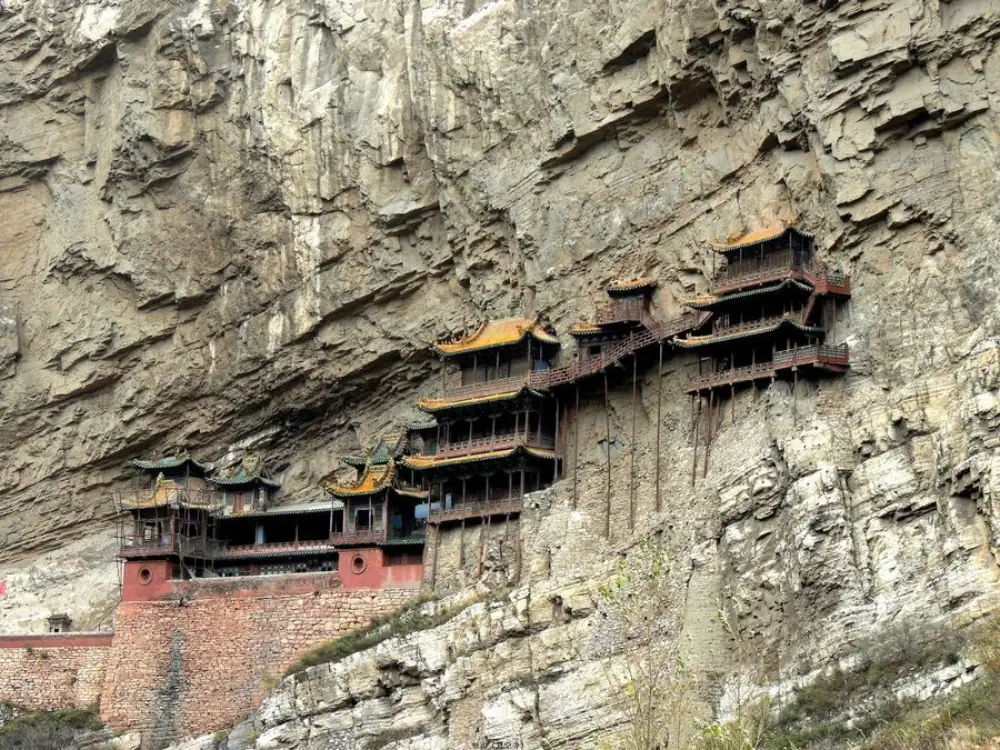
About 65km southeast of Datong, in the Hengshan Mountains, the Hanging Temple (built in 491 AD) clings to a sheer cliff face 75 metres above the Jinlong Gorge below. It’s suspended by wooden beams inserted horizontally into the cliff — the beams also serve as the walkways connecting the 40 halls.
The engineering is extraordinary: the cliff face overhangs slightly, protecting the wooden structures from rain over 1,500 years. The temple contains shrines dedicated to Buddhism, Taoism, and Confucianism simultaneously — a rare example of the three teachings sharing a single space.
Opening hours: 8:00am–6:00pm (summer), 9:00am–5:00pm (winter)
Entry fee: ¥130 per person
Access: Bus or taxi from Datong; approximately 1.5 hours. Most visitors combine it with a same-day trip to Mount Hengshan (恒山), one of China’s Five Sacred Taoist Mountains (¥80 entry), which is adjacent.
The Hanging Temple gets crowded quickly because the walkways are narrow — the cliff-hanging experience involves shuffling through narrow wooden galleries with others. Come early or on a weekday.
Datong Old City Wall
Datong’s city wall has been comprehensively restored over the past 15 years and is now one of the most impressive surviving Ming Dynasty walls in China. The circuit is 6.5km and can be walked in about 2 hours, or cycled in 45 minutes (bicycle rental available on the wall for ¥30).
Entry fee: ¥120 per person (includes entry to several sites within the old city)
Opening hours: 8:30am–6:30pm
The wall is 12–15 metres high and the top walkway is broad enough for horse carts (it was designed for military deployment). The views of the old city from the wall are good, though modern buildings surround it on all sides.
Inside the old city walls:
- Huayan Monastery (华严寺): A major Liao Dynasty monastery (11th century) with the largest wooden structure from that period surviving in China. Entry ¥60.
- Shanhua Monastery (善化寺): Another Liao and Jin Dynasty monastery; quieter and less visited than Huayan, but excellent architecture. Entry ¥50.
- Nine Dragon Screen (九龙壁): A 45-metre glazed tile screen from 1392 — the largest of its type in China, larger than the famous one in Beijing’s Beihai Park. Entry ¥20.
Where to Eat in Datong
Datong cuisine is Shanxi-style, heavy on noodles. Knife-shaved noodles (刀削面) are the city’s signature dish — a lump of dough is held in the arms while a blade is used to shave thin strips directly into boiling broth. The technique requires years to master and produces a uniquely textured noodle.
Where to eat knife-shaved noodles:
- The old city area has multiple small noodle restaurants (面馆); look for places with crowds of locals
- Dongfang Mianliang (东方面良): Popular chain with reliable quality, ¥15–25 per bowl
- Yonghe Noodle House: Near the city wall, good lamb and beef noodle options
Other local foods:
- Shanxi vinegar (山西醋): Used in virtually every dish; Shanxi vinegar is China’s most famous and is significantly sharper and more complex than rice vinegar
- Coated lamb (过油肉): Pork or lamb briefly cooked in oil, then braised with vegetables; ¥35–55
Getting to Datong
From Beijing: High-speed train (G-train) from Beijing North Station to Datong, about 2 hours, ¥120–160. This makes Datong a feasible two-day trip from Beijing.
From Taiyuan: High-speed train, about 1.5 hours, ¥80–110.
From Xi’an: Takes 4–5 hours by various combinations; easier to fly.
Datong’s high-speed rail station is Datong Station (大同站) — centrally located.
How Many Days Do You Need?
1 day (long day trip from Beijing): Yungang Grottoes only; tight but doable.
2 days: Yungang + Old City (wall, Huayan Monastery, Nine Dragon Screen)
3 days: Add the Hanging Temple and Mount Hengshan excursion
Two days is the recommended minimum to do justice to both the grottoes and the city.
When to Visit
Spring (April–May) and Autumn (September–October): Best conditions. Datong is in northern China at 1,000m elevation — summers are warm and pleasant (25–30°C), winters are genuinely cold (-10°C to -15°C).
July–August: Peak tourist season; grottoes can get crowded.
November–March: Very cold; some outdoor sites less enjoyable, but indoor monastery visits are fine.