
Fujian sits across from Taiwan and looks toward Southeast Asia — its population has historically been seafarers, traders, and emigrants. The Hokkien dialect spoken here is still the dominant language of overseas Chinese communities across Malaysia, Singapore, Indonesia, and the Philippines. This maritime history shows in the province’s architecture, cuisine, and character.
Seven days covers Fujian’s four distinct destinations: the European-influenced island of Gulangyu, the extraordinary Hakka earthen roundhouses of the Tulou country, the Silk Road port city of Quanzhou, and the dramatic tea mountains of Wuyi.
Table of contents
Open Table of contents
Getting There & Around
Entry: Xiamen Gaoqi International Airport (XMN) has international connections including Southeast Asia, Japan, and direct flights from some European hubs via connections. Fuzhou Airport (FOC) is the provincial capital’s airport.
HSR connections: Xiamen → Quanzhou: 30 minutes (¥30). Xiamen → Fuzhou: 1 hour (¥110). Xiamen → Wuyishan: 3-4 hours with transfer at Fuzhou or Wuyi North (¥150-200). The provincial HSR network is comprehensive.
Tulou: No direct HSR to the Tulou clusters. The best approach is high-speed train to Nanjing South (南靖南) or Yongding (永定) county, then taxi or bus. More detail in the Tulou section below.
Days 1-2: Xiamen & Gulangyu Island
Day 1: Xiamen
Xiamen (厦门) is one of China’s most livable cities — a clean coastal city with a Mediterranean-influenced old town, good beaches, and the relaxed energy of a place that knows it’s successful without needing to shout about it.
Zhongshan Road (中山路) is the historic commercial pedestrian street — late Qing and Republican-era arcaded buildings, traditional tea shops, and good street food. Walk it once without buying anything to get the feel.
South Putuo Temple (南普陀寺, free) is an active Buddhist temple complex on the southern edge of Xiamen University — the combination of religious activity and the adjacent university creates an unusual atmosphere. The vegetarian restaurant inside the temple complex serves excellent affordable Buddhists meals (¥30-50/set).
Xiamen University (厦门大学) campus is one of China’s most beautiful — the Ming-style buildings set against the hills behind and the sea in front. Worth walking through (free, open to public).
Hulishan Fortress (胡里山炮台, ¥35) on the southern peninsula was built in 1896 and contains one of the world’s largest coastal cannon (a Krupp gun). The fortifications face Kinmen Island (now part of Taiwan) — you can see the island clearly on a good day.
Day 2: Gulangyu Island
Gulangyu (鼓浪屿) is a small island (1.87 km²) 10 minutes by ferry from Xiamen, with no cars or motorcycles — only pedestrians and electric vehicles. It became a foreign concession in the 19th century and the architecture is an extraordinary mix of Western colonial buildings, Fujian vernacular houses, and Chinese courtyard gardens.
Ferry: Tourist ferry from Xiamen to Gulangyu ¥35 (includes return). The ferry runs frequently throughout the day and evening.
Tickets: Gulangyu charges a piano museum pass (¥30) for the main heritage area, but the island itself is walkable without tickets.
The island is famously musical — there’s a piano museum (¥50) and an unusually high number of pianos per capita, the result of the colonial period when European missionaries promoted musical education. The Piano Museum (钢琴博物馆) has 100+ antique instruments from multiple centuries.
Sunlight Rock (日光岩, ¥60) is the highest point on the island with 360° views of the surrounding sea, Xiamen skyline, and Kinmen island.
Shuzhuang Garden (菽庄花园, ¥30) is a Fujian merchant’s private garden built in 1913 facing the Taiwan Strait — pools, pavilions, and a bridge built along the shoreline contours. The most charming garden in Fujian.
Gulangyu food: The island’s food is expensive relative to mainland quality — it caters to day tourists. The pork puff pastry shaode (沙茶面 — spicy peanut broth noodles, ¥15-25) and oyster omelette (海蛎煎, ¥20-30) are the Fujian specialties worth eating anywhere on the island or in Xiamen.
Day 3: Fujian Tulou Day Trip
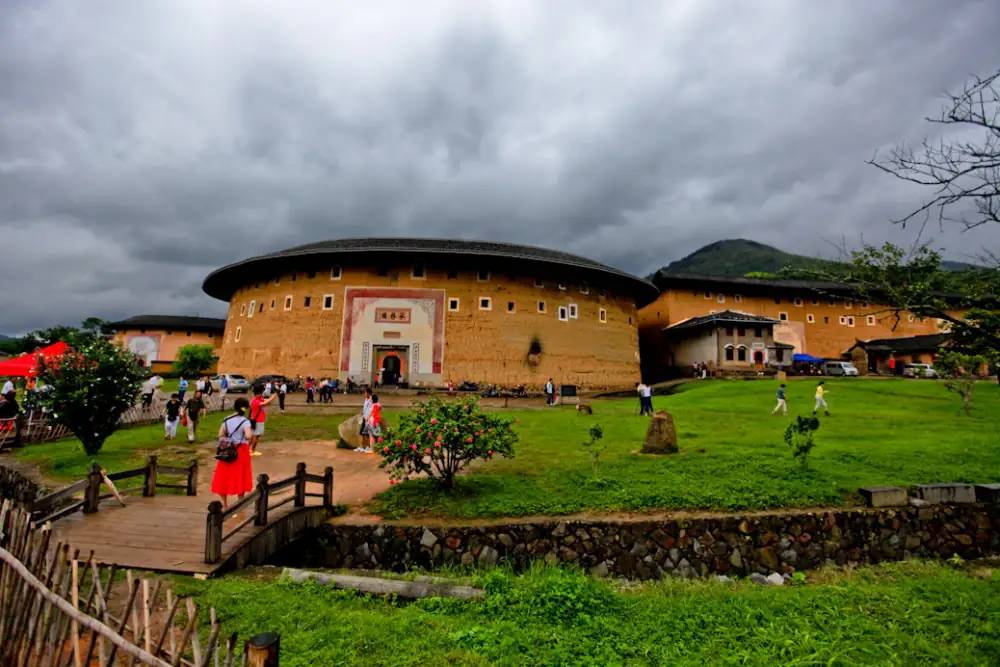
Tulou (土楼) are massive circular and square earthen fortresses built by the Hakka people — some housing hundreds of people from a single clan, some built as late as the 20th century. The UNESCO-listed Fujian Tulou clusters are spread across Nanjing (南靖) and Yongding (永定) counties.
Getting There
The easiest approach:
- HSR from Xiamen North → Nanjing South Station (25 minutes, ¥25) — the Nanjing County cluster (Taxia Valley, 田螺坑) is the most photogenic
- Or HSR to Yongding (takes longer with necessary transfers) — the Yongding County cluster (Hongkeng Village and Chengqi Building) is the most complete and elaborate
Taxi from Nanjing South to Taxia Valley: ¥40-60. The famous Taxia Valley five-tulou cluster (田螺坑, ¥90 combined ticket) — four round tulou and one square tulou arranged in a hillside formation — is the image you’ve seen in photographs. It’s genuinely that dramatic in person.
The Tulous Themselves
Chengqi Building (承启楼, ¥25, in Yongding) is the largest tulou — 4 concentric ring buildings housing 80 apartments, built in the 17th century and still inhabited. Outer ring rooms have been converted to small museums and guesthouses; inner ring residents still live and cook here. Staying overnight in a tulou guesthouse is highly recommended (¥80-150/night) — the communal courtyard at night, listening to older residents chat, is exactly the kind of experience that makes Fujian travel worthwhile.
If visiting Nanjing County as a day trip from Xiamen, taxi costs and the ¥90 combined ticket make the total cost manageable. Return to Xiamen in the evening.
Day 4: Quanzhou Maritime Silk Road Heritage
Journey: HSR from Xiamen → Quanzhou, 30 minutes, ¥30.
Quanzhou (泉州) was the world’s greatest maritime trading port from the Tang through early Ming dynasties. Marco Polo called it Zaytun — the port from which silk, porcelain, and spice flowed to the Arabian Peninsula, East Africa, and Southeast Asia. UNESCO inscribed Quanzhou’s “Eminent Maritime Heritage” as a World Heritage Site in 2021.
Kaiyuan Temple
Kaiyuan Temple (开元寺, ¥10) is the province’s largest Tang Dynasty Buddhist complex — built in 686 AD, with two Song Dynasty stone pagodas that have survived wars, earthquakes, and nine centuries intact. The main hall has stone lotus petals carved with 24 apsaras musicians on the ceiling beams — extraordinary detail.
Quanzhou Maritime Museum
Quanzhou Maritime Museum (泉州海外交通史博物馆, free) is one of China’s best specialized museums. The Song Dynasty maritime trade collection includes real Arab dhow anchors dredged from the harbor, ceramic fragments showing which Chinese goods were traded to which ports, and one of the world’s oldest surviving Arab-built wooden ships (13th century).
Qingjing Mosque & Old Town
Qingjing Mosque (清净寺, ¥3) is the oldest surviving mosque in China — built in 1009 by Arab merchants, in a classic Arab architectural style completely unlike the Chinese-Islamic mosques you see in Xi’an. The main prayer hall is roofless (the roof collapsed) but the stone arch facades are intact.
The surrounding Old City (鲤城区) has a remarkably high density of religious sites in a small area: in addition to the mosque, you’ll find the Guan Di Temple (Taoist), the Tianhou Palace (sea goddess temple), and a historic Buddhist monastery all within walking distance. Quanzhou’s religious pluralism was a direct product of its international trade history.
Days 5-6: Wuyi Mountain
Journey: HSR from Quanzhou → Wuyi North (武夷山北), ~3 hours (change at Fuzhou or Wuyi North — check routing). Cost ¥170-220.
Wuyi Mountain (武夷山) is a UNESCO dual heritage site (both cultural and natural) — the landscape of red sandstone cliffs, bamboo rivers, and ancient tea gardens has been a cultural touchstone since the Song Dynasty, when scholars came here to drink the famous Da Hong Pao (大红袍) oolong tea and write poetry.
Nine-Bend Stream
Nine-Bend Stream (九曲溪漂流, ¥160) is a bamboo raft ride down 9.5km of river winding through the red cliff gorges. This takes 2-2.5 hours and is one of the most scenic river journeys in eastern China. Book ahead in peak season (May-October) — it sells out by mid-morning.
Start the raft from Xingcun wharf in the morning. The raft trip ends at the Wuyi Palace scenic area (武夷宫) where the best cluster of ancient Wuyi buildings and tea ceremony pavilions is located.
Tianyou Peak
Tianyou Peak (天游峰, included in scenic area ticket ¥140) involves a 820-step climb to the summit with the best aerial views of the Nine-Bend River gorge. Allow 1.5-2 hours round trip from the base.
The Dahongpao Tea Bushes (大红袍母树, ¥30 extra in the Rock Tea Zone) — the original four ancient plants from which all Da Hong Pao tea is cloned, growing in a rock crevice above the stream. The original plants are no longer harvested (the tea sold as “Da Hong Pao” is from clones), but seeing the ancestral bushes is a pilgrimage for Chinese tea enthusiasts.
Wuyi Tea Culture
Spend part of Day 6 doing a proper gongfu tea ceremony at one of the valley tea houses — Wuyi is among the best places in China to learn about oolong production. Local tea from legitimate producers (look for official production certificates) costs ¥50-500/50g depending on grade and variety. Rougui (肉桂, cassia) and Shuixian (水仙, narcissus) are the signature varietals of the rock tea zone.
Day 7: Return
HSR from Wuyi North back to Xiamen (for departure flights) or Fuzhou/Shanghai/Hangzhou for onward travel.
Practical Information
| Item | Cost |
|---|---|
| Gulangyu ferry | ¥35 return |
| Gulangyu Sunlight Rock | ¥60 |
| Fujian Tulou (Taxia Valley) | ¥90 |
| Quanzhou Kaiyuan Temple | ¥10 |
| Wuyi Nine-Bend raft | ¥160 |
| Wuyi scenic area | ¥140 |
| Xiamen → Quanzhou HSR | ¥30 |
| Quanzhou → Wuyi Mountain HSR | ¥170-220 |
| Budget hotel | ¥200-350/night |
| Tulou guesthouse | ¥80-150/night |
Best time: April-June (spring teas being harvested, mild weather) and September-November (clear skies, autumn harvest). Summer is hot and humid but the landscapes are vivid. Typhoon season (July-September) can disrupt travel.
Fujian cuisine: One of China’s most underrated regional cuisines — light, seafood-heavy, and subtly flavored. Buddha Jumps Over the Wall (佛跳墙, expensive feast dish), oyster vermicelli (蚵仔面线), peanut soup (花生汤), and Hokkien braised pork rice (卤肉饭, though this version is more associated with Taiwan). In Xiamen, the morning market around Bashi Hutong has the most authentic and affordable local breakfast options.