
Table of contents
Open Table of contents
White-Headed Langur Reserve (白头叶猴保护区)
About the White-Headed Langur
The white-headed langur (Trachypithecus leucocephalus) is one of the world’s most endangered primates. Its total wild population is estimated at under 1,400 individuals, all living in a narrow band of karst limestone forest in Chongzuo Prefecture. They are found literally nowhere else.
The animals are striking: jet-black bodies with pure-white heads and long, graceful tails. They live in the limestone caves and cliff faces of the karst massifs, descending to feed on leaves and fruit. Spotting them requires patience and good binoculars, but the chance encounter with these rare animals in their habitat is one of the most remarkable wildlife experiences available in China.
Visiting the Reserve
The main access point is through the Baise Longtan National Nature Reserve (弄岗国家级自然保护区) and the associated Chongzuo Eco-Park (崇左生态公园), which provides guided wildlife viewing.
The best approach:
- Arrive at the eco-park early morning (07:00–09:00) when langurs descend from their cliff roosts to feed
- Hire a local guide (mandatory in the reserve; ¥80–¥150, $11–$21) who knows the animal locations
- Bring 8x42 or 10x50 binoculars at minimum; a 400mm+ telephoto lens for photography
Tickets to the eco-park: ¥50 ($7). Open 07:00–18:00.
The reserve also protects over 1,400 plant species, 200+ bird species and other mammals including the Sunda pangolin.
Mingshi Pastoral Scenic Area (明仕田园风景区)
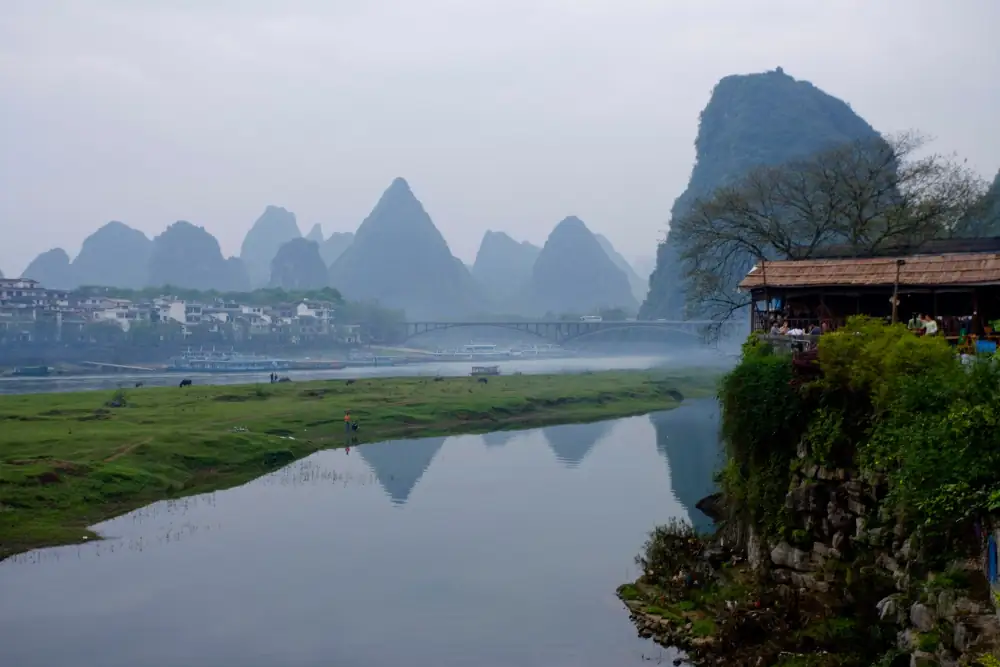
About 40 km from Chongzuo city centre, Mingshi is a valley of karst towers, paddy fields, bamboo groves and traditional Zhuang villages that looks almost absurdly picturesque. Bamboo raft punting through the valley (¥50–¥80, $7–$11 per person), cycling on farm paths and homestay stays in Zhuang wooden houses are the main draws.
It’s a popular location for Chinese photography enthusiasts and has appeared in numerous advertisements — you’ll recognise the scene immediately if you’ve seen any Guangxi tourism material.
Detian Transnational Waterfall (德天跨国大瀑布)
The Detian Falls cascade over a 200-metre-wide limestone cliff face on the Guichun River, which forms the border between China and Vietnam at this point. During the wet season (June–October), when the river is running high, the combined falls of Detian on the Chinese side and Ban Gioc on the Vietnamese side form one of the largest waterfalls in the world by volume — approximately 300 metres wide.
The setting is extraordinary: the white cascade framed by dark limestone karst towers, surrounded by lush tropical vegetation, with bamboo rafts (carrying tourists in bright life jackets) navigating the river below the falls on both sides of the invisible border line.
What to know:
- The falls are most impressive during or just after rainy season (June–October). In the dry season (December–March) they shrink significantly but are still photogenic.
- A bamboo raft ride up the river toward the falls provides the best vantage point and proximity (¥40–¥60, $6–$8)
- The park is open 07:30–17:30; tickets ¥80 ($11)
- You can see the Vietnamese side’s Ban Gioc Falls from the Chinese bank without a visa
Transport to Detian: The falls are about 150 km from Chongzuo city and 200 km from Nanning. Most visitors approach via Daxin County. Regular buses from Nanning (3–4 hours, ¥50–¥70) or a self-drive from Chongzuo (2.5 hours via expressway).
The Friendship Pass Border Crossing (友谊关)
Pingxiang, at the southern tip of Chongzuo Prefecture, hosts the Friendship Pass (友谊关) — China’s oldest land border crossing with Vietnam, used for over 2,000 years and one of the most historically significant border points in Asia.
The original gate was first constructed in the Han Dynasty and has been rebuilt multiple times; the current structure dates from the late Qing period. Travelling through here for a day trip into Vietnamese border towns (Dong Dang is immediately across) requires a valid Vietnamese visa; the crossing is open daily but has specific procedures for foreigners.
Even without crossing, the pass itself and its museum (¥30, $4) are worth visiting: the history of the Sino-Vietnamese War (1979) is particularly resonant here, and the landscape of limestone mountains straddling the two countries is beautiful.
Practical note for the crossing: Check current Sino-Vietnamese border regulations before planning. E-visa arrangements have changed multiple times; verify current entry requirements for your nationality at the Vietnamese embassy.
Zuo River Rock Art (左江花山岩画)
Inscribed on the UNESCO World Heritage List in 2016, the Zuojiang Huashan Rock Art Cultural Landscape consists of over 100 rock art sites along the Zuo River gorge. The artwork — painted directly onto sheer limestone cliffs in red iron oxide pigment — dates from roughly 500 BCE to 200 CE and was made by the ancient Luo-Yue people, ancestors of today’s Zhuang.
The most accessible site is at Huashan Scenic Area (花山风景区), accessible by boat from Ningming County (30 km from Chongzuo city). Cruise boats take visitors along the river to viewing platforms opposite the main cliff, where hundreds of figures — dancing, with arms raised, carrying swords — are painted in stylised forms on the vertical rock face.
Tickets: ¥90 ($13) including boat and scenic area access. Open 08:00–17:00.
Getting to Chongzuo
From Nanning
High-speed rail: Nanning East to Chongzuo, approximately 30 minutes; tickets ¥30–¥50 ($4–$7). Frequent services.
Regular train: Nanning to Chongzuo, 1 hour, ¥20–¥35 ($3–$5).
Bus: Regular coaches from Nanning to Chongzuo, 1.5 hours, ¥30–¥50 ($4–$7).
From Guilin
Rail: Guilin to Nanning (2 hours by high-speed), connect to Chongzuo. Total approximately 3 hours.
From Vietnam (Hanoi)
Border crossing at Friendship Pass: Buses from Hanoi to Dong Dang (border on Vietnamese side), cross to Pingxiang, then onward to Chongzuo or Nanning by rail. Popular route for overlanders; see the Vietnam-China overland guide for details.
Where to Stay
In Chongzuo City: Mid-range hotels from ¥180–¥350 ($25–$49) including several national chains. The Chongzuo International Hotel is the most reliable upscale option at ¥400–¥600/night ($56–$84).
Near Detian Falls: Small guesthouses in Daxin County serve as the base for falls visits. Rooms from ¥100–¥200 ($14–$28). The Detian International Resort offers more comfort at ¥350–¥600 ($49–$84).
At Mingshi Pastoral: Several authentic Zhuang village homestays (民宿) available from ¥120–¥250/night ($17–$35) including meals.
Best Time to Visit
September–October: Detian Falls are at their most spectacular following the summer rains, temperatures have moderated and the landscape is lushly green.
April–June: Spring is pleasant; early rainy season brings the river to good levels. White-headed langur young are often born in spring and early summer.
December–March: Dry season; falls are lower but the langurs are easier to spot (less foliage). Winter temperatures in Chongzuo are mild (15–20°C daytime).
Avoid: Chinese national holidays at Detian — the falls become extremely crowded.
Practical Tips
- Mosquitoes and insects: Subtropical borderland has significant mosquito population. Bring DEET repellent, especially for the nature reserve and Mingshi valley.
- Heat: July–August temperatures reach 35–38°C. Bring cooling towels and stay well-hydrated.
- Language: Almost no English in Chongzuo. Translation apps are essential. Some Zhuang villagers speak only their local dialect; communication requires patience.
- Currency for Vietnam border area: If visiting Pingxiang, carrying some Vietnamese dong is useful for small purchases on the Chinese side (vendors accept both currencies here).
- Wildlife note: The langur reserve requires advance booking through the Chongzuo municipal tourism bureau during peak periods. Check the official WeChat account.
A Suggested 3-Day Itinerary
Day 1: Arrive Chongzuo → White-headed langur viewing at eco-park (early morning) → Mingshi Pastoral afternoon and overnight Day 2: Bus to Daxin → Detian Falls (full day) → Overnight Daxin Day 3: Zuo River Rock Art at Huashan → Return Nanning via Chongzuo
Final Word
Chongzuo is the kind of destination that rewards travellers who’ve already done the Guilin circuit and want to go deeper into what Guangxi actually is: a region of extraordinary biological diversity, ancient Zhuang culture and a borderland history that stretches back millennia. The langurs alone make it worth the trip.