
Table of contents
Open Table of contents
Top Sights
Zhili Governor’s Office (直隶总督署)
Arguably the most historically significant and best-preserved government complex from the Qing Dynasty outside Beijing, the Zhili Governor’s Office served as the seat of power for the governor of China’s most important province for over 200 years.
The complex has been meticulously restored and converted into an excellent museum. The architecture follows the formal hierarchical layout of a major Qing administrative complex — a series of progressively more formal courtyards leading to the main audience hall, with side buildings for offices, residences and storage. Original furniture, documents and artefacts fill the halls with genuine historical atmosphere.
Key rooms to note:
- Main Audience Hall (大堂): Where the governor held formal audiences and issued decrees. The scale and formality of the space conveys the enormous authority of the position.
- Officials’ Offices (二堂, 三堂): More personal spaces where daily administrative work was conducted
- Li Hongzhang’s Personal Study: The great statesman’s private reading room, preserved as it was during his tenure (1870–1895)
Tickets: ¥50 ($7). Open Tuesday–Sunday 08:30–17:30. Allow 2–3 hours.
White Lotus Pond (莲花池公园)
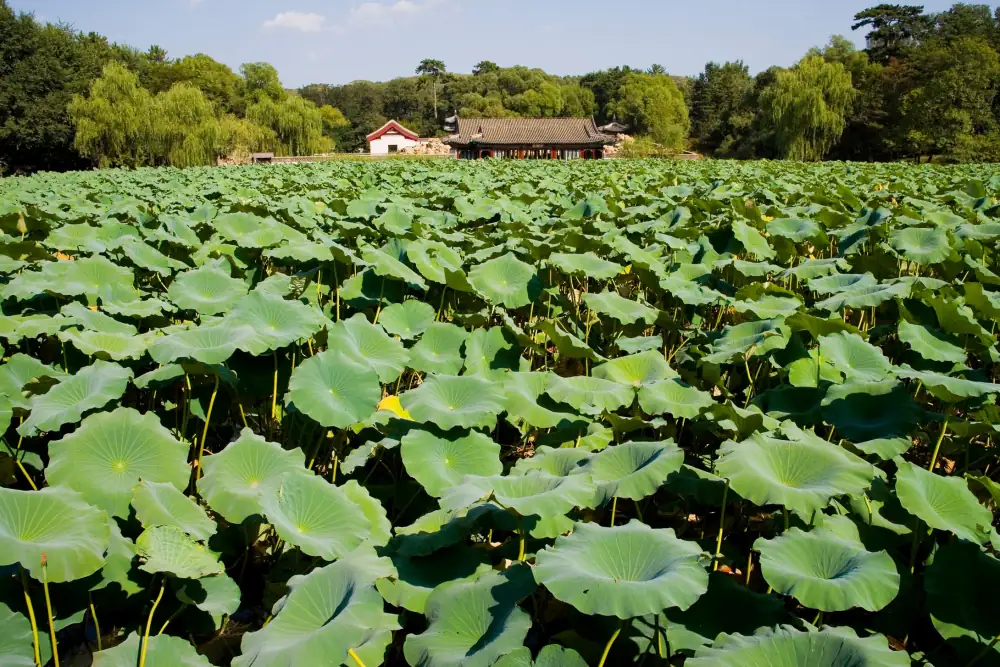
One of the most beautiful classical gardens in North China — and far less well-known than it deserves to be. White Lotus Pond has been a landscaped garden since the Han Dynasty, though the current layout dates mainly from the Yuan and Ming periods.
The centrepiece is a large artificial lake connected by bridges and walkways to several garden islands, planted with ancient trees, traditional pavilions and — in summer — a staggering bloom of lotus flowers that covers much of the water surface. The July–August lotus bloom is genuinely spectacular; the pond earned its name honestly.
Tickets: ¥35 ($5). Open daily 06:00–21:00.
Baoding Ancient City Wall and East Gate (古城墙)
Sections of Baoding’s original city wall survive, including the restored East Gate tower. Walking the restored section provides good city views and a sense of Baoding’s historical urban structure.
Baoding University District and Culture Street
Baoding has a large university population that gives it a livelier cultural atmosphere than its historical reputation suggests. The Culture Street (文化街) near Baoding University has bookshops, tea houses, art supplies and casual restaurants popular with students.
Baiyangdian Wetlands (白洋淀)
About 45 km east of Baoding, Baiyangdian is the largest freshwater wetland in the North China Plain — a network of shallow lakes, reed marshes and waterways covering about 366 square kilometres. It’s been described as “the kidney of North China” for its role in flood control and water purification, and has been designated the ecological core of the new Xiong’an Special Administrative Zone.
The wetlands are famous for:
- Reed cutting season (late autumn): The massive reed harvest creates golden landscapes
- Summer lotus bloom: The inner channels between reed beds are carpeted with lotus flowers in July–August
- Migratory birds: Over 200 bird species pass through; serious birding opportunities in spring and autumn
Boat trips: Traditional flat-bottomed boats (¥40–¥80 per person for tours of 1–2 hours) navigate the reed channels. The most atmospheric experience is an early morning ride in the mist.
Getting there: Regular buses from Baoding to Baiyangdian town (安新县), 1 hour, ¥20–¥30 ($3–$4).
Mancheng Han Tombs (满城汉墓)
About 15 km northwest of Baoding in the hills of Mancheng County, two Han Dynasty royal tombs (sealed since approximately 113 BCE) were discovered in 1968. The tombs of Liu Sheng and his wife Dou Wan contained the extraordinary burial suits sewn entirely from jade plaques threaded with gold wire — among the most spectacular archaeological finds of the 20th century.
The original jade suits are now in the Hebei Provincial Museum in Shijiazhuang (well worth the visit). The tomb caves themselves, hewn directly into the mountain, remain open to visitors and are genuinely impressive in scale — each tomb carved as a multi-room house inside the rock.
Tickets: ¥60 ($8). Bus from Baoding to Mancheng, then taxi.
Dingzhou Pagoda (定州开元寺塔)
In Dingzhou, about 80 km southwest of Baoding, stands one of China’s most important Song Dynasty pagodas. The Liaodi Pagoda (built 1001–1055) is China’s tallest standing pre-modern pagoda at 84.2 metres — an extraordinary example of Song brick engineering. It was actually constructed as a military observation tower to monitor Khitan (Liao Dynasty) movements to the north. The view from the upper levels is restricted but the exterior is exceptional.
Getting there: High-speed rail from Baoding to Dingzhou (15 minutes); then bus or taxi to the tower.
Baoding Food
Baoding has a distinctive North China culinary tradition with several foods it claims as distinctly its own.
Must-try:
- Baoding smoked pork ribs (驴肉火烧): Actually donkey meat (驴肉) in a flaky baked bread — the famous “donkey burger” of North China. Baoding competes with Hejian for the title of “best donkey burger in Hebei.” Available everywhere for ¥5–¥8 per piece.
- White cabbage hot pot (白菜炖豆腐): A Hebei winter staple; simple, warming
- Baoding meatballs (丸子汤): Fish or pork balls in a clear broth; street food classic
Restaurant areas: Yuhua Road (裕华路) has the highest concentration of good casual restaurants. A filling meal for two costs ¥60–¥100 ($8–$14).
Getting to Baoding
From Beijing
High-speed rail (recommended): Beijing West to Baoding East takes approximately 30–40 minutes; tickets ¥35–¥55 ($5–$8). This makes Baoding an easy day trip from Beijing, or a convenient overnight stop on the way south.
Regular train: Beijing to Baoding (old station), approximately 1.5 hours, ¥25–¥40 ($3.5–$6).
From Shijiazhuang (Hebei provincial capital)
High-speed rail: 20–30 minutes; tickets ¥25–¥45 ($3.5–$6).
From Taiyuan
High-speed rail: Taiyuan South to Baoding East, approximately 1.5 hours; tickets ¥120–¥185 ($17–$26).
Getting Around
The main tourist sites (Zhili Governor’s Office, White Lotus Pond) are in the city centre and walkable from each other. DiDi works well throughout the city. The city bus system covers major routes but requires Chinese reading ability.
Where to Stay
Budget (¥120–¥200 / $17–$28): Multiple budget hotels near the train stations. 7 Days Inn and Home Inns have several properties.
Mid-range (¥250–¥450 / $35–$63): Baoding International Hotel (保定国际大酒店) near the city centre is comfortable and well-located.
Upscale (¥600+ / $84+): Wanda Realm Baoding is the best business hotel. Howard Johnson Baoding is also a reliable choice.
Best Time to Visit
July–August: The lotus bloom at White Lotus Pond and Baiyangdian is at its peak. Hot and humid, but the lotus makes it worthwhile.
Spring (April–May): Pleasant temperatures; trees in Baoding’s parks are beautiful in blossom season.
Autumn (September–November): Best overall weather; Baiyangdian’s reed harvest season.
Winter: Cold and grey; functional for a transit stop but not ideal for extended exploration.
Practical Tips
- Beijing day trip: The 30–40 minute high-speed connection makes Baoding genuinely feasible as a day trip from Beijing. Leave early, see the Governor’s Office and White Lotus Pond, have a donkey burger lunch, back to Beijing for dinner.
- Xiong’an note: The new Xiong’an Special Administrative Zone, being built partly over Baiyangdian, is a major national development project; the area is undergoing significant change. Access to some Baiyangdian areas may be restricted as construction continues. Check current access before planning the wetland visit.
- Photography: The Governor’s Office’s main courtyard is best photographed in morning light. The White Lotus Pond is superb at dawn in summer.
Final Word
Baoding has been waiting for international visitors to discover it. The combination of first-rate historical sites (the Governor’s Office is genuinely one of the best-preserved Qing complexes in China), accessible nature (Baiyangdian), nearby archaeology (Han tombs) and the dramatic architecture of the Dingzhou pagoda give it a range that many more famous Hebei destinations lack. The 30-minute train from Beijing removes any logistical excuse for skipping it.