
Table of contents
Open Table of contents
The Southern Side of the Sacred Mountain
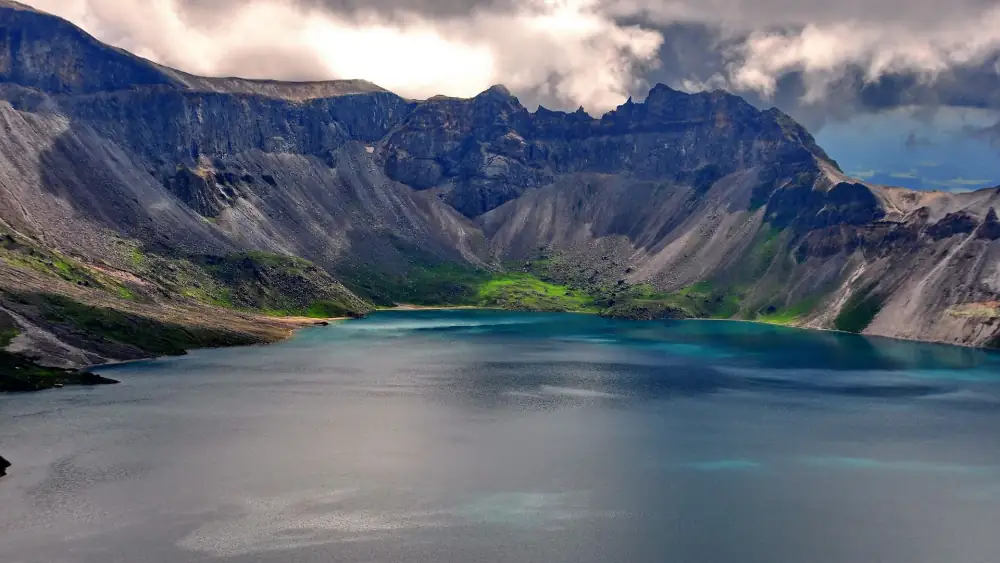
Changbai Mountain (长白山, “Ever-White Mountain”) is one of the most significant peaks in East Asia — a dormant volcano whose crater lake, Tianchi (天池, “Heavenly Lake”), straddles the border between China and North Korea. The mountain is sacred in both Korean and Manchu cosmology, and its slopes harbour some of the best-preserved temperate forest in Northeast Asia.
Most visitors approach Changbai Mountain from the north (via Erdaobaihe town), but the southern approach through Baishan (白山) offers a distinctly different experience. The southern route is less developed, less crowded, and arguably more scenic — the valleys are deeper, the forests are wilder, and the hot springs are more authentic. Baishan city itself is a modest industrial town, but as a base for exploring the southern Changbai area, it’s excellent.
I visited in September, when the forests were beginning to turn and the air was crisp and clear. The southern approach rewarded us with views of Tianchi that were, according to our guide, clearer than the northern side typically offers — the southern face catches different wind patterns that tend to disperse the clouds that so often obscure the crater lake.
Tianchi — The Heavenly Lake
Seeing the Crater Lake
Tianchi sits at 2,189 metres above sea level, filling the caldera of the last major eruption (which occurred in 1702). The lake is 9.82 square kilometres, up to 373 metres deep, and surrounded by 16 peaks. Its waters are an extraordinary deep blue — almost violet on a sunny day — and the sight of it emerging from the clouds is genuinely one of China’s most memorable natural spectacles.
The catch, and there’s always a catch with Tianchi, is that it’s frequently shrouded in cloud. Some estimates suggest that the lake is visible only about 30% of the time during the summer tourist season. The southern approach doesn’t guarantee visibility, but local guides claim the odds are slightly better than the northern side.
Southern access: The southern viewing platform (南坡) is reached via a winding mountain road from Changbaishan County (about 2 hours from Baishan). A shuttle bus takes you the final 20 km from the park entrance to the summit area, followed by a 15-minute walk to the viewing platform.
Entrance fee: ¥190 ($26 USD) including shuttle bus (June — September), ¥125 ($17 USD) off-season. The southern route is typically open from mid-June to mid-October, weather permitting.
Best time for visibility: Early morning, especially after a clear night. Clouds tend to build during the day. Check the weather forecast and be flexible with your plans.
What You Can and Cannot See
From the southern viewing platform, you’re looking north across the lake toward the highest peaks, which are actually on the Korean side of the border. The view is dramatic — steep caldera walls dropping to the blue lake, with the rugged peaks beyond. You can see the North Korean guard posts on the far shore (bring binoculars if you have them), and on very clear days, you can make out the North Korean town of Samjiyŏn on the distant hillside.
Photography is permitted, but do not photograph the border markers or military installations in detail. The Chinese border guards are generally relaxed about tourists, but use common sense.
Southern Changbai Scenic Areas
Wangtian’e Scenic Area (望天鹅景区)
About 60 km from Changbaishan County, Wangtian’e (also known as “Looking at the Goose” for a peak that resembles a goose’s neck) is a spectacular gorge carved by volcanic activity. The area features columnar basalt formations — hexagonal stone pillars created when volcanic lava cooled slowly — that form walls, cascades, and even a natural stone “organ” with dozens of pillars side by side.
The hiking trail through the gorge follows a stream for about 4 km, passing waterfalls, pools, and the extraordinary stone formations. It’s moderately easy — mostly flat with some stairs — and takes about 3 hours.
Entrance fee: ¥100 ($14 USD). Open May — October.
Highlight: The Shi Lin (Stone Forest) — a section where hundreds of basalt columns create a wall of hexagonal stones, each about 30-50 cm across. It’s a geological wonder that looks almost manufactured.
Fifteen-Dao-Gou (十五道沟)
A less-developed alternative to Wangtian’e, this valley follows one of the 15 streams that flow south from Changbai Mountain (hence the name, “Fifteen Stream Valley”). The scenery is similar — volcanic rock formations, waterfalls, and pristine forest — but with fewer visitors. There’s no entrance fee and minimal infrastructure — bring your own food and water.
Getting there: About 80 km from Changbaishan County. You’ll need a hired car or strong navigation skills — the road is paved but signage is limited.
Hot Springs
Changbaishan Hot Springs
The volcanic activity that created Changbai Mountain also produces geothermal hot springs, and the southern approach has several excellent options:
Changbaishan Hot Spring Resort (长白山温泉度假村): The largest facility, with multiple indoor and outdoor pools. The water temperature ranges from 38-42°C and is rich in minerals. Admission ¥168 ($23 USD) for a 3-hour session. Towel and locker included.
Wild Hot Springs: Several natural hot spring seeps exist along the southern slopes, where hot water emerges from the rocks into small pools. These are free to use but require local knowledge to find. Ask at your hotel or guesthouse — locals are usually happy to point you toward the best spots. Use caution — water temperatures can vary and some pools are dangerously hot.
Tip: Soaking in an outdoor hot spring surrounded by snow is one of the great Northeast China experiences. Visit in winter for the full effect.
Korean-Chinese Culture and Cuisine
Baishan and the surrounding Changbaishan area have a significant Korean-Chinese (朝鲜族) population, and the cultural influence is everywhere — from the bilingual signs to the restaurants serving kimchi alongside dongbei dumplings.
Must-Try Foods
Korean BBQ (朝鲜烤肉): Marinated beef and pork grilled at the table, served with lettuce wraps, ssamjang sauce, and banchan (side dishes). The quality of the local beef is excellent. Meals ¥50-80 ($7-11 USD) per person.
Cold Noodles (朝鲜冷面): Buckwheat noodles in cold beef broth with sliced pear, cucumber, and egg. The Changbaishan version is particularly good — the mountain water makes the broth exceptionally clean-tasting. ¥18-28 ($2.50-3.90 USD).
Kimchi Stew (泡菜汤): Spicy, sour, and warming — perfect after a day on the mountain. ¥25-35 ($3.50-4.90 USD).
Rice Wine (米酒): Korean-style sweet rice wine, served cold. Mildly alcoholic and very refreshing. ¥10-15 ($1.40-2 USD) per bowl.
Changbai Mountain Trout (长白山鳟鱼): Cold-water trout from the mountain streams, served grilled or steamed. The flesh is firm and sweet. ¥48-68 ($6.70-9.40 USD).
Dongbei Dumplings (东北饺子): Large, plump dumplings filled with pork and cabbage or pork and chive. A staple of the region. ¥15-25 ($2.10-3.50 USD) per plate.
Recommended Restaurants
Changbai Korean BBQ: In Changbaishan County town. Excellent meat quality and banchan selection. Meals ¥50-80 ($7-11 USD) per person.
Mountain Trout Restaurant: Near the Wangtian’e scenic area. Fresh-caught trout prepared simply. Meals ¥40-60 ($5.50-8.30 USD) per person.
Practical Information
Getting to Baishan
By Air: Changbaishan Airport (NBS) is about 60 km from Baishan city, with flights from Beijing, Shanghai, Changchun, and several other cities. The airport is small but modern. Taxi to Baishan ¥120-150 ($17-21 USD).
By Train: Baishan Station has trains from Changchun (4 hours, ¥50-100/$7-14 USD), Shenyang (6 hours), and other Northeast cities. High-speed rail connections are improving — check current schedules.
By Bus: Long-distance buses from Changchun (4 hours, ¥80/$11 USD) and Tonghua (2 hours, ¥40/$5.50 USD).
Getting to the Southern Changbai Area
From Baishan city to Changbaishan County (the base for the southern approach): about 2 hours by road. Hired car ¥300-400 ($42-55 USD) per day. Public buses depart from Baishan Bus Station (¥35/$4.90 USD, 2.5 hours).
Accommodation
Changbaishan County: The best base for the southern approach. Changbaishan Holiday Hotel — doubles from ¥250-500 ($35-69 USD). Several Korean-style guesthouses from ¥100-200 ($14-28 USD).
Baishan City: More basic, but convenient for transport connections. Doubles from ¥150-300 ($21-42 USD).
Hot Spring Resort: Stay on-site for easy access to the springs. Doubles from ¥400-800 ($55-111 USD).
Best Time to Visit
- June — September: The main tourist season. Tianchi is accessible, the forests are green, and the weather is warm (15-25°C at the base, 5-15°C at the summit).
- September — October: Autumn colours are stunning, and the weather is generally clear. Excellent for photography.
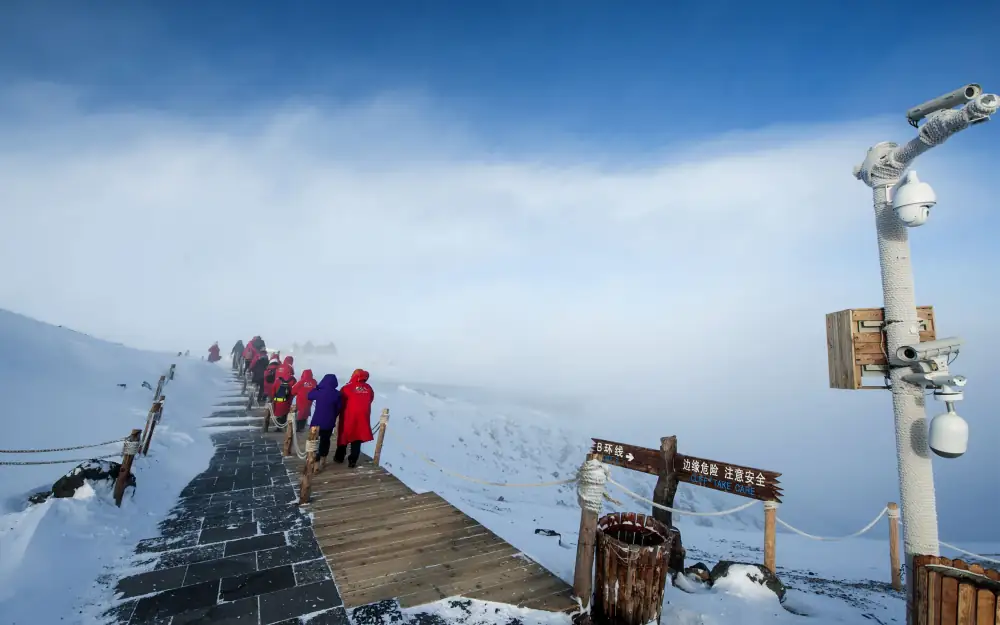
- December — March: Winter wonderland — snow, ice, and hot springs. Tianchi may be inaccessible due to snow. The rime ice (雾凇) on the trees is spectacular.
- April — May: Unpredictable — some roads may still be closed from winter.
Budget Estimate (3 Days)
| Item | Budget (¥) | Mid-Range (¥) |
|---|---|---|
| Transport from Changchun (round trip) | 200 | 700 (flight + taxi) |
| Accommodation (2 nights) | 200 | 600 |
| Meals | 240 | 500 |
| Tianchi entrance + shuttle | 190 | 190 |
| Wangtian’e entrance | 100 | 100 |
| Hot spring | 168 | 168 |
| Local transport | 150 | 400 |
| Total | ¥1,248 ($173 USD) | ¥2,658 ($368 USD) |
The Quiet Side of the Mountain
The southern approach to Changbai Mountain isn’t for everyone. It requires more effort, more patience, and more flexibility than the northern route. But those very qualities make it more rewarding. Standing on the southern viewing platform, looking across a crater lake that sits on an international border, with the forests of two countries stretching away below you — that’s an experience that stays with you. And knowing that you’ve seen the quieter, wilder side of one of Asia’s most sacred mountains makes the extra effort feel entirely worthwhile.