
Kashgar (喀什, Kāshí) sits at the western edge of China, where the Silk Road split into northern and southern routes around the Taklamakan Desert. For 2,000 years, this oasis city was one of the most important commercial crossroads in Central Asia — a place where Chinese silk and porcelain met Persian metalwork, Indian spices, and Sogdian merchants.
The Central Asian character is still visible: the old city’s narrow earthen lanes, the Uyghur language on every sign, the domed mosques, the bread ovens in doorways, the call to prayer five times daily. Kashgar is, in character and sensory experience, more Samarkand than Shanghai.
Important notice for travellers: Xinjiang requires additional documentation and registration procedures for foreign visitors. Check current entry requirements with your country’s foreign ministry before travel. The situation has fluctuated; this guide reflects conditions as of 2026 but requirements change.
Table of contents
Open Table of contents
Essential Information
| Detail | Info |
|---|---|
| Province | Xinjiang Uyghur Autonomous Region |
| Getting there | Flights to Kashgar (KHG) from Ürümqi (2 hrs), Beijing (5 hrs), Shanghai (6 hrs); or overland from Ürümqi (20+ hrs by train/bus) |
| Registration | All foreign visitors must register with local police within 24 hours of arrival; hotels handle this automatically |
| Best season | April–June and September–October; July–August very hot (45°C possible); November–March cold but culturally interesting |
| Language | Uyghur is the primary language; Mandarin widely spoken in commercial areas; Russian useful near Kyrgyzstan border |
The Ancient City (喀什古城)
The old city of Kashgar — officially the “Kashgar Ancient City Tourist Scenic Area” — is a 3.6-square-kilometre area of dense earthen-brick lanes and traditional Uyghur courtyard architecture. Most of the old city was reconstructed or heavily renovated from 2009–2013 (the original buildings were mostly mud brick, deemed structurally unsafe); the current structures are largely rebuilt in traditional style.
The reconstruction is a source of controversy among heritage conservationists — many original buildings were demolished, displacing residents and destroying authentic fabric. The current old city is more theme park than genuine historic cityscape in parts.
What remains authentic:
- The neighbourhood structure — the street pattern and spatial density of the old city
- The Id Kah Mosque (艾提尕尔清真寺) in the central square — the largest mosque in China, capacity 20,000 worshippers, authentically functioning
- Several craft workshops in the northern section of the old city where traditional Uyghur crafts continue: knife making, silk weaving (Atlas silk), copper etching, musical instrument repair
- The evening food market around the Id Kah Square — genuinely local, excellent food
The Id Kah Mosque: Reconstructed multiple times over centuries; the current main structure is from 1442, with subsequent expansions. Non-Muslim visitors may enter outside prayer times, particularly in the morning. The Friday midday prayer brings thousands of worshippers whose overflow fills the surrounding square — a spectacular spectacle but an active religious event; observe respectfully.
The Sunday Bazaar (喀什大巴扎)
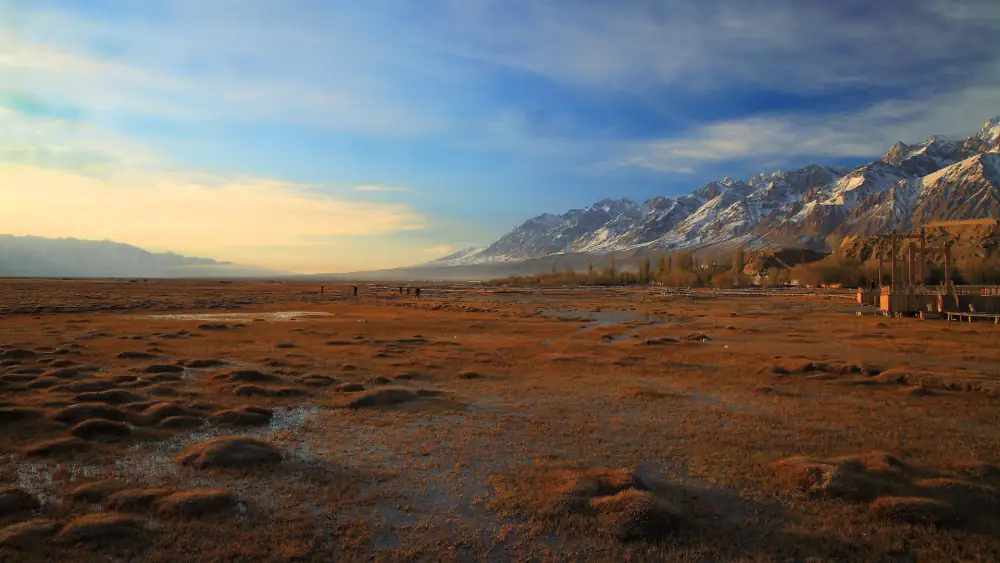
The traditional weekly market on the eastern edge of the city — now held daily as a tourist market, but Sunday retains the historical livestock market tradition.
The Sunday Livestock Bazaar (牲畜交易市场): 3 km from the old city, the livestock market operates in the early morning of Sunday. Thousands of sheep, goats, cattle, and horses are traded between Uyghur herding families. It’s a working commercial event — not a performance — and the scale and energy are remarkable.
Practical: Arrive early (8–9 AM). The livestock area is dusty and smelly; dress accordingly. Bargaining for animals is conducted entirely in Uyghur; watching and photographing (ask permission) is more appropriate than attempting to participate.
The main bazaar: The International Grand Bazaar (国际大巴扎) is a large purpose-built complex with hundreds of stalls selling Uyghur crafts, food, and textiles. Tourist-oriented but with genuine goods:
- Atlas silk (艾德莱斯绸): The distinctive Uyghur warp-resist dyed silk — complex geometric patterns in vivid jewel colours. Genuinely made in Kashgar region; look for handwoven versions (more expensive, irregular texture). Sold by the metre and as finished garments.
- Uyghur knives (英吉沙小刀): Steel blades with inlaid handles — a centuries-old craft tradition. The best come from Yengisar (英吉沙 county, 60 km south). Note: cannot be carried as cabin luggage on flights.
- Dried fruit and nuts: Kashgar and the Xinjiang basin are the source of extraordinary dried fruit — sultanas (无核白葡萄干) from Turpan, dried apricots (杏干), walnuts (核桃), dried mulberries (桑葚干). Buy from bulk vendors, not packaged tourist products.
Uyghur Food in Kashgar
Uyghur cuisine is Central Asian in character — lamb-centred, influenced by Uzbek and Persian traditions, cooked over wood fire or in clay ovens.
Polo (抓饭, Zhuāfàn): The Uyghur version of pilaf — rice cooked in lamb fat with carrots, onion, and braised lamb pieces. The defining everyday meal; available from pilaf houses (抓饭馆) throughout the old city from morning.
Samsa (烤包子, Kǎo bāozi): Lamb and onion pastries baked in a tandoor oven — the same clay-lined wood-fire oven used from Turkey to China. The pastry is flaky and layered; the filling intensely flavoured with cumin and onion. Best straight from the oven.
Laghman (拉条子, Lātiáozi): Hand-pulled wheat noodles served with a stir-fried lamb and vegetable sauce — the everyday noodle dish of Xinjiang. The noodles are excellent; the sauce flavour is deeper and more cumin-heavy than Chinese noodle dishes.
Naan bread (馕, Náng): The staple bread — flatbreads baked in tandoor ovens, ranging from plain (sāng) to sesame-topped to onion-filled. Available from every street corner. Fresh, still-warm naan from a tandoor oven is one of the better breads in the world.
Night Food Market (夜市): The area around Id Kah Square at night becomes a food market with dozens of vendors — lamb skewers (串串, grilled over charcoal), roast whole lamb (全羊), fried noodles, fresh-squeezed pomegranate juice. Open until midnight. Genuinely excellent.
Beyond the City
Karakorum Highway (中巴公路)
The road south from Kashgar toward Pakistan passes through 220 km of spectacular Pamir Mountain landscape before reaching Khunjerab Pass (4,693m) at the Pakistan border. Foreign visitors can travel as far as the pass (border crossing requires permit and Pakistani visa).
The road passes Karakul Lake (卡拉库里湖) — a high-altitude lake at 3,600m with the 7,546m Muztagata Peak reflected in its surface on clear mornings. This is one of the most dramatic landscape vistas in Xinjiang.
Practical: Day trip by shared jeep or chartered vehicle from Kashgar (¥200–300/person including park fees). Or stay overnight in Kirghiz yurt accommodation at the lake — extraordinary experience.
Abakh Khoja Mausoleum (香妃墓)
The most architecturally significant Islamic monument in China — a 17th-century tilework mausoleum following Central Asian architectural traditions. The tile work (turquoise, white, and blue geometric patterns) is genuinely beautiful. Outside the old city, 5 km north; ¥30 entry.
Practical Tips
Time zone: Xinjiang officially uses Beijing Time (UTC+8), but locals (particularly Uyghur communities) operate on Xinjiang Time (UTC+6), which is 2 hours behind. Most businesses have two sets of opening hours listed. Asking “Beijing time or Xinjiang time?” is standard.
Police registration: Hotels handle this automatically; guesthouses and private accommodation must confirm they register foreign guests. Carry your passport at all times; police checkpoints require it.
Photography: Ask before photographing people — in a functioning religious and commercial environment, this is basic courtesy. Many people will be glad to be photographed; some will decline.
Heat: Summer temperatures regularly exceed 40°C. Activities are best before 11 AM and after 5 PM. Stay hydrated.
Kashgar occupies a unique position in China — architecturally, culturally, linguistically, and historically it belongs as much to Central Asia as to East Asia. For travellers who have been to Uzbekistan or Kyrgyzstan, it feels like a familiar culture filtered through a Chinese administrative lens. For those who haven’t, it’s unlike anywhere else in the country.
Last updated: May 2026