
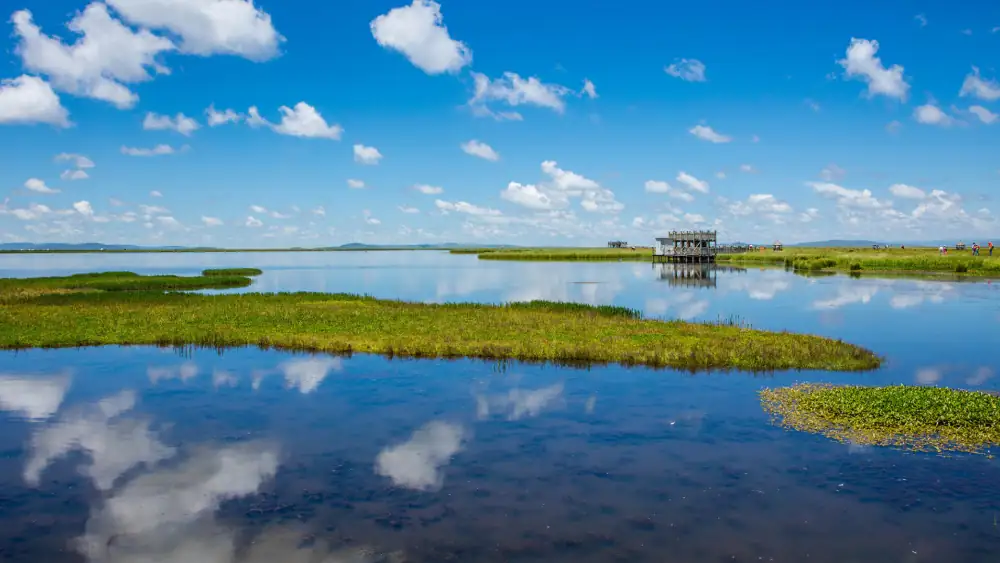
Jiuzhaigou Valley (九寨沟) contains the most extraordinarily coloured lakes in the world. The turquoise, emerald, azure, and cobalt blues of the chain of calcite-rich lakes are not enhanced in photographs — they really look like that. The underwater detail — fallen trees, white calcite formations, aquatic plants — is visible 20–30 metres down through water of crystalline clarity.
Five Flower Lake (五花海) is the most celebrated individual lake in the valley: its colours shift with viewing angle and light conditions through green, yellow, blue, and turquoise simultaneously — the multiple colours produced by different mineral concentrations and underwater light refraction across the shallow basin.
Table of contents
Open Table of contents
Essential Information
| Detail | Info |
|---|---|
| Province | Sichuan (northern Aba Tibetan autonomous prefecture) |
| Getting there | Fly to Jiuzhai Huanglong Airport (JZH) — direct from Chengdu (45 min), Beijing, Shanghai, and other cities; or bus from Chengdu (8–10 hours) |
| Ticket | ¥169 per person (April–November); ¥80 November 16–March 31; environmental transport bus included |
| Opening hours | 7:00 AM – 6:00 PM (April–November); 8:00 AM – 5:00 PM (winter) |
| Post-earthquake status | Partially reopened after the 2017 M7.0 earthquake; significant restoration complete as of 2023; some sections still restricted |
| Best season | Autumn (late September–November) for foliage plus turquoise lakes combination |
The 2017 Earthquake and Recovery
A M7.0 earthquake struck Jiuzhaigou on August 8, 2017, damaging multiple lakes and infrastructure. The valley was closed for nearly 5 years.
The reopening has been phased and managed. As of 2026, the main scenic areas — including Five Flower Lake, Nuorilang, and the Long Lake area — are fully accessible. Some hiking trails remain closed for restoration. The lakes have largely recovered naturally; some have changed in appearance due to calcite redistribution.
Visitor numbers are now strictly controlled: Daily capacity is 20,000 visitors (reduced from 40,000+ pre-earthquake). This makes advance booking essential and the experience significantly less crowded than historical accounts suggest.
Book tickets: Via the official Jiuzhaigou website (jiuzhai.com) or WeChat mini-program. Tickets often sell out 2–3 weeks ahead for autumn peak season.
Five Flower Lake (五花海)
The valley’s most famous and most beautiful lake. Approximately 5 hectares in area, with a maximum depth of 5 metres in the deepest section. The bottom is covered in calcium carbonate formations — white travertine deposits — and partially submerged Quaternary-era pine and spruce trees (some over 200 years old) preserved by the mineral-rich water.
The colours: The simultaneous multiple colours occur because:
- Different depths refract light differently through the mineral-rich water
- Aquatic plants of different species create different colour zones
- The viewing angle relative to the sun dramatically affects which colours are visible
The classic photograph — taken from the elevated boardwalk above the northern end — looks down over the lake in late morning light (sun from the south-southeast, light penetrating the water surface at the optimal angle). In this position, the lake appears simultaneously turquoise, emerald, electric blue, and golden.
Best time to visit: Late morning (10 AM–1 PM) for optimal light angle. Autumn (October) when the surrounding forest is gold, orange, and red — the combination of the coloured trees reflected in the turquoise water is extraordinary.
The Valley Structure
Jiuzhaigou comprises three valleys — Shuzheng Valley (树正沟), Rize Valley (日则沟), and Zechawa Valley (则查哇沟) — connected by an environmental bus system. The lakes and waterfalls are distributed throughout all three.
Most efficient route for a single day:
- Start at the valley entrance (Shuzheng Valley)
- Take bus to upper Rize Valley (Yuanshi Forest level)
- Walk downhill through Rize Valley: Arrow Bamboo Lake → Panda Lake → Five Flower Lake → Pearl Beach Falls
- Continue down to Nuorilang area
- Bus back to entrance
Total walking: approximately 8–10 km downhill on boardwalks; 4–6 hours.
Key Sites Beyond Five Flower Lake
Nuorilang Waterfall (诺日朗瀑布)
The widest highland waterfall in China — 270 metres wide, 20 metres high — at the junction of the three valleys. The water cascades over a broad travertine bench in a white curtain that thunders in spring and early summer (peak flow: May–June). In autumn, the surrounding forest is golden.
Pearl Beach Falls (珍珠滩瀑布)
A shallow waterfall where a broad shelf of rippled travertine breaks the river into thousands of parallel streams — the “pearl beach” effect where each stream catches the light individually. Extraordinarily photogenic. One of the best video and motion photography locations in China.
Long Lake (长海)
The largest lake in the valley (2 km long, 100m deep), at the highest elevation (3,100m altitude) and the most remote. Reached by bus from the upper Zechawa Valley. The water here is not turquoise — it’s a deep navy blue, a different and equally striking effect at high altitude. Far fewer visitors reach it.
The Tibetan Villages
Jiuzhaigou means “Nine Village Gully” — nine Tibetan villages were located within the valley before it became a protected area. Some remain as community residences; the Shuzheng Village (树正寨) at the valley entrance is accessible and has a small cultural exhibition on Jiuzhaigou Tibetan culture.
Huanglong Scenic Area (黄龙)
110 km south of Jiuzhaigou (1.5–2 hours by road), the Huanglong scenic area contains an entirely different but equally spectacular set of calcite formations — shallow terraced pools of turquoise water (5.4 km of travertine terracing), the Colorful Pools (五彩池) at 3,800m altitude, and the forest of ancient spruce and pine.
The combination: Many visitors fly into Jiuzhai Huanglong Airport (equidistant from both) and split time: 2 days in Jiuzhaigou, 1 day in Huanglong. Both are UNESCO World Heritage Sites, both extraordinary.
Altitude: Huanglong’s main terraces are at 3,600–3,800m — significantly higher than Jiuzhaigou. AMS is possible; take the first day slowly.
Practical Tips
Autumn colours: The golden window for “turquoise lakes + autumn forest” is narrow — approximately October 1–20 in most years. This is also the most crowded period. Balance: go October 15–25 for good colour with slightly less crowd pressure.
Photography: The best light for the turquoise lake colours is between 10 AM and 2 PM (sun high enough to penetrate the water). Early morning and late afternoon produce more atmospheric light but less lake colour clarity.
Environmental rules: Stay on the boardwalks; no swimming; no touching the water. The “no swimming” rule is enforced to protect the mineral balance that creates the colours.
Altitude medication: Jiuzhaigou base is at 2,000m; some lakes and the Long Lake area reach 3,100m. Carry altitude medicine as precaution; acclimatise in Chengdu (500m) before going.
Jiuzhaigou is one of the destinations where photographs actually undersell the reality. The colours are richer, more complex, and more alive than any image communicates — because the lake surface moves, the light changes, and the combination of the surrounding forest and sky changes the water colour continuously. It genuinely looks like this.
Last updated: May 2026