
Shaolin Temple has two lives: the real one and the Hollywood version. The Hollywood version involves orange-robed monks flying through the air and defeating evil with supernatural martial arts. The real Shaolin is a functioning Chan (Zen) Buddhist monastery, founded in 495 AD by Emperor Xiaowen of the Northern Wei Dynasty, where a genuine tradition of martial arts has been practiced for over 1,500 years.
The monastery’s martial tradition likely began practically — monks needed to defend the temple and maintain physical health through long periods of seated meditation. The martial arts became codified, became a cultural system, and became associated with the First Patriarch of Chan Buddhism, Bodhidharma (达摩, Da Mo), who is said to have meditated here for nine years facing a cave wall.
Today Shaolin Temple receives over two million visitors per year. The experience requires some navigation to get past the tourist trappings to the genuine substance.
Table of contents
Open Table of contents
The Temple Complex
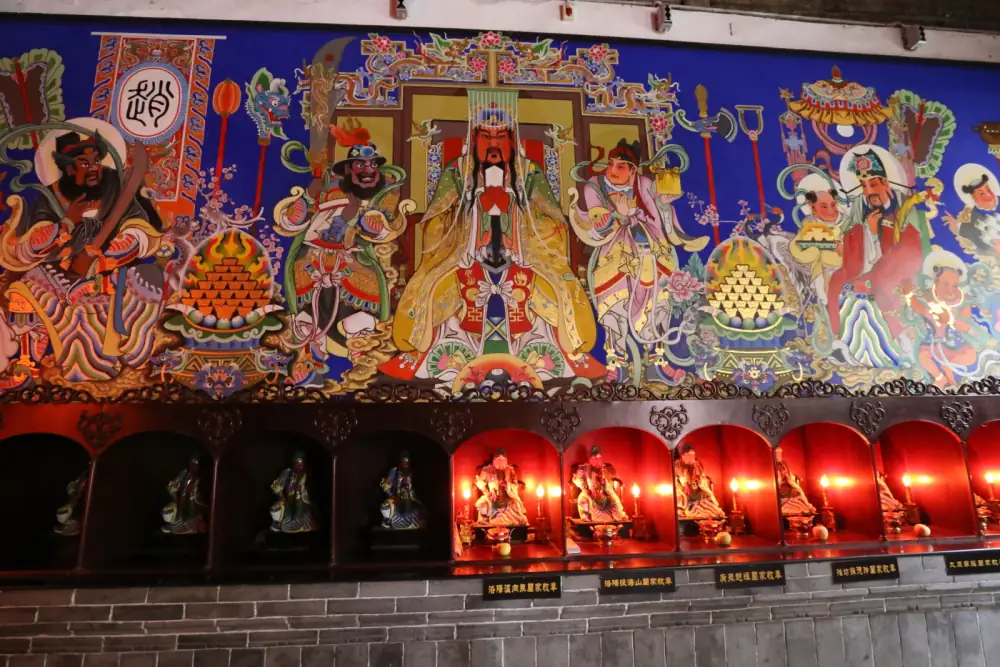
Shaolin Temple sits on Songshan Mountain (嵩山), about 80km from Zhengzhou and 12km from the county town of Dengfeng.
Scenic Area Entry Fee: ¥100 per person (includes entry to the temple complex, Pagoda Forest, and other sites within the scenic area)
Opening hours: 8:00am–6:00pm (summer), 8:30am–5:30pm (winter)
The temple complex itself consists of multiple courtyards and halls spanning over 1,400 years of building. Key structures include:
Tianwang Hall (天王殿)
The first major hall, with the four Heavenly Kings flanking the laughing Maitreya Buddha. This was rebuilt in the Ming Dynasty but the layout follows earlier foundations.
Main Hall (大雄宝殿)
The central hall, rebuilt in 1986 after a 1928 fire. Contains the principal Buddha triad and is an active place of worship — monks perform prayer services at specific times.
Pilu Pavilion (毗卢阁)
Contains murals from the Ming Dynasty depicting monks sparring and practicing martial arts — one of the few historical visual records of Shaolin martial practice.
Abbot’s Courtyard
The administrative heart of the monastery. The current Abbot, Shi Yongxin, has been a controversial figure in modernizing Shaolin’s brand, but the monastery functions.
The Pagoda Forest (塔林)
The Pagoda Forest is the cemetery of the Shaolin monks — a field of 240 stone pagodas of varying heights and styles, each marking the burial place of a distinguished monk, from Tang Dynasty through Qing. It’s the largest pagoda forest in China.
Location: About 300 metres west of the main temple
Entry: Included in scenic area ticket
The forest is extraordinary — each pagoda is unique, bearing the name and dates of its occupant, and the cumulative effect of 240 memorials spanning 1,400 years of a continuous monastic community is genuinely moving. It’s one of the least-crowded parts of the site, despite being one of the most significant.
Kung Fu Performances
Multiple kung fu performances happen throughout the day within the scenic area. There are two quite different types:
Tourist performances (at the main performance stage near the entrance): 20–30 minutes, daily at set times (typically 10:30am, 12:30pm, 2:30pm). High-energy, dramatic, primarily aimed at making a visual impact. Young performers who are students at the many commercial martial arts schools around Dengfeng. This is entertainment, not a traditional demonstration.
Genuine Shaolin monks performing: Occasionally monks demonstrate within the temple courtyards. These are not scheduled for tourists — they happen on religious occasions and during specific festivals. If you happen to witness one, it’s a very different experience.
The honest assessment: Most people visiting Shaolin will see the tourist performance. It’s professionally executed and enjoyable on its own terms. Don’t expect to see authentic ancient kung fu secrets — do expect to see very fit young people doing impressive gymnastics.
Shaolin Warrior Monks Show (禅宗少林·音乐大典)
An evening outdoor performance in the mountains above the temple, combining martial arts, music, and lighting. Runs from approximately April–October.
Tickets: ¥280–380 per person
Time: Begins at dusk (approximately 7:30pm in summer)
This is genuinely spectacular — one of the best produced evening shows in central China. Book in advance.
Short-Term Martial Arts Programmes
Several legitimate martial arts schools connected to or near Shaolin offer short-term training programmes for visitors:
Kung Fu study options:
- Day classes: ¥300–500 for a half-day or full-day introduction
- Week-long programme: ¥2,000–4,000 including accommodation and meals; basic but functional
- Month-long intensive: ¥8,000–15,000 for serious students
What to look for in a school:
- Affiliation with the Songshan Shaolin Wushu Academy (嵩山少林武术学院) or similar accredited institutions
- Chinese-speaking instructors who are actual martial artists (not just tour guides)
- Specific curriculum, not just “kung fu experience”
The area around Dengfeng has literally hundreds of martial arts schools of varying quality. The main commercial ones near the temple entrance cater primarily to tourism; schools further from the tourist area tend to offer more serious training.
Bodhidharma’s Cave (达摩洞)
About 1km up the mountain above the temple, the cave where Bodhidharma (Da Mo) is said to have meditated for nine years is accessible via a steep trail. The cave is now a small shrine. The trail is about 40 minutes each way and gives a good feel for the mountain landscape that surrounded the original monastery.
The rock formation at the cave: Legend says the shadow of Bodhidharma’s meditating form was burned into the cave wall from the heat of his concentration.
Songshan Mountain Hikes
Songshan (1,512m) is itself worth exploring beyond the temple complex. The mountains around Shaolin have several hiking trails, and the Songyang Academy (嵩阳书院) — one of China’s four great Song Dynasty Confucian academies, with two cypress trees over 4,500 years old — is about 5km from Shaolin.
Zhongyue Temple (中岳庙): Large Taoist temple complex at the foot of Songshan, impressive scale. Entry ¥30.
Three Emperors Summit Trail: The hike from Shaolin area to the Sanjian peak takes about 3–4 hours and gives excellent views of the Henan plains.
Getting to Shaolin
From Zhengzhou: Bus from Zhengzhou Bus Station or Zhengzhou South Bus Station to Dengfeng, about 2 hours, ¥40–55. From Dengfeng, tourist bus or taxi to Shaolin (¥15 bus, ¥25–35 taxi).
From Luoyang: Bus directly to Shaolin (fewer options) or to Dengfeng first. About 1.5–2 hours, ¥35–50.
Organized day trips from Zhengzhou or Luoyang are available and handle the transport logistics for ¥150–250 including lunch. Convenient but removes flexibility.
Practical Tips
- Arrive early (8am opening) to see the monks’ morning practice before tour groups arrive
- The scenic area is large — wear comfortable shoes as there is significant walking
- Photography inside the main temple halls is generally not permitted
- The commercial shops along the entrance approach sell a lot of tourist-grade merchandise; genuine martial arts equipment is available at specific suppliers in Dengfeng town
- The area is busiest July–August and during Chinese national holidays
Henan Temple Circuit
Shaolin pairs naturally with:
- Luoyang (Longmen Grottoes): 1.5 hours west
- Kaifeng: 2 hours east via Zhengzhou
- Zhengzhou museums and Shang Dynasty ruins: 1 hour from Dengfeng
A 3-day Henan itinerary of Luoyang + Shaolin + Kaifeng covers central China’s history from multiple dynasties efficiently.