
Table of contents
Open Table of contents
Getting There
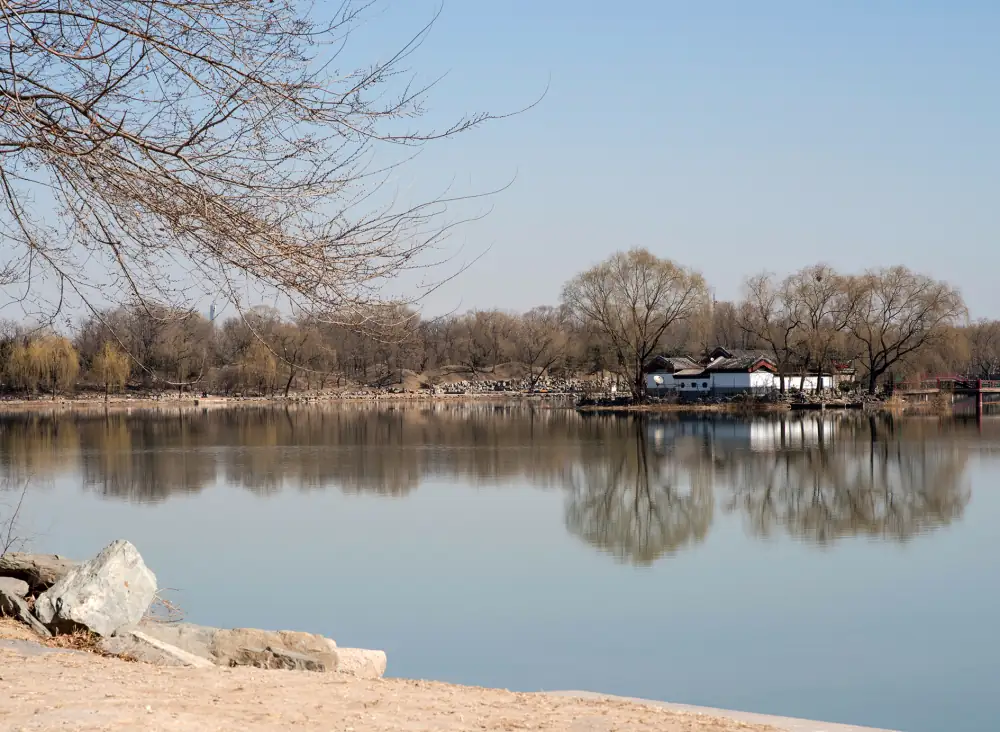
By Metro
The most convenient option. Line 4 to Beigongmen Station (北宫门站) brings you directly to the North Gate. Exit B is a short walk from the gate.
Line 4 to Xiyuan Station (西苑站) serves the East Gate — a slightly longer walk.
From the city center (Tiananmen area), the metro journey takes about 35–40 minutes.
By Bus
Multiple bus routes: 330, 331, 332, 346, 384, 394, 718, 726, 726 express, and others. Runs from multiple city center points.
By DiDi/Taxi
From the Forbidden City area: approximately 30–40 minutes by car, ¥40–60 depending on traffic.
Important Note
Beijing traffic can be severe, especially on weekends and holidays. The metro is almost always faster than road transport to the Summer Palace.
Tickets and Admission
Standard entry ticket: ¥30 (year-round)
- This gives access to most of the grounds but NOT to the interior of key buildings
Combined ticket (通票): ¥60 in peak season (April–October), ¥50 in off-season
- Includes access to all main buildings: Garden of Virtue and Harmony (德和园, the theater), Hall of Benevolence and Longevity (仁寿殿), Hall of Jade Ripples (玉澜堂), and others
Which to buy: If you’re visiting for the first time, the combined ticket is worth the extra ¥30 — the interior of the theater building (where Empress Cixi watched Peking Opera performances) and the Hall of Benevolence and Longevity (the main audience hall) add significant historical context.
Online booking: Required during peak times (National Day week, Spring Festival). Book on the Summer Palace WeChat mini-program (颐和园) or through major booking platforms.
Opening hours:
- Peak season (April 1–October 31): 6:30am–8pm (ticket offices close at 7pm)
- Off-season (November 1–March 31): 7am–7pm (ticket offices close at 6pm)
Entry starts at 6am — arriving at opening to walk the gardens in early light, before the masses arrive, is one of Beijing’s great morning experiences.
Main Areas: The Essential Circuit
East Gate to the Long Corridor (东门 → 长廊)
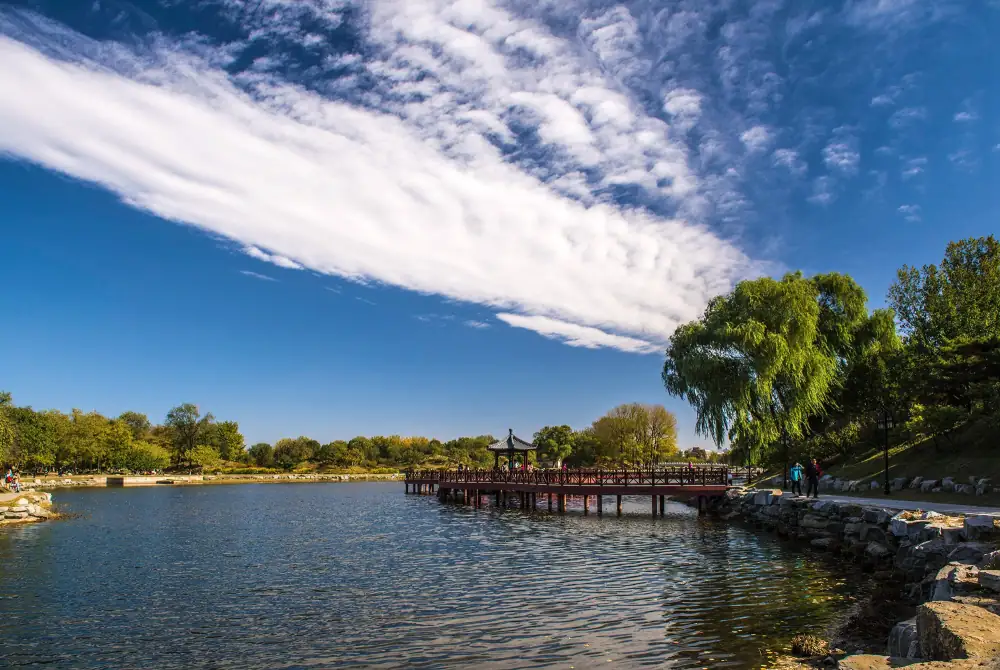
Most visitors enter from the East Gate (Dongmen) and head toward the lakefront. From the gate, the path leads through the administrative palace buildings where the Emperor conducted affairs of state — the Hall of Benevolence and Longevity (仁寿殿) is the main audience hall, with its elaborate throne and the garden of decorative rocks behind it.
Continue west toward the lake and you’ll reach the start of the Long Corridor (长廊, Chánglíng).
The Long Corridor (长廊)
This is arguably the single most remarkable architectural element in Beijing: a 728-meter covered walkway running along the northern bank of Kunming Lake, with over 14,000 paintings on its beams and crossbeams. Every panel of every beam section is painted with scenes from Chinese history, mythology, and landscape. No two panels are identical.
The Long Corridor was originally built in the 1750s and restored/expanded by Empress Cixi in the 1880s. Walking its full length takes 20–30 minutes, but longer if you stop to look at the paintings. Do stop — the range of subject matter is extraordinary, from famous battle scenes to delicate flower-and-bird compositions.
The Long Corridor gives views of Kunming Lake to the south and Longevity Hill to the north throughout its length. On spring mornings when the peach trees alongside it are in bloom, or on winter days when frost coats the roof beams, it has a particular atmospheric quality.
Photography: The morning light (8–10am) hits the painted beams beautifully. The perspective view down the full length is a classic composition. Detailed shots of individual painted panels reveal incredible miniaturist skill.
Longevity Hill (万寿山)
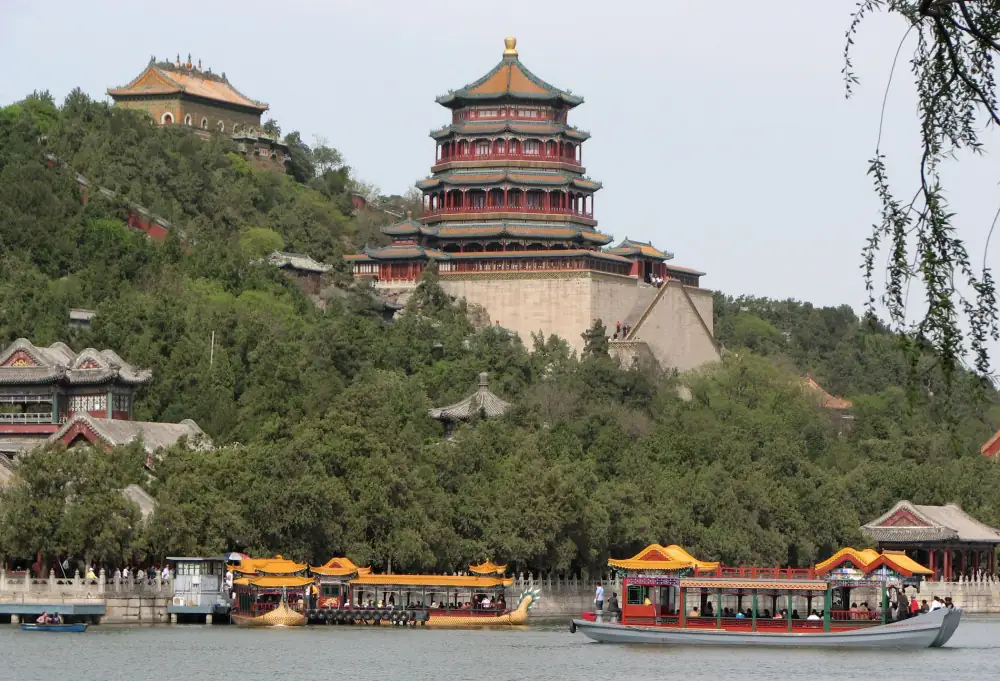
The artificial hill (built from earth excavated to create Kunming Lake) rises to 58m above the lake. Its southern slope, facing the lake, is dense with pavilions, temples, and the massive Buddhist temple complex of the Sea of Wisdom Temple (智慧海) at the top.
The main visual feature of the southern slope is the Foxiang Ge (佛香阁, Tower of the Fragrance of Buddha) — an octagonal, 41-meter-high tower that functions as the vertical focal point of the entire composition. You can see it from almost anywhere on the lake.
Ascending the hill: Multiple staircase routes. The direct central staircase is steep but gives the best architecture views. Allow 30–40 minutes to reach the summit and return.
From the summit, the view encompasses the entire Kunming Lake to the south, the Garden of Harmonious Interests to the east, and the Old Summer Palace ruins in the distance. On very clear days (typically October–November) the Western Hills are visible.
Kunming Lake (昆明湖)
The lake covers 220 of the Summer Palace’s 294 hectares — it’s an enormous ornamental lake, more like a shallow sea within a garden. In summer, lotus flowers cover large sections. In winter, the lake freezes and locals have traditionally ice-skated on it.
Boat rental: Available March–November from multiple points along the lakefront. Rowboats: ¥60 for 30 minutes. Small electric boats: ¥120 for 60 minutes. More atmospheric than walking and gives the reverse view of Longevity Hill and its tower from the water.
Seventeen-Arch Bridge (十七孔桥): Connecting the Eastern Causeway to Nanhu Island, this 150-meter bridge is named for its 17 arches. The bridge is a classic photography subject, particularly at sunrise when the stone lions along its railings catch the light. A famous photograph taken during the Winter Solstice sunset shows the sun perfectly aligned through all 17 arches simultaneously — this specific phenomenon draws crowds to the bridge every December.
Garden of Harmonious Interests (谐趣园)
Often missed by casual visitors (it’s at the northeast corner of the grounds), the Garden of Harmonious Interests is a garden-within-a-garden — a miniature classical garden with a central lotus pond, small pavilions, and covered walkways. It was modeled after Jichangyuan Garden in Wuxi.
In late June and July when lotus flowers bloom, this is one of the most beautiful small spaces in all of Beijing. Arrive early morning.
The Marble Boat (石舫)
One of Cixi’s most famous projects — a marble pavilion in the form of a boat, extended onto the lake with an ornate Western-influenced upper deck added after the 1860s destruction by Anglo-French forces. The symbolism of this “unsinkable boat” funded by navy money is not lost on historians. It’s picturesque if somewhat absurd, and the architectural detail is interesting.
Suzhou Street (苏州街)
The lakefront shopping street to the east of the Marble Boat is a replica of a Suzhou canal market, built in the 18th century for the Emperor’s amusement. It was destroyed by Anglo-French forces in 1860 and rebuilt in the 1990s. Now a commercial area within the park with snacks and souvenirs — not historically deep but visually interesting.
Seasonal Highlights
March–April: Peach and cherry blossoms along the Long Corridor and on the hillsides. One of Beijing’s finest spring experiences.
June–July: Lotus flowers in full bloom on the lake and in the Garden of Harmonious Interests. Morning light on the flowers and reflections of Longevity Hill is extraordinary.
October–November: Clear autumn skies, best visibility for views of the hill and across the lake. Some foliage color on the hillsides.
December–February: Ice skating on the frozen lake (when conditions permit). Snow transforms the entire composition. Fewer visitors. Dress very warmly.
Photography Guide
Best spots:
- Seventeen-Arch Bridge at sunrise (east-facing, morning light)
- Long Corridor looking west (morning light on beams and lake)
- Foxiang Ge Tower from the Long Corridor (midday or afternoon)
- View from the top of Longevity Hill (morning or evening)
- Marble Boat from the water (rent a rowboat for this angle)
Avoiding crowds in photos: The Summer Palace receives 20,000+ visitors daily in peak season. Strategies:
- Arrive at opening (6:30am) — you’ll have 60–90 minutes before crowds build
- The back (north and east) sections of the grounds have much fewer visitors
- Weekday mornings are significantly quieter than weekends
Practical Tips
How much time to allow: Minimum 3 hours for a focused walk of the main circuit. Half a day (5 hours) for a thorough visit. A full day to do it justice including boat rental, hill climb, and garden exploration.
Comfortable footwear: You’ll walk 5–8km in a thorough visit of the grounds.
Food: Restaurants and snack stands inside the park are overpriced. Eat before you come or bring snacks. The restaurant on Nanhu Island is decent for lunch. A convenience store just outside the East Gate has water and snacks at normal prices.
Combine with: The Old Summer Palace (圆明园, Yuanmingyuan) ruins are a 15-minute walk from the Summer Palace’s North Gate — a powerful and sobering complement to the intact palace grounds. The ruins were left unrestored after the 1860 destruction as a memorial to the devastation. Entry ¥25.
Combine with: The Garden of the Great Achievement (畅春园 site, now Beijing University campus) is nearby and opens to the public — less touristic but interesting for its relationship to the Summer Palace’s development.
The Summer Palace is a place that takes on different qualities in different seasons and at different times of day. If you’re in Beijing for more than three days, it deserves at minimum a morning visit — and ideally a second visit in a different season to see how completely the same space can feel different.