
Most visitors to Guangxi come for the Li River karst scenery and Yangshuo. But the limestone karst landscape is backdrop to a collection of ancient towns and river villages that pre-date the current tourist economy by centuries — and in some cases millennia. These places are less visited, less photographed, and far more atmospheric than the famous tourist spots nearby.
Table of contents
Open Table of contents
Daxu Ancient Town (大圩古镇)
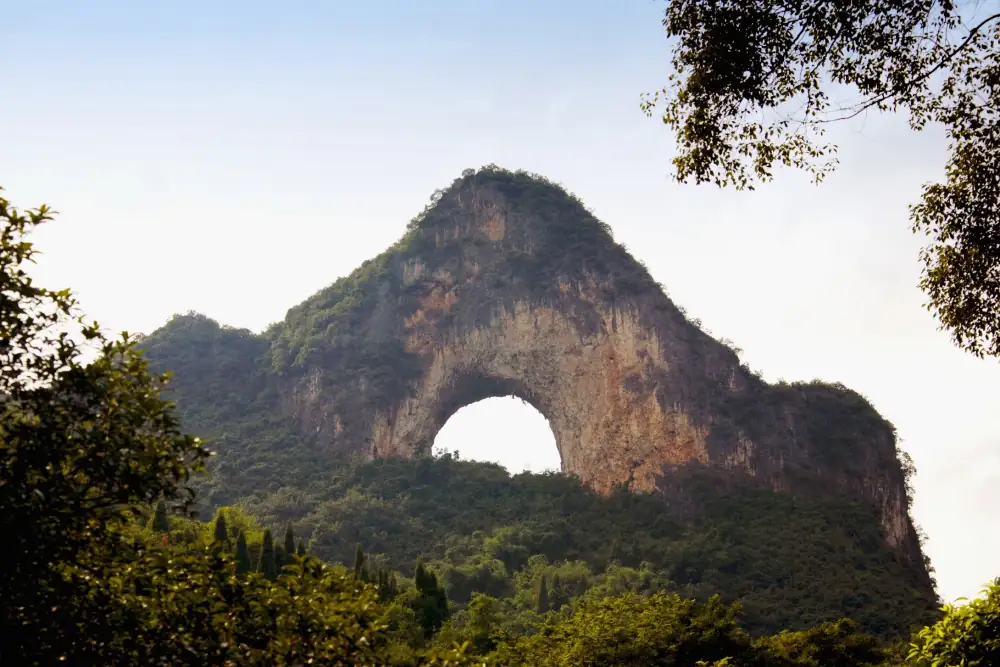
Daxu (大圩, “Great Market”) was one of the four great markets of Guangxi during the Ming and Qing Dynasties. Located 18km southeast of Guilin on the Li River, it served as a trading post between coastal Guangdong and inland Guangxi — silk, cotton, salt, and medicine passed through here on river junks.
What’s preserved
The main street (正阳路) runs parallel to the Li River and is still paved with the original flagstones, worn smooth by centuries of foot traffic. The houses are a blend of late Qing commercial architecture: two-story wooden shophouses with stone columns fronting the narrow lane, warehouses opening directly onto the river wharves.
Unlike Guilin’s polished tourist streets, Daxu is still primarily a working neighbourhood — elderly residents play mahjong outside, local merchants sell hardware and vegetables from ground-floor shops, and the occasional river barge ties up at the old stone wharf.
What to look for:
- Stone archways (古牌坊) at the entrance to the old street
- Ancient wells (古井) still used by local residents
- Riverside wharves where boats still occasionally dock
- Hakka clan houses (客家围屋) in the surrounding countryside
Getting there: Bus from Guilin South Bus Station (30 minutes, ¥6). Or by bicycle from Guilin on the Li River cycling path (18km, 2 hours).
Xingping Ancient Town (兴坪古镇)
Xingping (兴坪) sits on the Li River between Guilin and Yangshuo, surrounded by the most dramatic karst peaks on the entire river route. The town itself is on China’s 20 yuan banknote — the mountains visible behind the river on the blue note are photographed from the riverside north of town.
The ancient streets
Xingping has a small old town area of Qing Dynasty merchant houses along the original riverside promenade — less preserved than Daxu, more lived-in, still atmospheric. The town functions mainly as a fishing village; early mornings see cormorant fishermen on the river, casting their birds from bamboo rafts.
The 20 yuan viewpoint
Walk upstream (north) from the town ferry dock for about 15–20 minutes to the viewing spot where the famous banknote landscape was photographed. The best light: early morning (7–9am) or golden hour before sunset. Bring your 20 yuan note to compare.
Getting here
From Yangshuo: 30 minutes by bus (¥8), or hire a bicycle and cycle the 25km along the Li River road (beautiful but hilly).
By bamboo raft: From Yangshuo, you can hire a bamboo raft to pole upstream to Xingping — 3–4 hours, passing through the best karst scenery.
Huangyao Ancient Town (黄姚古镇)
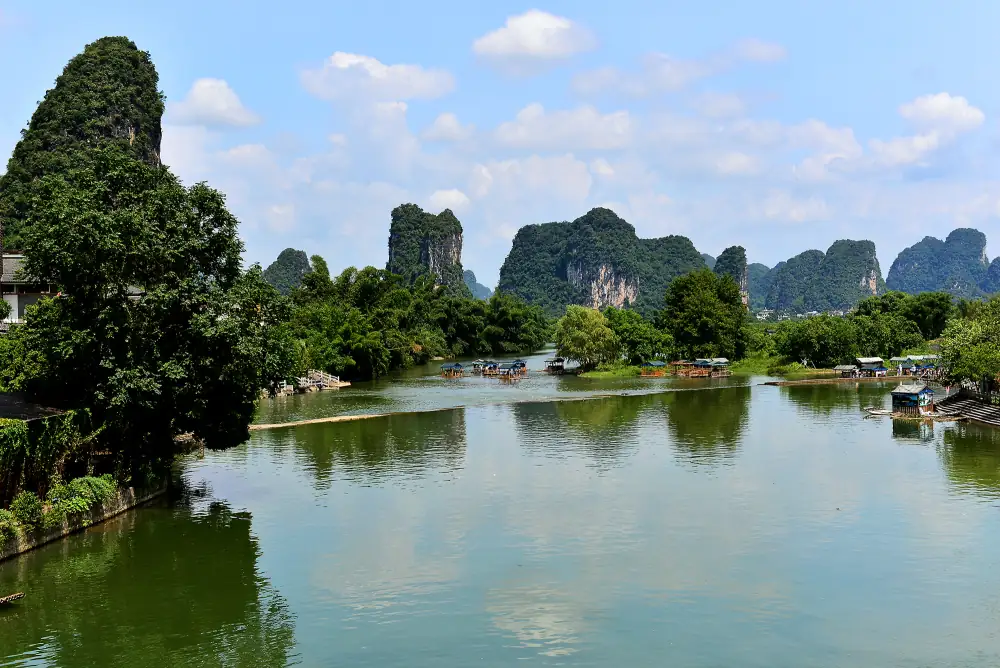
Huangyao (黄姚) is the most impressive and least-known of Guangxi’s ancient towns. Founded in the Song Dynasty (960–1279), the 1,000-year-old town has 300+ preserved buildings from successive dynasties and a population of Zhuang and Han families who have lived here continuously.
Why it’s special
Unlike the ancient towns in tourist hotspots that have been hollowed out into souvenir markets, Huangyao is a working community. Families still live in the Song, Ming, and Qing Dynasty houses. The narrow lanes (some barely wide enough for two people) wind around karst rocks that grow directly from the streets — buildings were constructed around, not through, the limestone outcrops.
Key buildings and sites:
- Baozhang Temple (宝珠观): a functioning Taoist temple in continuous use since the Song Dynasty; the incense rarely stops burning
- Five Wishing Well (五龙亭): a pavilion over the creek with five ancient wells
- Ancient banyan trees: some estimated at 500+ years old, their roots engulfing the stone lanes and walls
- Opera stage (戏台): Qing Dynasty performance stage still used for occasional community performances
The light and photography
The combination of karst rock outcrops growing between buildings, ancient banyan tree roots engulfing stone walls, and the small creek running through the old streets makes Huangyao one of the most photogenic locations in southern China. Come prepared for early mornings (dawn light through the lanes is spectacular) and rainy-day atmosphere (the stone surfaces reflect beautifully when wet).
Getting there: Huangyao is 200km from Guilin and not easy to reach by public transport. From Guilin by bus (3 hours via Hezhou); from Guangzhou by high-speed train to Zhaoqing then bus to Hezhou. Most visitors come on self-drive or tour. Accommodation is available in the town (guesthouses in traditional houses, ¥120–¥280/night).
Jiangtou Village (江头古村): Confucian Architecture
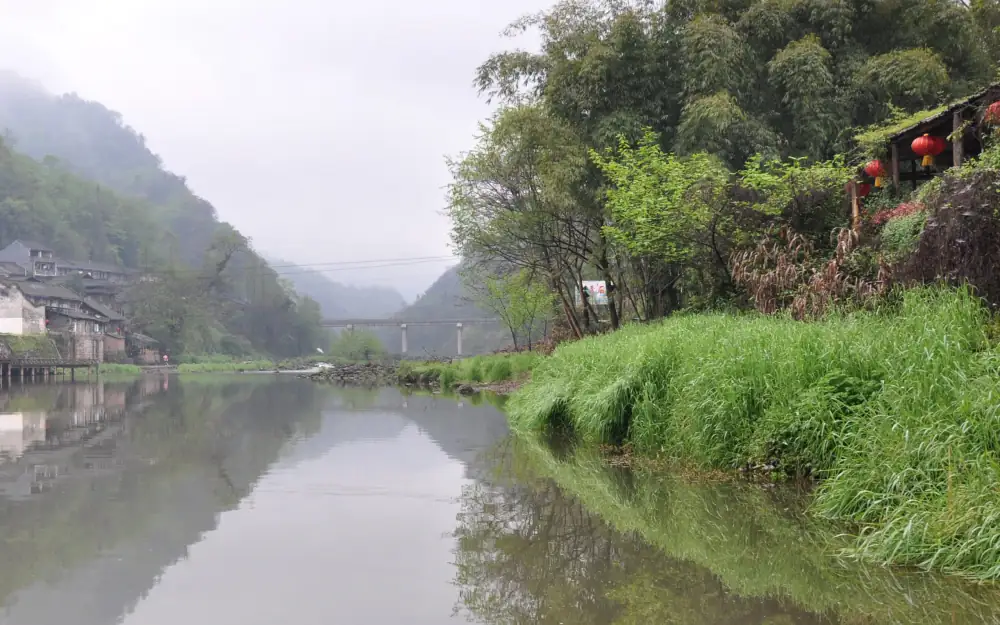
About 25km north of Guilin near Xing’an (兴安), Jiangtou Village (江头洲) is a 1,500-year-old Confucian clan village. The Zhou family (周氏) has lived here since the Han Dynasty; the village has over 100 preserved Ming and Qing buildings and a functioning ancestral hall where clan rituals are still observed.
What makes it different: Unlike most “ancient villages” that have been converted to tourist displays, Jiangtou’s population is still entirely descended from the original clan. The preservation is organic — buildings maintained by the families within them.
Getting there: 40km from Guilin, accessible by bus to Xing’an then taxi or DiDi.
Zhuang Culture Villages in Guangxi
The Zhuang (壮族) are China’s largest ethnic minority group (18 million), concentrated primarily in Guangxi. The Longji Rice Terraces area (龙脊梯田) north of Guilin contains both Zhuang and Yao minority villages:
Ping’an Village (平安寨): primarily Zhuang; excellent terrace views, good basic accommodation Dazhai Village (大寨): primarily Yao (Red Yao); famous for the women’s custom of growing hair to 2+ metres and coiling it on their heads; terrace views from higher elevation
Both villages have become fairly commercialised, but the terraces themselves remain spectacular. Best visited September–October (golden harvest, shallow water) or May–June (vivid green new planting, mist in the mornings).
Planning a Guangxi Ancient Town Route
3-day route from Guilin/Yangshuo:
- Day 1: Guilin → Daxu Ancient Town (morning, 2 hours) → Li River cycling to Yangshuo (afternoon, 4 hours on bicycle)
- Day 2: Xingping Day Trip from Yangshuo (morning), Yangshuo market and town (afternoon)
- Day 3: Yangshuo → Huangyao (3 hours by private car; stay overnight for best atmosphere)
Last updated: May 2026 · Huangyao entrance fee: ¥60. Other towns have no entrance fee but Huangyao charges for the old town area.