
Table of contents
Open Table of contents
- Liping — The Heart of Dong Culture
- The Dong Grand Song (侗族大歌)
- Chengyang Wind-Rain Bridge (程阳风雨桥)
- Zhaoxing Dong Village (肇兴侗寨)
- Basha Miao Village (岜沙苗寨)
- Huanggang Dong Village (黄岗侗寨)
- Dong Crafts — Indigo Dyeing and Embroidery
- Dong Cuisine
- Practical Information
- Budget Estimate (3 Days)
- The Sound That Stays
Liping — The Heart of Dong Culture
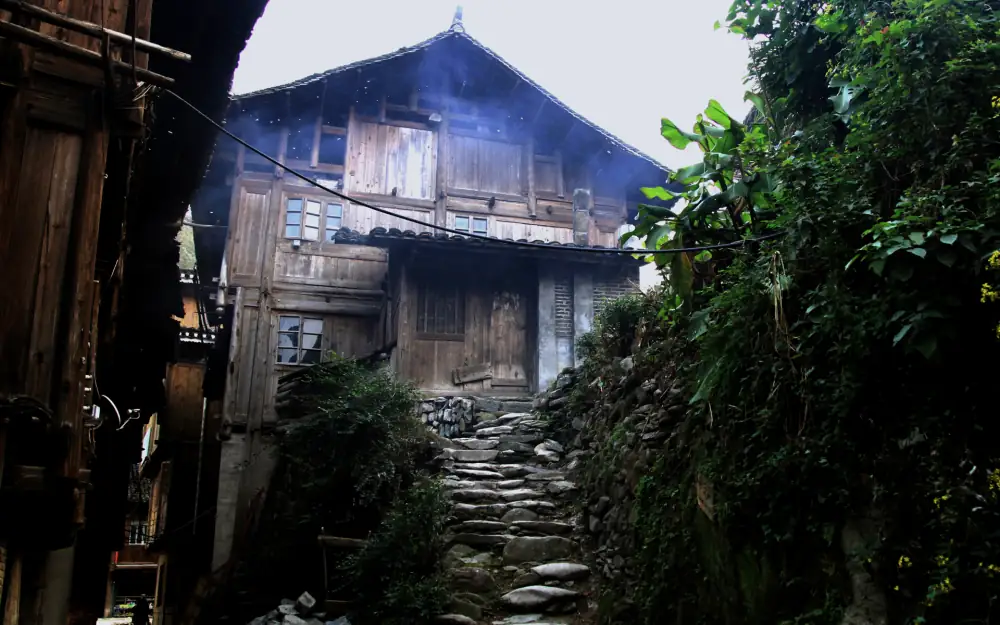
If you want to understand the Dong (侗) people — one of China’s most culturally distinctive ethnic minorities — you need to come to Liping (黎平). This county in southeastern Guizhou is the cultural epicentre of the Dong world, a landscape of wooden villages, drum towers, wind-rain bridges, and a musical tradition so extraordinary that UNESCO has recognised it as Intangible Cultural Heritage of Humanity.
I first heard the Dong Grand Song (侗族大歌) on a scratchy recording years before I visited Guizhou, and it sent chills down my spine. Multiple voices weaving together in complex polyphony, with no conductor and no written notation — passed down orally for centuries. Hearing it performed live in a Dong village, surrounded by the people who created it, was one of the most profound cultural experiences I’ve had in China.
Liping itself is a modest county town, but the surrounding countryside is dotted with Dong villages of extraordinary character and beauty. Some have been developed for tourism; others remain genuinely traditional. This guide will help you find both, and understand the difference.
The Dong Grand Song (侗族大歌)
A Musical Marvel
The Grand Song is the defining cultural achievement of the Dong people. It’s a form of polyphonic choral singing performed without instruments, without a conductor, and without written scores. Songs can involve anywhere from 3 to over 100 singers, with each voice following a different melodic line that interweaves with the others to create a rich, layered texture.
The subjects of the songs range widely — love, nature, work, history, moral teaching — and they serve as the primary vehicle for cultural transmission in traditional Dong society. Before the establishment of formal schools, Dong children learned everything they needed to know through song.
Hearing the Grand Song: The easiest way is to attend a performance at one of the tourist-oriented villages (Basha or Zhaoxing), where performances are staged daily. But for a more authentic experience, visit during a festival or ask locally about informal singing gatherings, which happen spontaneously in the evenings.
Annual Grand Song Festival: Liping hosts a major Grand Song Festival each November, drawing singing groups from across the Dong region. It’s an extraordinary spectacle — hundreds of singers in traditional dress performing in the open air. Book accommodation months ahead.
Chengyang Wind-Rain Bridge (程阳风雨桥)
Architecture Without Nails
About 3 hours north of Liping (and more commonly accessed from Sanjiang in Guangxi), the Chengyang Wind-Rain Bridge is one of the most remarkable wooden structures in China. Built in 1916, the 77-metre-long bridge spans the Linxi River in five pavilion-topped sections, all constructed without a single nail — the entire structure is held together by mortise-and-tenon joints.
The bridge serves both practical and social functions. It provides a covered crossing for villagers in all weather (hence “wind-rain”), and it’s a gathering place for socialising, courtship, and relaxation. On any given afternoon, you’ll find elderly villagers sitting on the bridge benches, chatting and watching the river.
Entrance fee: ¥60 ($8.30 USD). The bridge is part of a larger scenic area that includes several Dong villages. Allow 3-4 hours for the full visit.
The Eight Villages of Chengyang
The bridge connects a cluster of eight Dong villages, each with its own drum tower and character. Walking between them takes 30-60 minutes per village. The most picturesque are:
Ma’an Village: The closest to the bridge, with a fine drum tower and riverside setting. Several families offer homestay accommodation.
Pingtan Village: Slightly further, with excellent examples of traditional Dong wooden houses and a working indigo dye workshop.
Dazhai Village: The largest village, with a drum tower that’s particularly impressive at sunset.
Zhaoxing Dong Village (肇兴侗寨)
The Five Drum Towers
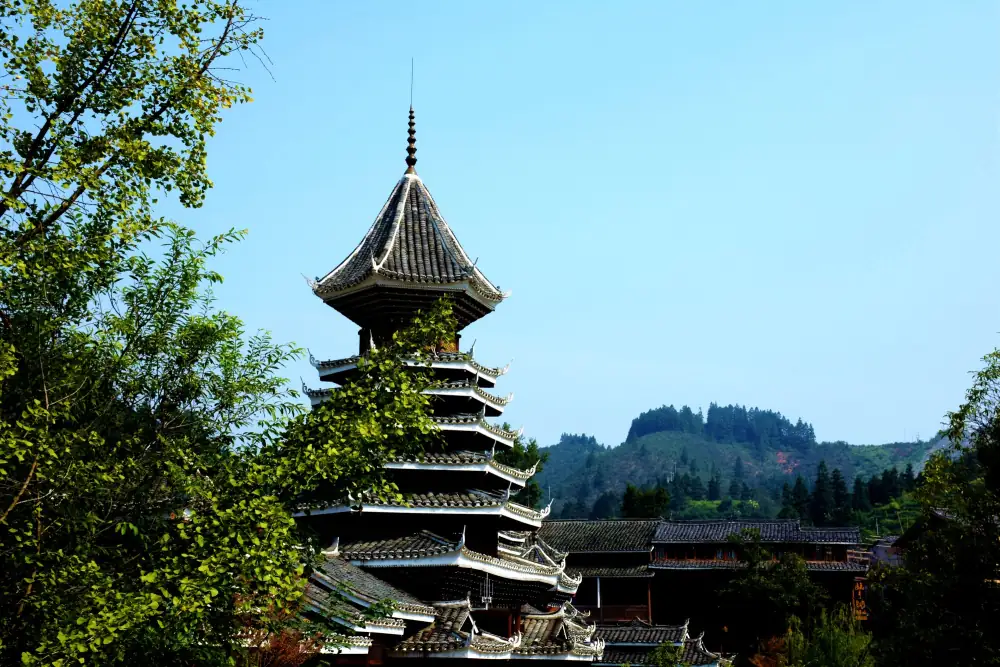
Zhaoxing is the largest Dong village in China and the most popular tourist destination in the Liping area. It’s home to five drum towers (鼓楼), each belonging to a different clan — a unique concentration that makes this village architecturally exceptional.
Drum towers are the iconic structures of Dong culture — tall, multi-storeyed wooden towers with pagoda-like roofs, built as clan gathering places and centres of village life. The drum inside was traditionally beaten to summon villagers for meetings or emergencies. The five towers of Zhaoxing, each in a different style, represent the five clans (luǎn) that make up the village community.
Entrance fee: ¥100 ($14 USD). This includes access to all five towers and the village area.
Grand Song performances: Held twice daily (10:30 AM and 3:00 PM) at the village performance area. ¥30 ($4.20 USD) extra.
Homestays: Numerous options from ¥80-200 ($11-28 USD) per person including meals. The quality varies — ask to see the room before committing.
Basha Miao Village (岜沙苗寨)
Though Miao rather than Dong, Basha is close to Zhaoxing and usually visited in combination. It’s famous for being one of the last villages in China where men traditionally carry firearms — specifically, antique matchlock muskets used in ceremonial contexts. The Basha men also wear distinctive hairstyles, with the front of the head shaved and the remaining hair pulled into a topknot.
The village puts on daily performances featuring traditional music, dance, and a demonstration of the tree-climbing skills for which Basha men are known. It’s touristy but visually striking.
Entrance fee: ¥80 ($11 USD) including performance.
Huanggang Dong Village (黄岗侗寨)
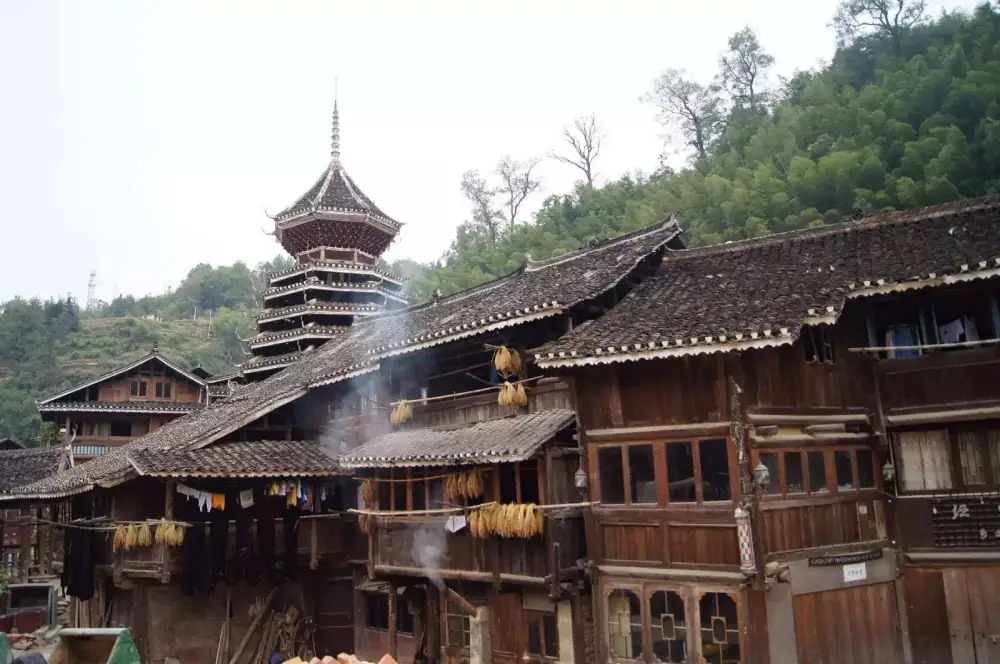
For those seeking a more authentic Dong experience, Huanggang is the answer. About 30 km from Zhaoxing via a rough road, this village receives very few tourists and maintains traditional Dong life with minimal concession to commercialisation.
The village has a fine drum tower, a wind-rain bridge, and — most importantly — a community that still practices the Grand Song as a living tradition rather than a performance. If you visit in the evening, you may be invited to join a singing session in the drum tower, where villagers gather to socialise and sing after the day’s work.
Getting there: No public transport. Hire a car from Zhaoxing for ¥200-300 ($28-42 USD) for the round trip. The road is unpaved for the last 10 km — not suitable for low-clearance vehicles.
Staying overnight: Several families offer basic homestay accommodation for ¥50-80 ($7-11 USD) per person including meals.
Dong Crafts — Indigo Dyeing and Embroidery
Indigo Dyed Cloth (侗布)
The Dong are renowned for their indigo-dyed cloth, a deep blue fabric produced through a laborious traditional process. Fresh indigo leaves are fermented in water for weeks to create a dye vat, and cotton cloth is repeatedly dipped and dried until the desired depth of colour is achieved. The finished cloth is then beaten with wooden mallets to create a slight sheen.
Several villages around Liping offer dyeing workshops where you can try the process yourself. In Pingtan village (near Chengyang), the Wu family workshop offers 2-hour sessions for ¥50 ($7 USD), including a small piece of cloth to take home.
Dong Embroidery and Silverwork
Dong women are skilled embroiderers, creating intricate patterns on clothing, baby carriers, and ceremonial items. The silver jewellery worn by Dong women for festivals is extraordinary — full sets can weigh over 5 kg and are crafted by specialist silversmiths within the community.
Dong Cuisine
Local Specialities
Sour Soup Fish (酸汤鱼): The Dong version differs from the Miao — slightly sweeter and often incorporating local herbs. ¥38-58 ($5.30-8 USD).
Oil Tea (油茶): The Dong version of the Yao oil tea — tea leaves fried in oil with rice, peanuts, and meat. A Dong breakfast staple. ¥8-12 ($1.10-1.70 USD).
Pickled Fish (腌鱼): Carp fermented with rice bran and chilli — a traditional Dong preserved food with a complex, tangy flavour. ¥28-38 ($3.90-5.30 USD).
Sticky Rice (糯米饭): Dong sticky rice, often coloured with natural dyes and served in bamboo tubes. ¥5-10 ($0.70-1.40 USD).
Roasted Meat (烤肉): Pork and chicken roasted over charcoal, seasoned with local herbs. ¥20-35 ($2.80-4.90 USD) per portion.
Practical Information
Getting to Liping
By Air: Liping Airport (HZH) has flights from Guiyang and a few other cities. Limited schedule — check availability.
By High-Speed Train: Congjiang Station (on the Guiyang-Guangzhou line) is about 50 km from Zhaoxing and 80 km from Liping town. From Guiyang: 1.5 hours. From Guangzhou: 3 hours. This is the most practical option.
By Bus: From Guiyang (6-7 hours, ¥120/$17 USD), from Kaili (4-5 hours, ¥70/$9.70 USD).
Getting Around
The villages around Liping are spread across a large area. Options:
Hired car: ¥400-600 ($55-83 USD) per day. The most flexible option for visiting multiple villages.
Local buses: Connect Liping town to Zhaoxing (1.5 hours, ¥20/$2.80 USD) and other major villages. Infrequent — check schedules.
Motorcycle taxi: Available for shorter distances. ¥20-50 ($2.80-7 USD) per trip.
Accommodation
Zhaoxing Village: Multiple homestays, ¥80-200 ($11-28 USD) per person with meals. The Zhaoxing Hotel offers more comfort from ¥200-350 ($28-48 USD) per room.
Chengyang Area: Guesthouses in Ma’an and other villages, ¥60-150 ($8.30-21 USD) per person with meals.
Liping Town: Basic hotels from ¥100-250 ($14-35 USD) per room.
Best Time to Visit
- Spring (March — May): Rape flowers in bloom, pleasant temperatures.
- Autumn (October — November): Harvest season, Grand Song Festival in November.
- Summer (June — August): Green and lush but rainy. Some roads may be difficult.
- Dong New Year: Usually in late October or November (varies by village). The most important Dong festival with singing, dancing, and feasting.
Budget Estimate (3 Days)
| Item | Budget (¥) | Mid-Range (¥) |
|---|---|---|
| Train from Guiyang (round trip) | 120 | 120 |
| Local transport | 150 | 800 (hired car) |
| Accommodation (2 nights) | 160 | 500 |
| Meals | 180 | 400 |
| Entrance fees | 180 | 180 |
| Activities/workshops | 80 | 200 |
| Total | ¥870 ($120 USD) | ¥2,200 ($305 USD) |
The Sound That Stays
I’ve traveled extensively in China’s minority regions, and what distinguishes the Dong from every other group I’ve encountered is the music. The Grand Song isn’t performed for tourists — it’s performed because it’s who the Dong people are. When you hear it echoing through a wooden drum tower on a misty evening, with the fire crackling and the river flowing beneath the wind-rain bridge, you understand something essential about the relationship between culture and place. The Dong didn’t create the Grand Song despite their environment — they created it because of it. Come to Liping, sit in a drum tower, and listen. That’s all you need to do.