
Guizhou (贵州) is the province that China forgot to develop — rugged mountain terrain that resisted both agricultural expansion and industrial connectivity preserved a landscape of extraordinary natural beauty and some of China’s most authentic ethnic minority cultures.
Table of contents
Open Table of contents
Qiandongnan — Heart of Miao Country
Qiandongnan Miao and Dong Autonomous Prefecture (黔东南苗族侗族自治州) is home to 30+ ethnic minority groups in one of China’s most culturally rich regions.
Xijiang Thousand Households Miao Village (西江千户苗寨)
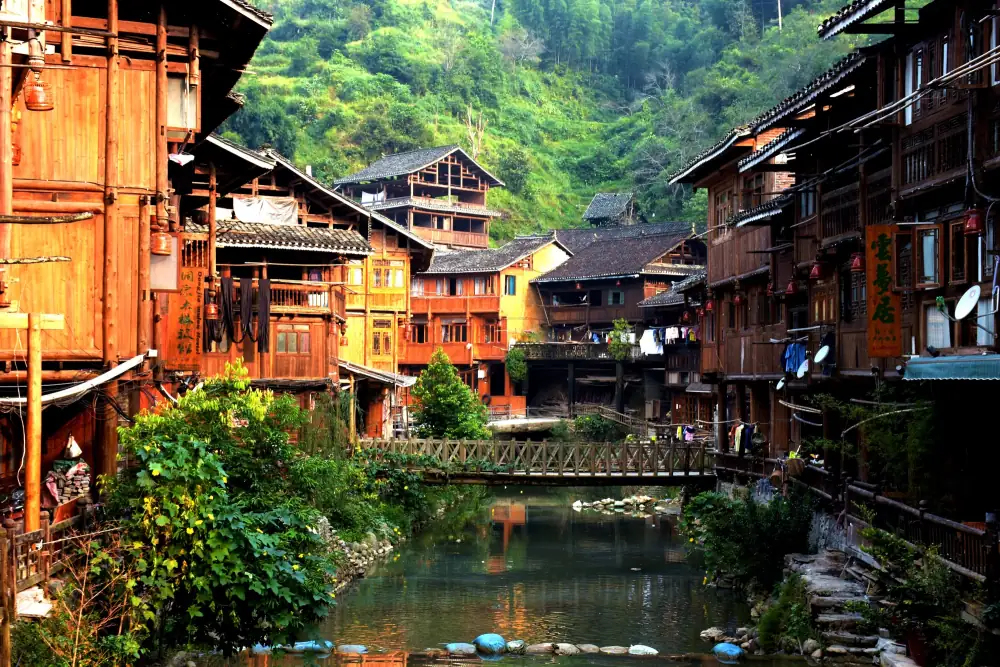
The largest Miao minority village in the world — 1,285 traditional wooden stilt houses cascading down hillsides above a river valley. Genuinely inhabited by 6,000+ Miao people. The evening light-up show (7pm daily) when the entire village is illuminated is one of China’s most spectacular cultural spectacles.
Entry: ¥100. Stay overnight to experience the village after day-trippers leave — atmosphere transforms completely after 8pm.
Miao culture to experience:
- Miao silver jewelry — extraordinary craftsmanship; Miao women traditionally wear over 10kg of silver headdresses and necklaces for festivals
- Batik (蜡染) — traditional indigo-dyed fabric with wax-resist patterns
- Miao New Year festival (苗年) — usually November; the most spectacular ethnic festival in China’s southwest
Zhenyuan Ancient Town (镇远古城)
A 2,000-year-old town straddling the Wuyang River between dramatic cliff faces — one of the most naturally spectacular townsite settings in China. Ancient temples climb the cliffs; blue-tiled roofs of Ming and Qing houses line the river. Entry ¥120.
Dong Ethnic Villages — Zhaoxing
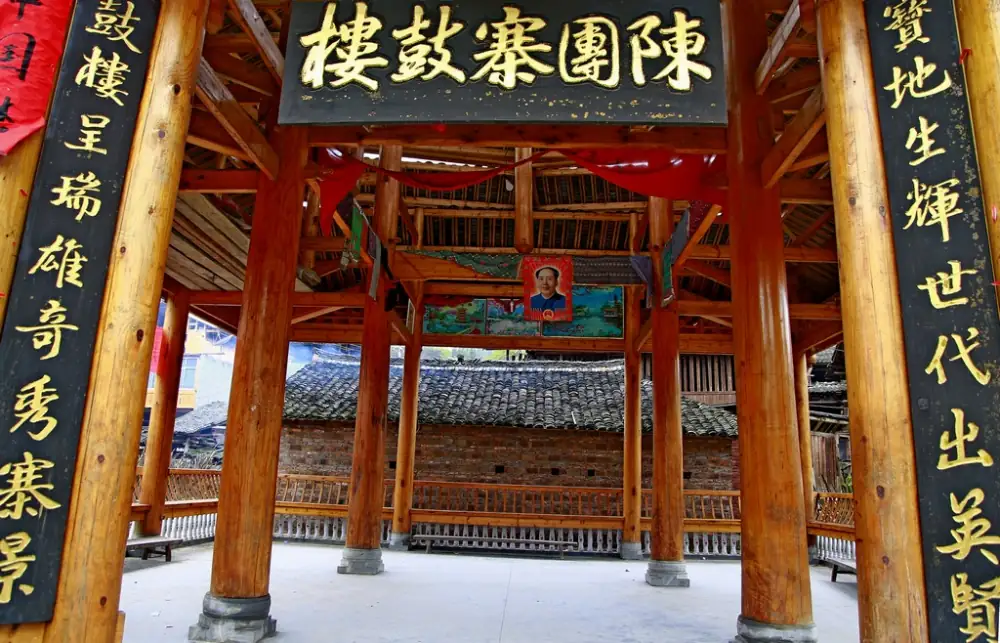
The Dong people (侗族) are famous for their extraordinary communal architecture — drum towers (鼓楼) and covered wind-and-rain bridges (风雨桥) built entirely without nails using wooden joinery.
Zhaoxing (肇兴) — the largest Dong village; five separate drum towers representing five family clans. The evening singing of Dong Grand Song (侗族大歌) — polyphonic choral music that UNESCO declared intangible cultural heritage — is extraordinary. Entry ¥80.
Huangguoshu Waterfalls (黄果树瀑布)
Asia’s largest waterfall — 78 metres high, 101 metres wide. The falls are unique in that a natural cave behind the curtain of water allows you to walk directly behind the main cascade (a thunderous, soaking experience). During peak flow (July–September), the falls are spectacular.
Entry: ¥180 including shuttle buses in the scenic area
Best time: July–October for maximum water volume; March–June for green scenery
Getting there: 2 hours bus from Guiyang or Anshun
Longgong Caves (龙宫风景区)
An underground river system near Huangguoshu — boat through limestone caverns with spectacular stalactite formations. Entry ¥150.
FAST Telescope (贵州500米口径球面射电望远镜)
The world’s largest single-dish radio telescope — a 500-metre diameter dish built into a natural karst depression in a remote Guizhou valley. Operational since 2016, it has detected multiple fast radio bursts and dozens of new pulsars.
Visitor access: Public viewing platform from a distance (the telescope is not accessible for closer approach). Science exhibition centre. Entry ¥40. Near Pingtang County.
Guiyang (贵阳)
The provincial capital is a functional but not spectacular city — use it as a transport hub. The Qingyan Ancient Town (青岩古镇) 30km south is genuinely well-preserved with Ming and Qing fortification walls, temples, and the unusual Qingyan bacon tofu (玫瑰糖).
Guizhou Baijiu: Maotai (茅台) distillery is in Renhuai City, 3 hours from Guiyang — China’s most famous spirit is produced here. Distillery tours available.
Practical Info
Getting there: Guiyang has a large airport with connections to all major Chinese cities. High-speed train from Chengdu (2.5 hours), Chongqing (1.5 hours), Guangzhou (4 hours).
Getting around: Most ethnic minority areas require buses, tour vans, or hired drivers. The roads are dramatic (mountain terrain) but well-maintained and increasingly well-connected.
Best time: April–June (spring, flowers); October–November (clear skies, post-harvest festivals)