
Water arrives in Shuhe before you do. It comes down from two spring-fed pools below the pine ridge, splits into three channels at the top of the village, then runs along the base of every wall and beneath a hundred small stone slabs laid flat as bridges. Follow one channel uphill on a clear morning and the lanes frame a wedge of Jade Dragon Snow Mountain, still white at the top in June. This is a Naxi farming settlement that grew rich on the mule trade, then grew quiet again, and it now serves as the calmer half of any Lijiang trip.
Table of contents
Open Table of contents
What Shuhe actually is
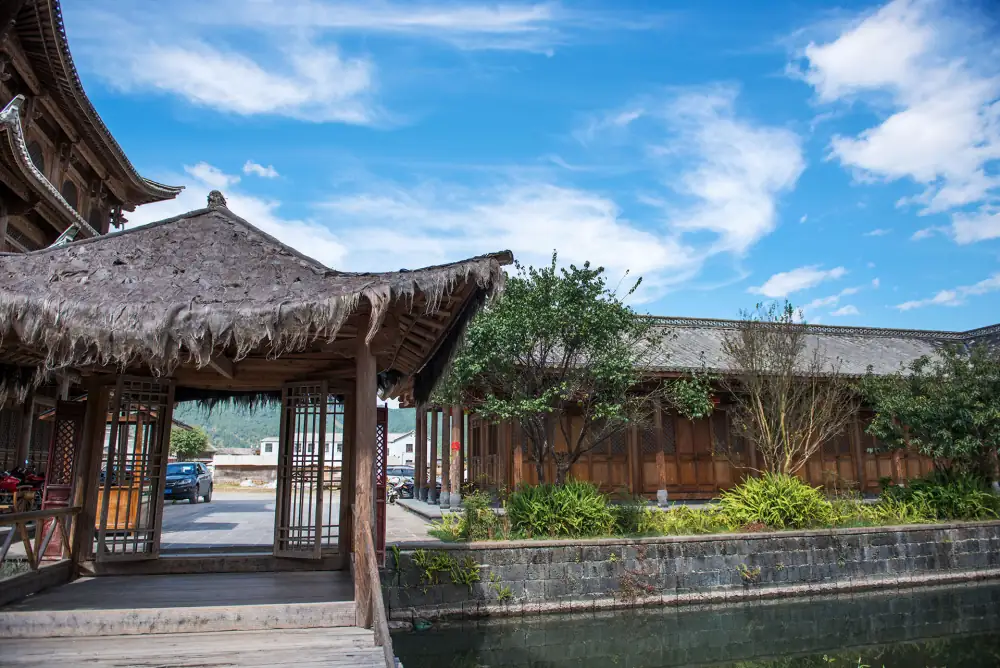
Shuhe (束河) is a small Naxi (纳西) town on the northwest edge of the Lijiang (丽江) plain, four-odd kilometres from the walls of the main old town and set right against the foot of the hills. Its Naxi name refers to the peak behind it — the village below the high summit — while its other local name simply means the place of clear springs. Both hold up. Grain fields still reach the northern edge of the built-up area, the water is cold enough to numb your fingers, and hillside forest starts within a five-minute walk of the busiest lane.
What makes the place more than picturesque is its trade history. Shuhe was one of the earliest Naxi settlements on the plain, and it became a working staging post on the Tea Horse Road (茶马古道), the mule network that hauled Yunnan tea north into Tibet and brought back hides, wool and salt. Craftsmen were brought in from the lower Yangtze under the Mu family, the hereditary Naxi rulers, and the town specialised: leather. Shuhe became the cobblers’ village of the whole Yunnan–Sichuan–Tibet borderland, turning out boots, saddlery, hemp cord and ironwork for caravans that would not see a town again for weeks. Its tanners travelled the routes themselves and came home with money and a habit of building bigger courtyards than farming alone would justify. That is the layer worth looking for: wide gateways for pack animals, upper storeys added for stock, a market square scaled for trading rather than gossip. Anyone with an interest in Chinese trade history will find more substance here than the souvenir shops suggest.
How it differs from Lijiang’s Dayan old town
Dayan (大研), the UNESCO-listed old town at the heart of Lijiang, deserves its reputation: a density of canals, bridges and tiled roofs that nothing else in China quite matches. It is also loud, enormous and thoroughly monetised. Shuhe is the same architectural family at a third of the intensity:
| Shuhe | Dayan (Lijiang old town) | |
|---|---|---|
| Scale | A village core you can cross in fifteen minutes | A maze that takes days to learn |
| Crowds | Concentrated on two or three lanes | Everywhere, most of the day |
| Nights | A short bar row, then silence | Bar streets audible from many guesthouses |
| Setting | Fields and forested hills on three sides | Fully urban, ringed by the new city |
| Guesthouses | Larger courtyards, more garden space | More choice, tighter plots |
| Mountain views | Frequent, from lanes and rooftops | Rarer, mostly from viewpoints |
Neither is a substitute for the other. The sensible plan gives Dayan a full day and an evening, then sleeps in Shuhe.
A walking line through the town
Shuhe rewards wandering, but there is a sequence that takes in the substance without doubling back. Allow three or four unhurried hours.
Qinglong Bridge (青龙桥)
Begin at the Ming-dynasty stone arch over the Qinglong River at the southern approach. Known in Naxi as the bridge where the springs gather, it is the largest stone arch bridge in the Lijiang area, and generations of hooves and boots have worn its deck into shallow hollows. Stand on it early, before the photographers arrive, and the stream noise bounces off the arch to fill the whole approach.
Sifang Jie and the listening square (四方街)
Shuhe’s Sifang Jie is tiny, barely thirty-odd metres across, with five lanes radiating out and water running around its edges. It was one of the oldest markets on the plain and, unusually, held a night market — traders working by torchlight along the river, remembered as fireflies at the night market. The square is the town’s pivot: whichever lane you take, you will pass back through it. A short walk away, the newer Sifang Listening Square (四方听音广场) hosts bonfire dancing and live music, which is either a highlight or a reason to book a room further off.
The Chama Ancient Road museum grounds
On the slope above the old square, the Tea Horse Road museum occupies a former temple compound with painted halls, a courtyard of old trees and displays on the caravan trade, Naxi crafts and Dongba (东巴) pictographic script. The exhibits are uneven and the labelling patchy, but the buildings and murals justify the detour, and the grounds are the quietest corner of town at midday.
Jiuding Dragon Pool (九鼎龙潭)
Walk north-west and the lanes climb slightly to a spring-fed pool at the foot of the wooded ridge — the source of the town’s water and its best single sight. The pool is glassy, the weed sways, and when the air is still Jade Dragon Snow Mountain reflects whole in it. A covered gallery crosses the water with the tall Dragon Gate above it; carp crowd the shallows, unbothered by people. A broken, unlettered stone stele near the bank rings like a bell when tapped — one of those small marvels nobody signposts properly.
The western ridge and Shilian
Behind town, the west hill offers an easy walk through pine and oak that turns properly red in autumn. Further along the ridge stands the small Shilian temple (石莲寺), built at the mouth of a cave and once used by village students who could not light lamps at home and read by the temple’s lights instead. The appeal is the climb, the quiet and the view down onto the fields — and this is the start of the town’s better walking country.
Getting there and getting around
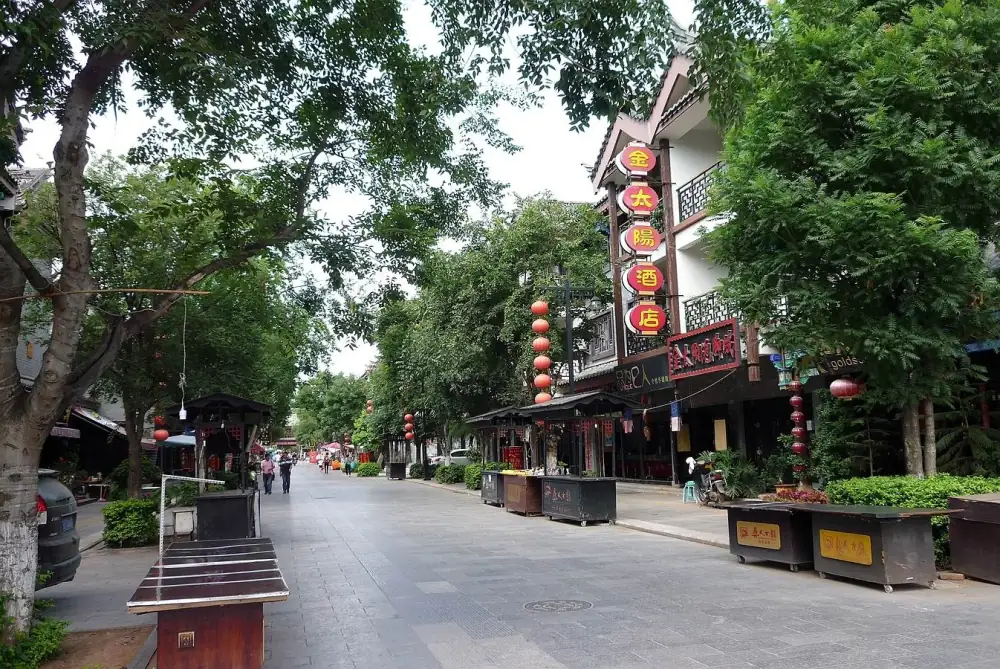
Lijiang is well connected: flights land from Kunming, Chengdu, Shanghai, Beijing, Guangzhou and Shenzhen among others, and trains run in from Kunming and Dali. From the airport, take the shuttle into town and switch to a taxi for the last leg; from the railway station, most guesthouses will arrange a car if you ask when you book.
From Dayan the journey is short. Taxis take about twenty minutes. Shared minibuses fill and go through the day from the markets in the new town, cheerfully overloaded and the most entertaining option. Cycling is genuinely pleasant: the road is flat, surfaced and lined with roses in season, and bike hire is easy at both ends.
Inside Shuhe, motor vehicles are kept out of the core, so everything is on foot, with car parks around the perimeter. Onward trips — Lashi Lake (拉市海), Baisha (白沙), Yuhu (玉湖), the Jade Dragon Snow Mountain gate — are served by drivers waiting at the gates and by guesthouse-arranged cars; agree the terms before you get in.
The ride north
The best day out starts at the north gate on a bicycle. Head up the rose-lined avenue to Baisha, a smaller and rougher Naxi village famous for its Ming-era temple frescoes, then keep climbing past Yufeng Temple and Yushuizhai to Yuhu, a stone-built village at the mountain’s southern foot where the American botanist Joseph Rock lived for decades. Yuhu’s houses are stacked dry-stone rather than rendered mud brick, so it looks nothing like Shuhe, and the mountain’s reflection in its old artificial lake is why people ride up. It is a steady climb of several hundred metres — do it on your second or third day, since the altitude punishes enthusiasm.
Altitude and the seasons
Shuhe sits at roughly 2,400 metres. That is high enough to notice: stairs feel longer, alcohol hits harder, and sunburn arrives faster than the temperature suggests. Serious altitude sickness is unusual here, but a slow first day and plenty of water help. Treat these days as acclimatisation if the snow mountain or Shangri-La come next.
The climate is a highland monsoon one: cool for the latitude, small annual swing, enormous daily swing. Layers matter more than season.
- Spring (March to May). One of the two best windows. Blossom in the courtyards, green barley in the fields, dry air and long clear afternoons. Nights still bite.
- Summer (June to August). The rains fall from roughly July, usually as heavy afternoon bursts rather than continuous grey. Cool enough to feel like relief if you have come from lowland China, but this is the crowded school-holiday stretch and the mountain hides in cloud.
- Autumn (September to November). Sharp light, wildflowers on the slopes, banked clouds, red leaves on the west hill. The mountain shows itself most reliably now, and early autumn is the sweet spot.
- Winter (December to February). Bright, dry, startlingly sunny at midday and near freezing at dawn. Rooms without proper heating are a real problem; ask specifically. The upside is emptiness and the year’s cleanest views.
Thin air, low dry-season humidity and little industrial haze mean that on a moonless winter night the stars over the fields north of town are extraordinary.
Where to stay
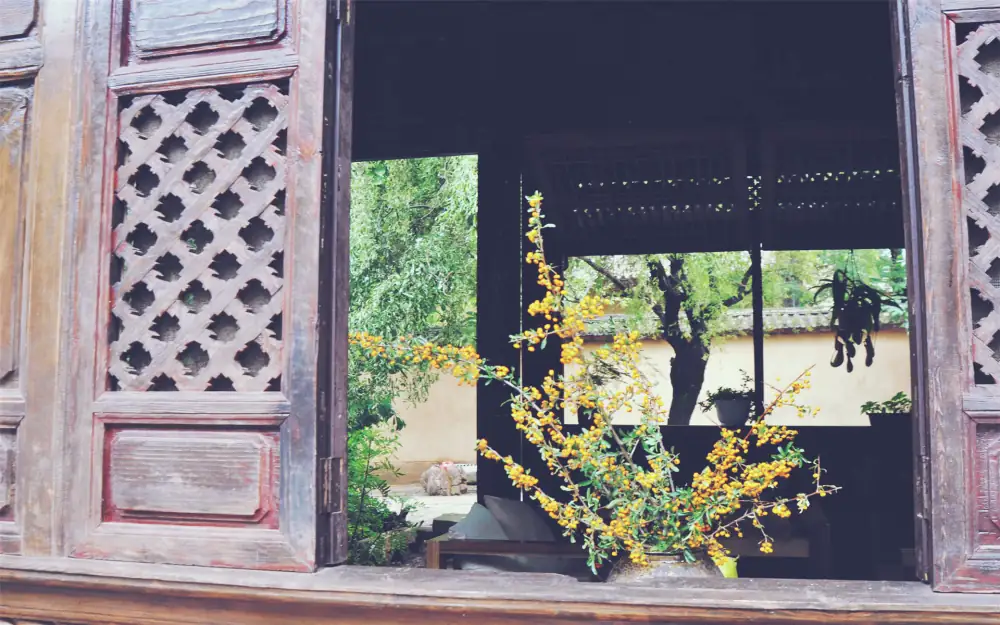
Almost all accommodation here is guesthouse accommodation, and the courtyard is the point. Shuhe’s plots are larger than Dayan’s, so you get gardens, cactus and fruit trees, sun terraces and the occasional stream running through the yard. Choosing the right lane matters more than choosing the right building.
- Around the listening square and the bar row. Convenient, lively, noisy until late. Fine if you intend to be out anyway.
- Renli and the upper lanes (仁里). A slight climb, older houses, the best mountain views from upper rooms, quiet by ten. Where most repeat visitors end up.
- Qingquan and the streams near the old square. Central without being on the main axis; water noise instead of speaker noise.
- The northern and eastern fringes, towards the fields. Quietest of all, with proper darkness at night, in exchange for a walk to dinner.
Ask directly about heating and hot water between November and March, because plenty of charming courtyards are cold at dawn. And ask which side of the building your room is on: street-facing rooms with wooden windows do little to stop sound.
What to eat
Naxi cooking is hearty, salt-cured and less chilli-heavy than Sichuanese food, with Tibetan and Han influences layered over a highland farming base. Eat where the menus are shortest.
- Cured pork rib hotpot (腊排骨). The regional signature and the dish to order if you order only one. Ribs salted and air-dried through the winter, then simmered in plain water until they nearly fall apart. The broth is the best part.
- Naxi grilled fish. Split, rubbed with salt, pepper and five-spice, cooked slowly before a fast fry and a scattering of chilli, Sichuan pepper and crushed peanuts. Crisp skin, soft flesh.
- Chicken-bean jelly (鸡豆凉粉). A local pulse ground and set into a soft block, served cold with chilli and vinegar in summer or pan-fried in slices when it is cold.
- Lijiang baba (丽江粑粑). A layered wheat flatbread, sweet with sugar or savoury with ham and pepper-salt, fried until it puffs. Best eaten within minutes of leaving the pan.
- Black goat hotpot. Big-format, generous, communal, and better with four people than two.
- Rice blood sausage (米灌肠). Rice, pig’s blood and spices packed into casings, then sliced and fried or steamed. A traditional Naxi winter preparation.
- Pu’er tea. Drunk everywhere, in courtyards, all afternoon. Buying it is a rabbit hole; drinking it is simple.
Barbecue skewers of yak and black goat appear along the lanes after dark, and there are more cafés per head here than any village needs. For more on the region’s cooking, our Yunnan food notes go further.
Honest advice, including what to skip
Shuhe is commercialised, and anyone selling it as an untouched village is not being straight with you. The main lanes are wall-to-wall shops selling the same drums, bells, silver and tie-dye you will see across the province. What survives is a matter of geometry: the town is small, the interesting streets are the empty ones, and the fields are close.
Do without hesitation: the dawn hour anywhere in town, before the shutters go up; Jiuding Dragon Pool; the ride to Baisha and Yuhu; an afternoon doing nothing in a courtyard, which is the local art form and not a joke; one dinner of cured ribs.
Skip without regret:
- The souvenir strips. Almost nothing is locally made. The exceptions are the woodcarving and indigo-dye workshops where you can watch the work happening.
- The bar row late on. Shuhe’s bars are mostly quiet-bar territory, with guitars and original songs, and some are lovely. The louder ones are a pale copy of Dayan’s; if you want that scene, go to the original.
- Staged evening performances. Variable at best. The bonfire dancing on the listening square is looser and more fun.
- A third full day inside the town. Shuhe is not deep enough to fill it. Use the time on the mountain, at Lashi Lake or in Dayan.
One bureaucratic quirk: the wider Lijiang area operates a heritage maintenance levy on visitors, and whether it is asked of you in Shuhe depends on where you enter, when, and who is on the gate. Enforcement is inconsistent and the rules are periodically revised. Keep your accommodation booking details to hand and don’t argue with staff at the barriers.
Shuhe’s appeal is finally a matter of speed. Travellers who arrive with a checklist find a small town with a handful of modest sights and leave underwhelmed. Those who arrive with a book, no fixed plan and a willingness to sit by the water until the light goes tend to extend their stay. Build it into a wider southwest China itinerary as the slow node between harder-working days, and it does exactly the job it should.